
The Cañete Valley farm did not need another complete feed mill. Grinding equipment, ingredient storage, weighing points and feed distribution were already in place, but the mixing stage was still relying on a labor-intensive system that could not consistently distribute small quantities of minerals and premix through large batches of maize- and soybean-based pig feed. As production increased, the mixer became the part of the feed process most likely to undermine formulation control.
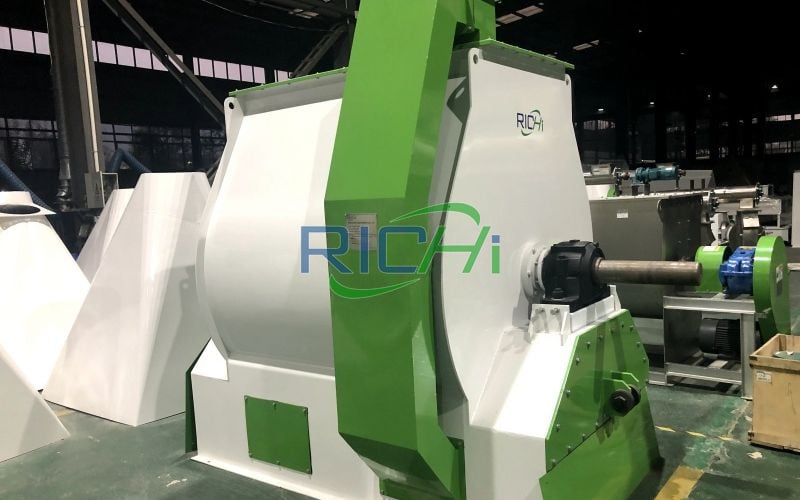
The Cañete Valley farm did not need another complete feed mill. Grinding equipment, ingredient storage, weighing points and feed distribution were already in place, but the mixing stage was still relying on a labor-intensive system that could not consistently distribute small quantities of minerals and premix through large batches of maize- and soybean-based pig feed. As production increased, the mixer became the part of the feed process most likely to undermine formulation control.
The farm therefore installed one SLHJ2A feed mixer machine for animal feed formulation accuracy in Peru. The 22 kW paddle mixer was integrated between the existing ingredient batching section and finished-feed discharge, giving the operation a 1,000 kg nominal batch size and a dedicated mechanical mixing stage for sow, nursery, grower and finisher feeds without replacing equipment that was still useful elsewhere in the mill.
Name:
pig feed mixing machine
Country:
Peru
Date:
2025
Capacity:
1,000 kg per batch
Model:
SLHJ2A
Main Motor Power:
22 kW
Mixing principle:
single-shaft paddle mixing
Application:
pig feed mill
The customer operates a commercial farrow-to-finish pig unit in the Cañete Valley south of Lima. The farm keeps approximately 800 breeding sows and markets pigs throughout the year, so feed is not produced as an occasional farm task. It is a daily manufacturing operation.
The coastal location is also practical for a swine project. Feed ingredients and imported nutritional inputs can move through the Lima-Callao commercial corridor, while maize, bran, fish-derived ingredients and other materials are available through Peru's established feed and agricultural supply chains.
The farm's previous mixing method had become unsuitable for this scale. Manual or semi-manual blending can appear acceptable when a ration consists mainly of two or three bulk ingredients, but problems become much more serious when a 1,000 kg batch contains only a few kilograms of vitamin-mineral premix, salt or another micro-ingredient.
The customer wanted the formula developed by its nutritionist to be represented as consistently as practical in every portion of the finished batch, rather than simply knowing that the correct total quantities had entered the mixer.
An 800-sow farrow-to-finish operation requires considerably more than four tonnes of complete feed per day when breeding animals, nursery pigs, growers and finishers are considered together.
The SLHJ2A was therefore not selected on the assumption that four 1,000 kg batches would cover the entire farm's daily requirement. Instead, the 1-tonne batch size gives the feed room enough production flexibility to manufacture multiple diets during the day while keeping batch quantities manageable.
Depending on animal inventory, feed stage and production schedule, the mixer can run repeated batches during one or more shifts. The farm also maintains short-term finished-feed storage so mixing does not have to occur at exactly the same moment feed is delivered to each pig house.
This makes the machine appropriate for the scale of the operation without exaggerating either batch capacity or daily feed demand.
Maize is the principal energy ingredient in most of the farm's pig diets. Soybean meal supplies much of the protein, while wheat bran and other locally available cereal by-products can be used according to formulation economics and the nutritional requirements of each production stage.
Fish meal may be included in selected younger-pig diets where the nutritionist specifies it, which is commercially plausible in Peru given the country's major fishmeal industry. It is not automatically added at a fixed 10% rate to every starter ration.
Mineral sources, salt, amino acids, vitamins and other feed additives represent much smaller additions by weight but require much more careful distribution. These are the ingredients that make mixer performance especially important.
The formulation itself is controlled separately from mixing. A good mixer cannot correct an incorrect ingredient weight, and accurate scales cannot compensate for a poorly performing mixer. The customer therefore treats batching accuracy and mixing uniformity as two linked quality-control steps.
The paddle arrangement was selected because the customer needed rapid movement of bulk ingredients together with reliable incorporation of comparatively small additions.
Rather than depending mainly on slow circumferential movement, the paddles move material in several directions through the mixing chamber. This creates repeated exchange between different regions of the batch and helps reduce localized concentration of ingredients.
The customer's operators initially assumed that running the mixer longer would automatically improve uniformity. In practice, mixing quality depends on several factors working together.
Batch filling level has to remain within the machine's effective working range. If the chamber is substantially underfilled, the paddles may not move the material as designed. If it is overloaded, circulation can be restricted and motor load can increase.
Ingredient addition sequence also matters, particularly for micro-ingredients. A few kilograms of premix should not simply be dropped onto one corner of a large mass immediately before discharge.
The farm therefore developed a controlled charging procedure. Major ground ingredients enter first, followed by smaller macro ingredients. Micro-ingredients are introduced through a defined addition point after being accurately weighed, and where necessary they can be pre-blended with a portion of a carrier ingredient before entering the main mixer.
This dilution step is often more useful than trying to solve micro-ingredient distribution solely by extending mixing time.
The farm verifies mixing uniformity through a sampling procedure rather than relying only on crude-protein results from finished feed.
Protein concentration can vary because of ingredient sampling, laboratory analysis and actual formulation differences, so it is not always the most sensitive indicator of whether a mixer distributes small additions properly.
For mixer validation, the quality-control team uses an appropriate tracer or selected ingredient marker and collects samples from multiple points in a finished batch. The coefficient of variation is then calculated from those samples.
A CV below approximately 10% is commonly used as a practical target for many complete-feed mixing applications, while individual mills may set tighter internal standards according to product type and validation method.
The SLHJ2A operating time is therefore based on the customer's own mixing test rather than a universal statement that every pig-feed formula requires exactly 4.5 minutes.
The farm produces feed for several physiological stages. Nursery pigs require a different nutrient density and ingredient profile from finishing pigs, while gestating and lactating sows have separate requirements again.
The 1,000 kg batch size makes these changes easier to manage than a much larger mixer that would force the farm to manufacture several tonnes of every formula at once.
Production is scheduled so diets with similar ingredient profiles can be grouped where practical. More sensitive formulas are positioned in the sequence according to the farm's cross-contamination procedure, and the mixer and downstream transfer equipment are cleaned or flushed when required.
The farm does not need a second dedicated mixer merely because it produces a lactation ration. A separate mixer becomes justified only if production volume, segregation requirements or scheduling create a real operational need.
Some swine diets contain vegetable oil or another liquid ingredient to adjust energy density and feed characteristics. Liquid addition changes mixer selection and operating procedure because pouring oil into one point can create localized wet lumps instead of uniform distribution.
Where liquid inclusion is required, the customer uses a controlled spray arrangement rather than dumping the full amount into the chamber.
The liquid is introduced after dry ingredients have already begun circulating, allowing it to contact a larger moving surface area. Nozzle condition and oil temperature are checked because poor atomization can create uneven coating even when the mechanical mixer itself is operating correctly.
This is another reason the project focuses on the complete mixing process rather than describing the SLHJ2A as a machine that automatically guarantees formula accuracy.
Ground maize and other major ingredients are transferred from the customer's existing preparation section to the batching system. Ingredients are weighed according to the diet formula and then discharged into the SLHJ2A.
Once mixing is complete, the bottom discharge opens rapidly so the mixed feed leaves the chamber without a long trickle period. The material then moves to finished-feed holding or the next handling stage used by the farm.
The customer produces mash feed for much of this operation, so purchasing the mixer did not require installation of a feed pellet machine simply to make the project look more complete. The investment was made specifically because mixing was the process bottleneck.
Cross-contamination control is particularly important when a feed room produces diets containing different premixes or additives.
The customer therefore considers mixer discharge completeness, conveying-system residues and production sequencing together. Material left in a conveyor after the mixer has emptied can contaminate the following batch even if the mixer itself is clean.
Accessible surfaces and the rapid discharge arrangement make routine inspection easier. When a more thorough changeover is required, the operation follows its feed-safety procedure rather than relying on one generic flushing method for every formula.
This became especially important as the farm moved away from informal manual mixing toward a documented batch process.
The most immediate improvement is confidence in the manufacturing process.
The nutritionist can formulate a diet knowing that the feed room has a repeatable method for weighing and distributing ingredients. Operators also have a defined batch size, charging order and mixing-time reference instead of adjusting the process by eye.
This does not mean the mixer alone can guarantee faster pig growth, lower mortality or a specific feed-conversion improvement. Animal performance still depends on genetics, health, environment, ingredient quality, feeder management and the nutritional formulation itself.
What the machine can improve directly is the consistency with which a correctly batched formula is physically blended before it reaches the animals.
The project site uses Peru's 60 Hz electrical system, but actual voltage and plant distribution were confirmed before equipment manufacture.
The customer also reviewed the stability of its local power supply because unexpected voltage variation can trip motors or control equipment. Electrical protection was configured around the actual installation rather than assuming that every Peruvian farm has the same site voltage.
The 22 kW mixer itself is only part of the connected load. Conveyors, air compressor requirements for pneumatic functions and upstream grinding equipment also have to be considered when calculating the feed room's simultaneous power demand.
The SLHJ2A was shipped by sea from Qingdao Port in China to the Port of Callao in Peru. For a customer located in the Cañete Valley, Callao provides a practical container gateway to the Lima and central-coast market.
Peru's National Port Authority identifies Callao as the country's highest-volume port with its largest storage capacity, while current terminal information shows that Callao remains the country's dominant container gateway.
RICHI supplied equipment drawings, electrical information and installation requirements before shipment so the customer could prepare the mixer position and surrounding connections before the equipment reached the farm.
The final sailing time and inland delivery period depend on carrier schedules and customs conditions, so the project does not use a fixed 30-day ocean transit as a permanent specification.
Training covered batch loading, correct filling level, ingredient sequencing, mixer timing, discharge inspection and routine maintenance.
Particular attention was given to micro-ingredient handling. The operators learned that formulation accuracy can be lost before the mixer starts if small ingredients are weighed with unsuitable scales or added inconsistently.
RICHI also provided guidance for developing a mixing-uniformity test so the farm could validate the process with its own materials rather than depend indefinitely on factory recommendations.
Once the customer had established an acceptable mixing curve, that result became the operating reference for routine production and future periodic verification.
“The biggest change is that our feed room now works by batch control instead of judgment. The operator knows exactly what goes into a one-tonne batch, how it is added and how long it is mixed. When the nutritionist changes a formula, we can reproduce it instead of hoping the ingredients are evenly distributed. That has made feed production much easier to manage.”
The customer also found that the machine made production planning more predictable. Instead of tying several workers to manual mixing, the feed room can schedule repeated batches according to the day's demand while personnel focus on ingredient preparation, weighing and quality checks.
The customer is a large pig farm but not an independent feed manufacturer producing hundreds of tonnes every day for outside customers.
A 1,000 kg batch mixer therefore offers a practical compromise. It is large enough for commercial on-farm feed production but small enough to allow several diets to be manufactured without building excessive finished-feed inventory.
Peru's coastal swine-production environment also makes the chosen ingredient profile realistic: maize and soybean-based rations can be combined with bran, fish-derived protein where nutritionally appropriate and imported or domestically supplied premixes.
The machine is not justified because every Peruvian pig operation needs an SLHJ2A. It is justified because this particular farm has enough daily feed demand, existing grinding infrastructure and multiple formulas to make controlled batch mixing worthwhile.
This feed mixer machine for animal feed formulation accuracy in Peru project shows why mixer selection should begin with batch structure rather than simply total tonnes per year.
The Cañete customer needed to mix bulk maize and soybean ingredients together with much smaller mineral and premix additions, produce several swine diets, and fit the new machine into an existing feed room. One SLHJ2A with a 1,000 kg nominal batch size provided enough capacity while preserving flexibility between formulations.
For another project, RICHI Machinery would first need the daily feed requirement, number of formulas, target batch size, ingredient bulk density, minimum micro-ingredient inclusion, whether liquids are added, existing weighing equipment, available installation space and required number of production hours.
Those figures determine whether a 1-tonne paddle mixer is appropriate or whether another mixer size provides a better fit.
The objective is not simply to mix faster. It is to build a repeatable manufacturing process in which the formula written by the nutritionist is weighed accurately, distributed uniformly and reproduced from one batch to the next.
Having the right mix of reliable, high-quality pellet machine and pelletizing systems and expert support is essential to your success. Watch how our end-to-end feed pellet plant solutions have helped our customers optimize their performance.
Our customized and future-proofed turnkey pellet plant solutions is designed with you at the core. From vision to reality and beyond, our team stays connected with yours. Giving you peace-of-mind with an expert at your side.
At RICHI, we go beyond project completion. With RICHI Servicee, we’re your dedicated partners in success. Count on us for expert guidance, minimal downtime, and optimized productivity. Choose RICHI for unmatched service and support.


Meet global product demands and quality standards with industry-leading pellet plant design, engineering, equipment, and construction services for pellet processors.


Your Partner Beyond Project Completion
2000+ cases
RICHI is the leading designer, manufacturer and builder of pellet plants in the world, completing over 2000 projects in 140 countries across 6 continents.
Read More
Increase plant productivity, profitability, and safety by integrating high quality equipment into your pellet production line. Over the years, RICHI has become China's top pellet equipment manufacturer. At the same time, RICHI has established valuable partnerships with the world's leading component and raw material manufacturers to bring you the best there is in technology, automation, and efficiency in pelleting plant machinery.

For nearly 30 years, RICHI has been providing best-in-class pellet plant equipment and services to clients across a variety of industries, sizes, and needs. We pride ourselves on the knowledge and skill that each team member possesses – from our technical sales team to our process design engineers. You can count on RICHI Machinery to take your operation to the next level of innovation, quality, and success.
Need help with your pellet manufacturing plant project? Contact us today.
ANIMAL FEED
BIOMASS
WOOD
ORGANIC FERTILIZER
AQUA FEED
CAT LITTER
MUNICIPAL WASTE RECYCLING
SPECIAL PELLET PRODUCTION
RICHI Machinery continues to deliver world class pellet mill equipment, pellet plant engineering and project solutions that add value to our customers in the animal feed, wood waste, agriculture waste, organic fertilizer, cat litter and special pellet products industries. Throughout the years, we RICHI Machinery have built strong brand, becoming industry-leading pellet machine manufacturer. We value integrity, promise quality, and prioritize your success.
Learn MoreWith our expert team, we precisely implement your process engineering requirements in pellet mill and pelletizing plant systems. No matter which industry you’re in – we understand your needs and deliver solutions that meet the highest standards.
At RICHI, quality comes first. Our pellet making machine and related pellet line equipment undergo rigorous quality controls to ensure they meet the highest standards. Rely on products that are durable, safe, and efficient.
With decades of experience in pellet machine and pellet production line production, we have earned a reputation as a trusted partner in various industries. Our expertise allows us to cover a wide range of applications.
Not only do we offer premium pelleting equipment, but we are also experts at designing, building, installing, and maintaining facilities from the ground up. Our expertise is within pellt plant process design, discovering the most efficient, productive, and profitable way to handle your materials in an end-to-end cycle.
○ RICHI MACHINERY
Keeping in touch with us is an effective way to solve all your problems. If you have any needs or questions, please leave your contact information, then RICHI technical consultants will send design, quotation, videos to your mailbox. You can also contact us directly via WhatsApp: +86 13838389622
Copyright©2015-2026 by HENAN RICHI MACHINERY CO., LTD. All rights reserved.