
The North Sumatra customer was already familiar with EFB long before pellet production entered the discussion. The company handled palm-processing residues for biomass users and had access to empty fruit bunches from nearby palm oil mills, but transporting wet, bulky EFB over long distances was inefficient.
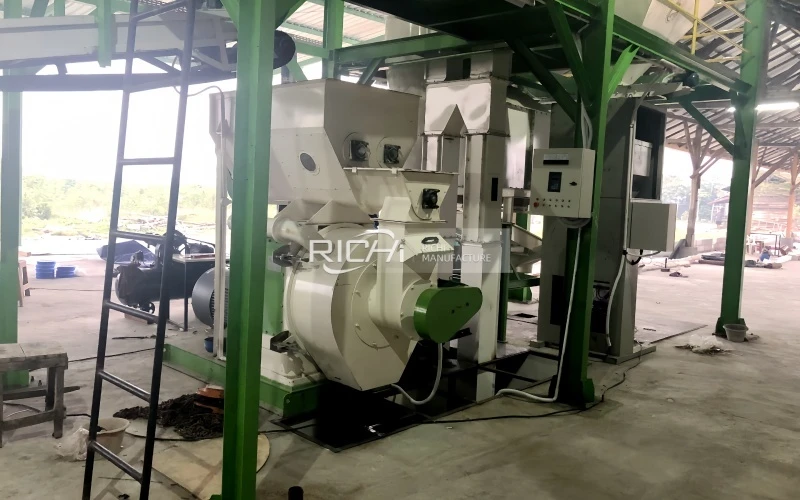
The North Sumatra customer was already familiar with EFB long before pellet production entered the discussion. The company handled palm-processing residues for biomass users and had access to empty fruit bunches from nearby palm oil mills, but transporting wet, bulky EFB over long distances was inefficient. The commercial opportunity was not simply to “make pellets from waste”; it was to convert a difficult, high-moisture palm residue into a denser fuel product that industrial boiler users could store, transport and meter more easily.
That led to the installation of two MZLH520 efb pellets machines in Indonesia. The customer already had EFB shredding, drying, fine grinding and material storage equipment, so the two 132 kW pellet mills were added as the main densification stage rather than as part of a completely new turnkey plant. Each machine provides a reference capacity of approximately 1.5–2.0 T/H under suitable material conditions, giving the plant a combined nominal pelletizing capacity of about 3–4 T/H when both units are operating.
Name:
EFB pellet mill
Country:
Indonesia
Date:
2025
Capacity:
3–4 T/H
Model:
MZLH520
Main Motor Power:
132 kW
Raw Materials:
EFB fiber
Pellet diameter:
8 mm
North Sumatra has an established palm oil processing industry, which makes empty fruit bunches a realistic raw material for this project. EFB is generated directly at palm oil mills after fresh fruit bunches have been processed and the fruit has been separated from the bunch structure.
The problem is its physical condition.
Fresh EFB is extremely bulky, fibrous and wet. Moisture can commonly be around 60–70% when the material leaves the palm oil process. At that condition, direct long-distance transportation is inefficient because much of the transported weight is water.
The customer had previously supplied part of its palm biomass in loose or shredded form. That business remained possible for users located close to the source, but it became less attractive as transport distance increased.
Producing pellets allowed the company to create a more standardized fuel format with higher bulk density and more predictable handling characteristics.
The plural keyword efb pellets machine in Indonesia reflects the actual project configuration: two MZLH520 units.
The customer was not buying two machines simply to keep one permanently idle as a backup. The existing preprocessing system had enough capacity to supply more than one pellet mill, and projected fuel demand justified a combined nominal output of approximately 3–4 T/H.
Two machines also gave the plant greater operating flexibility.
During normal production, both units can operate when enough prepared EFB fiber is available. When one pellet mill requires a ring-die inspection or roller adjustment, production can continue at reduced capacity through the other machine.
This arrangement is more useful for a commercial biomass producer than depending entirely on one large pelletizer whose maintenance would stop the complete densification section.
The most important technical point in this project is that the MZLH520 receives prepared fiber, not fresh empty fruit bunches straight from the palm oil mill.
The customer’s process begins with coarse size reduction. Whole EFB is opened and shredded so the long intertwined fibers become easier to dry and feed.
Because fresh material can carry extremely high moisture, drying is a major energy-consuming stage of the project. The customer’s existing drying system reduces the moisture substantially before the material moves to fine grinding.
After drying, the EFB is further reduced to a relatively uniform fibrous particle size suitable for ring-die pelletization.
For efficient pellet formation, the prepared material normally needs to be brought into approximately the low-to-mid teens in moisture, with final adjustment made according to actual pellet quality and machine load.
This is a much more realistic process than describing EFB as simply shredded once and then fed directly into the pellet machine.
| Project Parameter | Configuration |
|---|---|
| Equipment | EFB pellet machine |
| Model | MZLH520 |
| Quantity | 2 units |
| Main Motor Power | 132 kW per unit |
| Arch-Breaking Feeder Power | 3 kW per unit |
| Forced Feeder Power | 1.5 kW per unit |
| Ring Die Inner Diameter | 520 mm |
| Available Pellet Diameter | 4–12 mm |
| Project Pellet Diameter | 8 mm |
| Reference Capacity | Approximately 1.5–2.0 T/H per machine |
| Combined Reference Capacity | Approximately 3–4 T/H |
| Main Product | Industrial EFB fuel pellets |
The customer selected 8 mm pellets as its main commercial specification because the product is intended primarily for industrial biomass fuel applications rather than household stoves.
Actual capacity depends on EFB fiber length, moisture, ash content, bulk density, die specification and the condition of the feeding system. The 1.5–2.0 T/H figure per MZLH520 therefore represents a reference production range for suitable prepared material rather than a fixed guarantee for every batch of palm residue.
One reason the customer paid particular attention to the feeding system is the structure of EFB fiber.
Ground wood sawdust generally flows more predictably than long, lightweight palm fiber. EFB can bridge in a storage hopper or form an uneven mat above the pelletizing chamber if preprocessing is poor.
The arch-breaking feeder helps disturb material that would otherwise hang up in the hopper, while the forced feeder pushes the light fibrous material toward the ring-die chamber at a more controlled rate.
This feeding stability matters directly to pellet quality.
When the material supply suddenly falls, die load and pellet density can change. When a large surge enters the chamber, motor load can rise sharply. Stable feeding therefore becomes one of the most important operating indicators for an EFB pellet plant.
The original project used 10–12% moisture as the pelleting target. That is a reasonable starting region for many biomass pellet applications, but the customer does not treat 11% as a fixed number that must be maintained regardless of raw-material condition.
EFB contains different proportions of fiber, residual mineral matter and fine particles from batch to batch. Its behavior also changes after different drying histories.
If the fiber is too dry, pellet formation can become unstable and fines may increase. If it is too wet, pellet durability and machine throughput can suffer, and downstream cooling becomes more difficult.
The operators therefore use moisture measurement together with pellet appearance, ring-die load, fines level and finished strength to establish the best production window.
Drying alone does not create suitable pellet-mill feedstock.
Even after coarse shredding, EFB fibers can remain too long and irregular for stable ring-die compression. The existing hammer-milling section therefore performs secondary size reduction after drying.
This gives the two MZLH520 machines a more consistent feed material and reduces the risk that long strands wrap, bridge or enter the die unevenly.
For another efb pellets machine in Indonesia project, the required grinding stage would depend on the customer's starting material. A plant buying already dried and milled EFB fiber would need less preprocessing than a facility receiving whole fresh bunch residue directly from a palm oil mill.
EFB is not identical to clean wood biomass.
Palm residues can contain relatively high ash and alkali components, including potassium and sodium. These characteristics matter when pellets are burned in industrial boilers because ash chemistry can influence deposition, fouling and clinker formation.
The customer therefore does not sell EFB pellets only according to diameter and moisture.
Fuel quality also needs laboratory evaluation.
Where a buyer requires lower-ash or more demanding industrial fuel specifications, additional EFB washing or other pretreatment may be considered before drying and pelletizing.
This is an important commercial distinction. The MZLH520 can densify prepared fiber, but the pellet mill cannot remove ash-forming minerals that are already present in the raw material.
The original project attempted to position the same pellets for industrial boilers and domestic biomass stoves.
For this customer, concentrating on industrial users is more realistic.
EFB fuel characteristics are different from premium low-ash wood pellets. Industrial boiler operators are better positioned to evaluate fuel ash, combustion behavior and feeding requirements according to their furnace systems.
The customer therefore targets industrial biomass users capable of handling agricultural-residue fuel rather than presenting the 8 mm EFB pellet as a universal household heating product.
This also gives the production team a clearer quality specification and allows raw-material procurement, testing and die selection to be organized around one market.
Material leaving the ring die is warm and should not move directly into sealed storage or packaging.
The customer uses its downstream cooling system to reduce pellet temperature and allow the product to stabilize mechanically.
After cooling, screening removes loose fines and broken pieces. Suitable fines can be returned to the pelletizing process where appropriate.
This stage is particularly important in Indonesia’s humid climate. Warm material entering a sealed bag or silo can create condensation if temperature and moisture are not properly controlled.
The finished product is therefore checked for temperature and moisture before longer-term storage.
The customer already had most of the expensive preprocessing equipment before ordering the MZLH520 units.
The full process can be summarized as:
This is the only list used in the case because the actual process sequence is easier to understand in this format.
The two efb biomass pellet mills were installed in parallel so the prepared fiber distribution system could feed either machine individually or both machines together.
The investment decision was based on what the company already owned.
Its drying and crushing equipment had enough remaining capacity, and replacing those machines would not have improved the actual bottleneck.
The pelletizing stage was what prevented the company from converting prepared fiber into a standardized fuel product at the required scale.
RICHI therefore focused the project on the two MZLH520 palm fiber pellet machine units and the interfaces required to connect them to the existing process.
For a new investor starting with fresh EFB and no equipment, the recommendation would be completely different. That customer would need to consider shredding, drying, fine grinding, pelletizing, cooling, screening, dust collection and packing as an integrated system.
The customer uses the two-machine layout to organize maintenance more intelligently.
Ring dies and rollers are inspected according to actual wear rather than a fixed number of operating hours. EFB ash, soil contamination, fiber preparation and pellet compression all influence wear life.
If one machine requires scheduled die or roller service, the second pellet mill can continue processing material at reduced plant capacity.
This does not eliminate downtime completely, but it prevents routine maintenance on one pelletizer from automatically stopping all fuel pellet production.
Critical wearing parts are kept on site so maintenance can be planned around production rather than around international spare-parts delivery.
EFB collected around palm oil mills can pick up soil, sand and other contamination during handling and storage.
That material does not disappear during pelletizing.
Excessive soil increases ash content and can also accelerate wear inside the grinding and pelletizing equipment.
The customer therefore keeps EFB storage and handling areas controlled and removes obvious foreign material before the fiber reaches downstream processing.
For industrial fuel buyers, this also improves consistency between pellet batches.
The two MZLH520 units were shipped by sea from Qingdao Port in China to Belawan Port in North Sumatra.
Belawan is a major logistics gateway for North Sumatra and has established cargo activity connected with the region’s palm oil industry, making it an appropriate arrival port for this project.
Before shipment, RICHI supplied equipment dimensions, motor data, electrical information and installation drawings so the customer could prepare foundations and material connections.
Because two pellet mills were being integrated into an existing facility, particular attention was given to maintenance clearance, fiber distribution and discharge connections rather than simply placing the machines wherever floor space was available.
The first production trials showed that EFB preparation had more influence on stable capacity than the customer originally expected.
When the fiber entered with consistent moisture and fine-grinding quality, both MZLH520 units could be loaded much more evenly. When wetter or longer fibers entered the buffer section, feed fluctuations appeared immediately.
The operators therefore began treating moisture, fiber length and feeding stability as three linked control points.
They also found that forcing a wetter batch through the pellet mills simply to maintain hourly output was not economical. The better response was to correct the upstream drying or blending condition.
A two-machine configuration makes sense only when raw-material supply and preprocessing capacity are sufficient.
At a combined reference output of 3–4 T/H, the plant can consume approximately 24–32 tonnes of prepared EFB fiber during an eight-hour pelleting shift.
Because fresh EFB contains so much water, the quantity entering the factory before drying can be much higher than the final pellet output.
This means a customer should not select two MZLH520 biomass pellet machines simply because several palm oil mills are located nearby.
RICHI first needs to know how many tonnes of fresh EFB are reliably available per day, moisture after collection, existing drying capacity, fine-grinding capacity and actual required production hours.
This efb pellets machine in Indonesia project is a practical example of expanding an existing palm-biomass facility without replacing useful processing equipment.
The North Sumatra customer already had the difficult front-end stages required for EFB: shredding, drying and fine grinding. Two MZLH520 pellet mills were therefore installed where the additional capacity was genuinely required.
For another Indonesian project, RICHI would first evaluate fresh EFB supply, moisture, whether the bunches have been pressed or shredded, available dryer evaporation capacity, final ground fiber size, required pellet diameter and the intended industrial fuel market.
Fuel-quality targets should also be provided. If the buyer requires low ash or tighter combustion specifications, raw-material washing or additional pretreatment may need to be considered before pelletization.
With these figures, RICHI Machinery can determine whether one MZLH520 is enough, whether the two-machine configuration used in this project is justified, or whether another pellet mill model would provide better utilization.
The purpose is not simply to install more pelletizers. It is to match pelletizing capacity to the amount of EFB that the plant can actually shred, dry, grind and sell as a consistent industrial fuel product.
Having the right mix of reliable, high-quality pellet machine and pelletizing systems and expert support is essential to your success. Watch how our end-to-end feed pellet plant solutions have helped our customers optimize their performance.
Our customized and future-proofed turnkey pellet plant solutions is designed with you at the core. From vision to reality and beyond, our team stays connected with yours. Giving you peace-of-mind with an expert at your side.
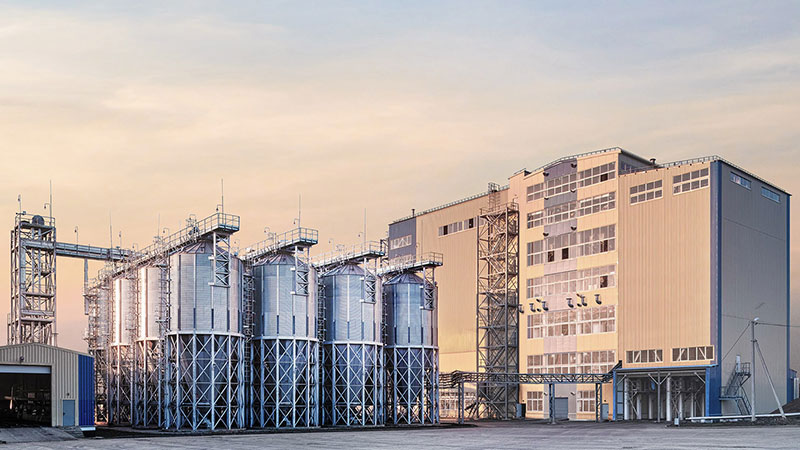
At RICHI, we go beyond project completion. With RICHI Servicee, we’re your dedicated partners in success. Count on us for expert guidance, minimal downtime, and optimized productivity. Choose RICHI for unmatched service and support.
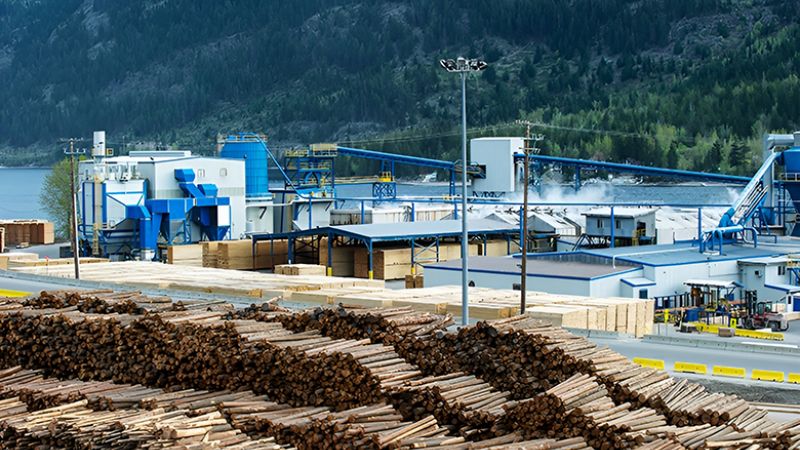


Meet global product demands and quality standards with industry-leading pellet plant design, engineering, equipment, and construction services for pellet processors.


Your Partner Beyond Project Completion
2000+ cases
RICHI is the leading designer, manufacturer and builder of pellet plants in the world, completing over 2000 projects in 140 countries across 6 continents.
Read More
Increase plant productivity, profitability, and safety by integrating high quality equipment into your pellet production line. Over the years, RICHI has become China's top pellet equipment manufacturer. At the same time, RICHI has established valuable partnerships with the world's leading component and raw material manufacturers to bring you the best there is in technology, automation, and efficiency in pelleting plant machinery.

For nearly 30 years, RICHI has been providing best-in-class pellet plant equipment and services to clients across a variety of industries, sizes, and needs. We pride ourselves on the knowledge and skill that each team member possesses – from our technical sales team to our process design engineers. You can count on RICHI Machinery to take your operation to the next level of innovation, quality, and success.
Need help with your pellet manufacturing plant project? Contact us today.
ANIMAL FEED
BIOMASS
WOOD
ORGANIC FERTILIZER
AQUA FEED
CAT LITTER
MUNICIPAL WASTE RECYCLING
SPECIAL PELLET PRODUCTION
RICHI Machinery continues to deliver world class pellet mill equipment, pellet plant engineering and project solutions that add value to our customers in the animal feed, wood waste, agriculture waste, organic fertilizer, cat litter and special pellet products industries. Throughout the years, we RICHI Machinery have built strong brand, becoming industry-leading pellet machine manufacturer. We value integrity, promise quality, and prioritize your success.
Learn MoreWith our expert team, we precisely implement your process engineering requirements in pellet mill and pelletizing plant systems. No matter which industry you’re in – we understand your needs and deliver solutions that meet the highest standards.
At RICHI, quality comes first. Our pellet making machine and related pellet line equipment undergo rigorous quality controls to ensure they meet the highest standards. Rely on products that are durable, safe, and efficient.
With decades of experience in pellet machine and pellet production line production, we have earned a reputation as a trusted partner in various industries. Our expertise allows us to cover a wide range of applications.
Not only do we offer premium pelleting equipment, but we are also experts at designing, building, installing, and maintaining facilities from the ground up. Our expertise is within pellt plant process design, discovering the most efficient, productive, and profitable way to handle your materials in an end-to-end cycle.
○ RICHI MACHINERY
Keeping in touch with us is an effective way to solve all your problems. If you have any needs or questions, please leave your contact information, then RICHI technical consultants will send design, quotation, videos to your mailbox. You can also contact us directly via WhatsApp: +86 13838389622
Copyright©2015-2026 by HENAN RICHI MACHINERY CO., LTD. All rights reserved.