
The Bhutanese customer did not begin with a plan to manufacture fertilizer and household fuel from the same machine. The commercial question was narrower: could dry cattle manure that was difficult to store and transport be converted into a denser solid fuel for institutional heating and selected rural thermal users? That distinction changed both the raw-material preparation and the equipment choice.
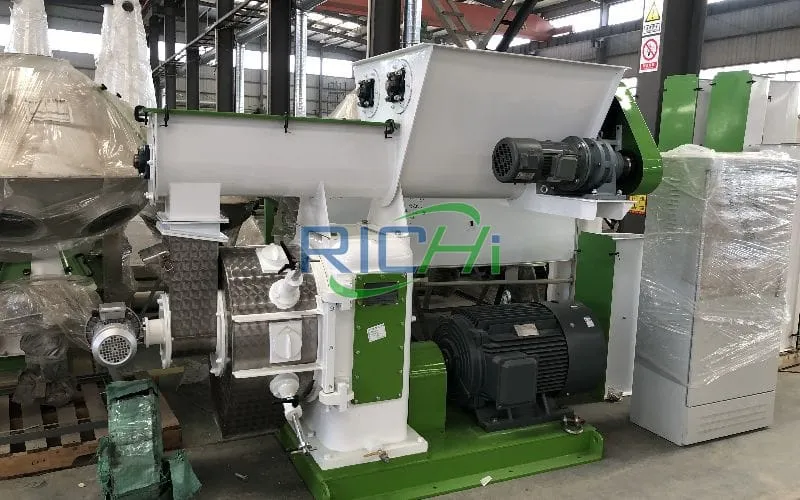
The Bhutanese customer did not begin with a plan to manufacture fertilizer and household fuel from the same machine. The commercial question was narrower: could dry cattle manure that was difficult to store and transport be converted into a denser solid fuel for institutional heating and selected rural thermal users? That distinction changed both the raw-material preparation and the equipment choice.
The processor originally searched for a cow dung briquetting machine in Bhutan, but its target product was not a large block-shaped briquette. It wanted small cylindrical fuel units that could be handled automatically and blended with other dry biomass. RICHI therefore configured one FZLH350 ring-die densification machine for a cattle-manure-based fuel product, while compost and fertilizer material remained in a separate production stream.
Name:
Cow Dung Pellet Press
Country:
Bhutan
Date:
2025
Capacity:
3–5 T/H
Model:
FZLH350
Main Motor Power:
37 kW
Raw Materials:
Fresh Cow Dung
Pellet diameter:
8–10 mm
The customer operates a small regional biomass and agricultural-residue processing business serving farms and institutional users in central Bhutan. Its business already included collection of dry wood residues, crop by-products, and livestock waste from several surrounding communities.
The key word is several.
A single farm with 50 cattle cannot provide enough dry manure to keep an industrial 37 kW ring-die machine economically utilized. Bhutan’s 2023 agriculture and livestock census recorded more than 260,000 bovines nationwide, but those animals are distributed among many farms and districts rather than concentrated in one giant feedlot.
The customer therefore uses an aggregation model. Manure is collected from contracted dairy farms and livestock groups and combined with dry biomass residues already moving through the company’s collection network.
Animal dung is not Bhutan’s dominant household fuel.
Historically, fuelwood and other biomass have played a much larger role, while animal dung has been used only occasionally in some rural areas. FAO material describing Bhutan’s rural energy mix specifically lists fuelwood, wood chips, briquettes and occasional animal dung use.
That means a cow-dung fuel project needs a specific customer rather than a vague claim that every Bhutanese household wants dung briquettes.
For this project, the processor targets small institutional boilers, workshops, agricultural heating applications, and rural users already familiar with solid biomass fuels. The product is not positioned as a universal replacement for electricity, LPG, or firewood.
The customer’s supply area is centered on cattle-producing communities rather than high-altitude yak regions.
Bhutan’s livestock census shows that important milking-yak populations are concentrated particularly in places such as Thimphu and Gasa, while other districts have much stronger cattle populations.
The fuel blend is based primarily on dried and stabilized cattle manure combined with clean lignocellulosic residues. Typical supporting materials include sawdust, planer shavings, finely processed wood residues, and limited quantities of suitable dry crop residues where available.
The exact ratio changes with ash content, moisture, combustion behavior, pellet strength, and the specification required by the end user.
Fresh cattle manure is much too wet and inconsistent for stable ring-die densification.
The customer first separates obvious contaminants and allows the manure to undergo controlled drying and stabilization. Depending on season and collection method, mechanical drying or sheltered solar drying can be used before final moisture adjustment.
The material must then be broken down into a reasonably uniform feedstock.
Large fibrous clumps, stones, bedding pieces, and foreign matter are removed before the manure is mixed with the dry biomass fraction.
The pelletizer receives prepared material, not fresh dung straight from the cattle shed.
Pure dried cattle manure can be densified, but it is not automatically the best fuel formulation.
Manure has comparatively high ash content relative to clean wood. Its combustion behavior also depends strongly on feeding, bedding contamination, soil contamination, and mineral content.
Blending with suitable clean biomass can improve physical structure and raise the proportion of combustible organic material.
For the Bhutan customer, the dry biomass fraction typically comes from sawdust and small wood-processing residues already available through local workshops and timber-processing activities.
The company does not use painted wood, chemically treated timber, plastic-contaminated residues, or demolition wood simply because those materials can physically enter the mixer.
The customer initially used the term “briquetting machine” because that is how many buyers describe biomass densification equipment.
Technically, the FZLH350 is a ring-die pelletizing machine rather than a piston press producing large 50–90 mm briquettes.
The finished product in this project is therefore a small-diameter cylindrical densified fuel, approximately 8–10 mm in diameter.
This distinction matters for prospective buyers.
If a customer actually wants large logs or block briquettes, a dedicated briquetting press is the more appropriate machine. If the target is small cylindrical material suitable for auger feeding, bagging, and more uniform combustion, a ring-die machine can be the better configuration.
| Project Parameter | Configuration |
|---|---|
| Equipment | Ring-die densification machine |
| Application Term | Cow dung briquetting machine |
| Model | FZLH350 |
| Main Motor Power | 37 kW |
| Anti-Bridging Feeder | 2.2 kW |
| Forced Feeder | 0.75 kW |
| Ring Die Inner Diameter | 350 mm |
| Project Product Diameter | 8–10 mm |
| Application | Cattle-manure-based densified fuel |
The machine’s anti-bridging and forced-feeding systems are particularly useful because dried manure-biomass mixtures are much less free-flowing than grain.
Even with these systems, feed preparation remains essential. Excessively wet or lumpy material will reduce throughput and can destabilize pellet formation.
For fertilizer-type material, an FZLH350 may be quoted within a multi-ton-per-hour reference range under suitable conditions.
A dry cow-dung fuel blend creates a different operating condition.
Bulk density, ash, fiber percentage, biomass ratio, particle size, moisture, die compression, and required product strength all affect output. For that reason, the Bhutan customer does not build its business plan around a guaranteed 4 T/H simply because that number appears in a general machine table.
Commissioning begins at a conservative feed rate and increases only after motor load, product density, die behavior, and durability are stable.
This is especially important in Bhutan, where the raw-material collection network is much smaller than the feedstock systems supporting large industrial manure-processing projects in major livestock regions.
The customer also handles organic fertilizer material, but it does not sell the same blend as both fuel and fertilizer.
That would create a serious product-positioning problem.
For fertilizer, the priority is nutrient value, compost maturity, sanitation, soil application, and fertilizer quality. For fuel, the priorities shift toward moisture, ash, calorific behavior, density, combustion characteristics, and contaminant control.
The FZLH350 in this project is assigned to the fuel stream.
Composted manure intended for agricultural use continues through the customer’s existing fertilizer process rather than being mixed with sawdust and automatically marketed as a dual-purpose product.
Fresh material leaving the ring die is warm and requires stabilization before final storage.
The customer cools the cylindrical fuel before screening. Loose fines are removed and can be returned to the preparation section when their quality remains suitable.
Finished material is then stored under dry conditions.
This matters particularly for manure-based fuel because hygroscopic material can regain moisture if stored in an exposed or poorly ventilated area.
The customer therefore treats dry storage as part of product quality control rather than assuming densification alone makes the material weather-resistant.
The processor does not market the product with one universal heating-value number.
Cattle manure varies considerably in ash and mineral content. A sample contaminated with soil can behave very differently from manure collected from a cleaner housed-dairy system.
Before supplying a regular industrial customer, representative material is evaluated for moisture, ash, combustion performance, and other parameters relevant to that user’s equipment.
Blending ratios are then adjusted where necessary.
This prevents the machine from being blamed for a fuel-quality problem that actually originated in feedstock contamination.
Bhutan’s total market and dispersed livestock structure do not justify treating this project like a large Indian or Southeast Asian biomass factory.
The customer already had manure collection, biomass storage, crushing, and mixing capability. The new investment therefore focused on one densification machine.
Production is organized in campaigns.
When enough dry prepared feedstock has accumulated and a confirmed order is available, the machine operates for several hours. It does not need to run continuously simply because it is an industrial machine.
This operating model fits Bhutan much better than assuming a small local company can continuously supply 3–5 tonnes of dry dung mixture every hour throughout the year.
Bhutan has no seaport.
The FZLH350 was shipped from Qingdao Port to an Indian seaport and then moved under transit arrangements toward Bhutan. Bhutan’s official Liaison and Transit Office in Kolkata handles third-country cargo bound for Bhutan through Kolkata and Haldia ports.
From India, the equipment continued toward the Bhutanese border and entered through the Phuentsholing trade corridor.
Phuentsholing itself is a dry port and inland trade gateway, not a maritime port. Bhutan’s mini dry port there has operated as a transshipment and customs facility since 2019.
This routing reflects Bhutan’s landlocked logistics structure.
Because the equipment originates from a third country, the customer also had to consider Bhutan’s import procedures for industrial machinery.
Bhutan’s Department of Industry states that machinery, equipment, parts, and production inputs imported by businesses from third countries require the appropriate import approval and licensing process.
RICHI therefore supplied the commercial invoice, packing information, machine specifications, electrical information, and other equipment documentation required by the customer and its logistics agent.
The first production trials used the customer’s actual dried cattle-manure and biomass blend.
Operators adjusted feed rate, moisture, die conditions, and biomass proportion while monitoring main-motor load and the physical strength of the finished product.
If the manure fraction was too high and ash-rich, fuel quality declined even when pellet formation remained acceptable.
If the blend contained too much coarse woody material, feeding became less stable.
The commissioning process therefore produced a working material specification as well as a machine setting.
“The main lesson was that collecting manure is easier than collecting consistent manure. Material from different farms has different moisture, bedding, and dirt content. The machine works best when we prepare the blend first and reject contaminated material. We now treat the fuel specification as seriously as the machine setting.”
The customer also found that raw-material aggregation, not machine capacity, was the main factor controlling future expansion.
Before adding another unit, the business would need more contracted manure supply, more dry biomass, and confirmed industrial fuel customers.
A 37 kW industrial ring-die machine is unlikely to be justified by an individual household or a very small livestock farm.
A more realistic buyer is a cooperative, manure-collection enterprise, biomass processor, agricultural-service company, or larger integrated livestock operation that already aggregates material from multiple farms.
The buyer should also have drying capability, protected storage, size-reduction equipment, mixing, cooling, and a defined market for the final fuel.
Without those elements, purchasing the pelletizer first would simply move the bottleneck somewhere else.
This cow dung briquetting machine in Bhutan project is a regional aggregation application built around one FZLH350, a prepared cattle-manure feedstock, clean dry biomass blending materials, and a specific thermal-fuel market.
The machine produces 8–10 mm cylindrical densified fuel rather than large block briquettes. Fresh manure is dried and prepared before processing, fuel and fertilizer streams remain separate, and actual output is established through material testing instead of assuming the highest nominal machine capacity.
For another Bhutanese customer, RICHI Machinery would first calculate the daily quantity of collectable manure, moisture after drying, bedding and soil contamination, available sawdust or agricultural residues, desired fuel diameter, actual operating hours, electrical supply, downstream cooling and screening, protected storage, and the boiler or thermal system that will consume the finished fuel.
Those figures determine whether an FZLH350 is appropriate or whether the customer actually needs a smaller densification machine, a different pellet mill, or a true large-diameter briquetting press.
Having the right mix of reliable, high-quality pellet machine and pelletizing systems and expert support is essential to your success. Watch how our end-to-end feed pellet plant solutions have helped our customers optimize their performance.
Our customized and future-proofed turnkey pellet plant solutions is designed with you at the core. From vision to reality and beyond, our team stays connected with yours. Giving you peace-of-mind with an expert at your side.
At RICHI, we go beyond project completion. With RICHI Servicee, we’re your dedicated partners in success. Count on us for expert guidance, minimal downtime, and optimized productivity. Choose RICHI for unmatched service and support.


Meet global product demands and quality standards with industry-leading pellet plant design, engineering, equipment, and construction services for pellet processors.


Your Partner Beyond Project Completion
2000+ cases
RICHI is the leading designer, manufacturer and builder of pellet plants in the world, completing over 2000 projects in 140 countries across 6 continents.
Read More
Increase plant productivity, profitability, and safety by integrating high quality equipment into your pellet production line. Over the years, RICHI has become China's top pellet equipment manufacturer. At the same time, RICHI has established valuable partnerships with the world's leading component and raw material manufacturers to bring you the best there is in technology, automation, and efficiency in pelleting plant machinery.

For nearly 30 years, RICHI has been providing best-in-class pellet plant equipment and services to clients across a variety of industries, sizes, and needs. We pride ourselves on the knowledge and skill that each team member possesses – from our technical sales team to our process design engineers. You can count on RICHI Machinery to take your operation to the next level of innovation, quality, and success.
Need help with your pellet manufacturing plant project? Contact us today.
ANIMAL FEED
BIOMASS
WOOD
ORGANIC FERTILIZER
AQUA FEED
CAT LITTER
MUNICIPAL WASTE RECYCLING
SPECIAL PELLET PRODUCTION
RICHI Machinery continues to deliver world class pellet mill equipment, pellet plant engineering and project solutions that add value to our customers in the animal feed, wood waste, agriculture waste, organic fertilizer, cat litter and special pellet products industries. Throughout the years, we RICHI Machinery have built strong brand, becoming industry-leading pellet machine manufacturer. We value integrity, promise quality, and prioritize your success.
Learn MoreWith our expert team, we precisely implement your process engineering requirements in pellet mill and pelletizing plant systems. No matter which industry you’re in – we understand your needs and deliver solutions that meet the highest standards.
At RICHI, quality comes first. Our pellet making machine and related pellet line equipment undergo rigorous quality controls to ensure they meet the highest standards. Rely on products that are durable, safe, and efficient.
With decades of experience in pellet machine and pellet production line production, we have earned a reputation as a trusted partner in various industries. Our expertise allows us to cover a wide range of applications.
Not only do we offer premium pelleting equipment, but we are also experts at designing, building, installing, and maintaining facilities from the ground up. Our expertise is within pellt plant process design, discovering the most efficient, productive, and profitable way to handle your materials in an end-to-end cycle.
○ RICHI MACHINERY
Keeping in touch with us is an effective way to solve all your problems. If you have any needs or questions, please leave your contact information, then RICHI technical consultants will send design, quotation, videos to your mailbox. You can also contact us directly via WhatsApp: +86 13838389622
Copyright©2015-2026 by HENAN RICHI MACHINERY CO., LTD. All rights reserved.