
The Tajik customer was not trying to grind cotton stalks simply because they were abundant. The company already had a defined use for the material: part of the ground stalk would become feedstock for non-wood fuel pellets, while another portion would be blended into composting operations as a structural carbon source. What the plant lacked was a grinding system capable of processing large volumes of dry, woody cotton stalk without turning the hammer mill into a constant maintenance problem.
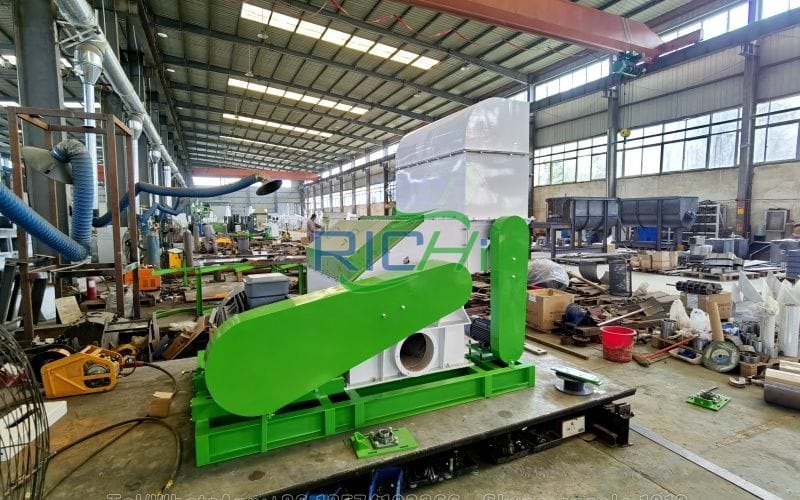
The Tajik customer was not trying to grind cotton stalks simply because they were abundant. The company already had a defined use for the material: part of the ground stalk would become feedstock for non-wood fuel pellets, while another portion would be blended into composting operations as a structural carbon source. What the plant lacked was a grinding system capable of processing large volumes of dry, woody cotton stalk without turning the hammer mill into a constant maintenance problem.
The biomass pellet project was located in Khatlon, one of Tajikistan’s principal cotton-growing regions. Instead of feeding whole stalks directly into a hammer mill, the customer installed a two-stage size-reduction section: coarse chopping first, then fine grinding with an SFSP66×120 cotton stalk hammer mill in Tajikistan. The 185 kW machine was selected as a standalone replacement for an undersized grinder that had become the bottleneck in the company’s existing biomass preparation system.
Name:
Cotton Stalk Crusher
Country:
Tajikistan
Date:
2026
Capacity:
5-6T/H
Model:
SFSP66×120
Main Motor Power:
185 kW
Quantity:
1 unit
Screens:
6 mm and 8 mm
Tajikistan remains a significant cotton-producing country. Official statistics show that national cotton output reached 382,945 tonnes in 2025, and Khatlon continues to be one of the country’s core agricultural regions. Cotton therefore creates a substantial seasonal stream of stalks after harvest.
The customer does not assume that every stalk left in the field can be economically collected.
Recoverable volume depends on field access, harvesting practice, collection cost, moisture, soil contamination, competing uses and the need to leave some crop residue where agronomically appropriate.
The plant therefore signs collection agreements with several cotton farms within a defined transport radius instead of basing production on a theoretical national residue figure.
The project uses stalks, branches and woody stem material remaining after cotton harvesting.
This is different from cotton gin trash, cottonseed hulls or textile waste.
The stalks are much more rigid than ordinary straw and cannot be handled in the same way as wheat straw or alfalfa hay. Long stems can bridge inside hoppers, wrap around feeding systems and create impact loading if they reach the hammer chamber without adequate pre-cutting.
That is why the customer separates coarse size reduction from fine grinding.
The first machine in the preparation section is a coarse chopper.
Loose cotton stalk bundles are fed into this unit and reduced to shorter pieces, typically in the several-centimetre range. The exact cut length varies according to stalk diameter and dryness, but the objective is to eliminate long rigid stems before hammer milling.
The chopped material is then transferred to the SFSP66×120 by conveyor.
This protects the hammer mill from being used as both a primary stalk breaker and a fine grinder at the same time.
| Project Parameter | Configuration |
|---|---|
| Equipment | Cotton stalk hammer mill |
| Model | SFSP66×120 |
| Quantity | 1 unit |
| Main Motor Power | 185 kW |
| Pre-Processing | Coarse stalk chopping before hammer milling |
| Project Screens | 6 mm and 8 mm |
| Primary Application | Biomass fuel pellet feedstock preparation |
| Secondary Application | Carbon-rich structural material for compost blends |
The customer selected the larger 66×120 grinding chamber because its existing downstream biomass section required several tonnes of prepared material per hour during peak production.
The 185 kW motor was not justified by the statement that “cotton stalk always needs 185 kW.” Motor selection depends on feed rate, screen opening, stalk condition, incoming particle size and required final fineness.
For this plant, the large model matched the rest of the line better than installing a smaller hammer mill and forcing it to run continuously at maximum load.
The stalk is woody and mechanically demanding, but abrasive wear is influenced heavily by external contamination.
Soil, sand and mineral particles carried in from the field can accelerate hammer and screen wear much more than the clean plant fibre itself.
The customer therefore focuses on keeping collected stalks away from excessive soil contamination.
Loads containing large amounts of dirt are either cleaned or rejected before grinding.
This is more useful than assuming cotton naturally contains so much silica that standard hammers must always fail after a fixed number of hours.
The SFSP66×120 was supplied with wear-resistant hammer configuration suitable for dry agricultural stalks.
Hardfacing or carbide-enhanced hammer options can be used where field contamination and operating hours justify the additional cost, but they are not presented as universally mandatory.
The customer monitors hammer wear from rotor balance, grinding capacity, power consumption and particle-size distribution.
If one side of a reversible hammer wears unevenly, the maintenance team rotates or replaces it according to actual condition.
No fixed claim such as “standard hammers last 80 hours while carbide hammers last exactly 400 hours” is used because actual life depends on material cleanliness and operating conditions.
An 8 mm screen can be useful for coarse biomass preparation, but particles leaving an 8 or 10 mm hammer-mill screen are not automatically ideal feed for a ring-die biomass pellet mill.
The customer therefore uses a finer screen when producing material that will go directly into pelletizing.
The main fuel-pellet campaign uses approximately a 6 mm screen, with the resulting particle distribution checked before pellet production.
For compost preparation, a coarser 8 mm screen can be used because the purpose is different: the stalk fibre needs to provide structure and carbon rather than enter a pellet die immediately.
The plant does not publish a fixed 3.5 T/H at 8 mm and 4.5 T/H at 10 mm as though these figures apply to every cotton stalk batch.
Larger screen openings generally increase throughput, but actual capacity is also affected by pre-chop size, stalk diameter, moisture, hammer condition and contamination.
The operators therefore record tonnes per hour alongside motor current and finished particle distribution.
The best setting is the one that supplies the next production stage consistently, not simply the setting with the highest hammer-mill throughput.
Dry stalks fracture more efficiently than wet flexible stems.
However, the plant does not use 12–14% moisture as an absolute requirement for every campaign.
Incoming stalk moisture is checked first.
Material that is too wet for efficient hammer milling is allowed to dry or is routed through appropriate drying preparation. Material that is already sufficiently dry proceeds without unnecessary thermal treatment.
Excessively wet stalk can reduce throughput and increase screen plugging, while extremely dry, dusty feedstock requires stronger dust-management discipline.
Cotton stalk grinding creates airborne fibre and fine particulate matter.
The SFSP66×120 therefore operates with aspiration and downstream dust collection rather than relying on an open discharge.
The customer uses a cyclone for primary separation and a bag filter for fine dust control.
The system is sized according to airflow, pressure drop and dust loading rather than described with a fixed 99.5% capture rate that has not been independently measured at the site.
Housekeeping is also important because settled agricultural dust can become both an occupational and combustible-dust hazard.
Cotton stalk collection can introduce wire, broken tools or metal fragments from field and transport operations.
A magnetic separator is therefore positioned ahead of the hammer mill where appropriate.
This protects the rotor, hammers and screens from avoidable impact damage.
The protection stage is particularly important on a 185 kW high-speed grinder because a small contaminant entering at full operating speed can cause much more damage than ordinary plant fibre.
The primary outlet for the fine-ground cotton stalk is the customer’s biomass fuel operation.
Tajikistan-specific research has already demonstrated that cotton field residues can be densified into pellets and briquettes with good mechanical durability, supporting the technical credibility of this application. At the same time, the same research found that cotton-residue fuels should not simply be treated as equivalent to premium wood pellets because their ash, nitrogen, sulphur and heating characteristics differ.
The customer therefore positions the final product as an agricultural-residue fuel rather than a wood-pellet substitute for every boiler.
Cotton stalk pellets can provide useful thermal energy, but combustion-system compatibility matters.
The customer supplies industrial or agricultural thermal users whose boilers can handle non-wood biomass fuels and their ash characteristics.
Representative fuel batches are checked for moisture, ash and combustion behavior before long-term supply arrangements are expanded.
The plant does not claim that cotton stalk pellets can be used interchangeably in every household wood-pellet stove.
A coarser fraction of the processed stalk is used as a structural carbon material in the company’s composting operation.
The purpose is not to call raw ground stalk “organic fertilizer.”
Instead, chopped and ground cotton stalk can be blended with manure and other nitrogen-rich organic materials to improve carbon balance, porosity and structure during composting.
Only after the biological treatment is completed does the resulting material become a stabilized compost product.
This distinction avoids suggesting that simply grinding stalks with a 10 mm screen creates finished fertilizer.
Cotton fields may be exposed to crop-protection products, dust and soil contamination, and the woody stalk is not the most obvious first-choice bedding material when other residues are available.
The company therefore keeps the SFSP66×120 focused on its two applications: biomass fuel preparation and compost-feedstock preparation.
Once stalk reaches the processing plant in a reasonably dry and clean condition, size reduction is technically straightforward.
The more difficult business question is collecting a low-value bulky residue economically.
Stalks are scattered across many farms after harvest, and transport distance can quickly erase the value created by pelletizing.
The customer therefore maps supplier farms by distance and prioritizes areas where sufficient stalk can be accumulated without excessive trucking.
This is particularly important for a large SFSP66×120, which requires a much more organized supply chain than a small farm grinder.
Tajikistan’s 2025 cotton production was about 382,945 tonnes, but there is no reliable one-step conversion from national cotton output to a fixed quantity of commercially collectable stalk.
Residue-to-crop ratios vary, and not all stalk is available for removal.
The customer therefore bases equipment utilization on contracted dry tonnes within its sourcing radius, not on a national residue estimate multiplied from cotton-fibre output.
The pre-processing machine is selected for fibrous agricultural stalk, not for logs and large woody timber.
The customer’s requirement is to shorten and open cotton stalk before fine grinding.
Depending on the final project configuration, this can be done with a straw crusher, stalk chopper or other appropriate coarse-size-reduction machine.
A conventional wood drum chipper is therefore not mandatory for every cotton stalk project.
Instead of immediately changing hammer type or increasing motor load, the commissioning team first stabilized the material entering the hammer mill.
When coarse stalk pieces were too long, feeding became uneven and power draw fluctuated.
After the chopper settings were tightened, the SFSP66×120 received a much more uniform feed.
Only then were screen and hammer-mill feeding parameters optimized.
“The hammer mill has enough power, but power was not the whole problem. Our biggest improvement came from controlling what entered the mill. When the stalks are cut to a consistent length and we keep soil out of the material, capacity is more stable and hammer wear is easier to manage.”
The company now records feedstock condition together with maintenance data.
This makes it easier to determine whether falling throughput is caused by worn hammers, screen condition, wetter stalks or a poorly prepared incoming batch.
The maintenance team checks hammers, screens, rotor balance, bearings, fasteners, aspiration ducts and accumulated dust at scheduled intervals.
Wear parts are replaced according to condition rather than after a fixed 50-, 500- or 600-hour promise.
This approach is especially important when processing agricultural residues because contamination can change significantly between suppliers.
Tajikistan has no seaport, so logistics require a sea-and-land combination.
The SFSP66×120 and related equipment were exported from Qingdao Port and routed through an international freight corridor suitable for Central Asian delivery before continuing overland to Tajikistan.
The final port and border route were selected according to freight availability, customs conditions and transit practicality at the time of shipment rather than hard-coded as Bandar Abbas for every project.
International routing can therefore be adjusted according to current regional transport conditions.
The large main motor makes electrical preparation a substantial part of the project.
The customer confirmed available three-phase power, transformer capacity, cable sizing, motor-starting arrangement and protection before shipment.
Foundation and supporting steelwork were also reviewed because vibration control and rotor alignment are important for a large high-speed hammer mill.
The machine could not simply be placed on an existing light workshop floor and connected like a small farm grinder.
An SFSP66×120 straw crusher machine with a 185 kW drive only makes sense when there is enough material to keep the equipment utilized.
The customer is therefore a commercial biomass and organic-resource processor aggregating stalk from multiple cotton farms rather than an individual farm grinding its own post-harvest residue.
This matches both the machine scale and Khatlon’s concentrated cotton-production environment.
This cotton stalk hammer mill in Tajikistan project is a heavy-duty agricultural-residue preparation application built around one central engineering principle: the hammer mill should perform fine grinding, not every size-reduction task in the plant.
The Khatlon customer uses one SFSP66×120 with a 185 kW main motor. Whole cotton stalk is first shortened with a coarse stalk-processing machine, contaminants are controlled, and the prepared material is then hammer-milled. A finer screen is used when the material is destined for biomass pellet production, while a somewhat coarser fraction can be prepared for compost blending.
The machine is not justified by claims that cotton stalk is always the world’s most abrasive crop residue, that carbide hammers are universally mandatory, or that stalk moisture must always be exactly 12–14%. Actual grinding performance depends on stalk condition, soil contamination, pre-cut length, screen opening, moisture, hammer condition, airflow and downstream particle-size requirements.
For another customer evaluating a cotton stalk hammer mill in Tajikistan, RICHI Machinery would first calculate contractable dry stalk volume, collection radius, incoming stalk length, soil contamination, moisture, target particle size, required T/H, downstream pellet or compost process, dust-control requirement, available electrical power and existing pre-chopping equipment before confirming the hammer-mill model.
That assessment determines whether an SFSP66×120 is justified or whether a smaller grinder would provide better utilization and lower installed power.
Having the right mix of reliable, high-quality pellet machine and pelletizing systems and expert support is essential to your success. Watch how our end-to-end feed pellet plant solutions have helped our customers optimize their performance.
Our customized and future-proofed turnkey pellet plant solutions is designed with you at the core. From vision to reality and beyond, our team stays connected with yours. Giving you peace-of-mind with an expert at your side.
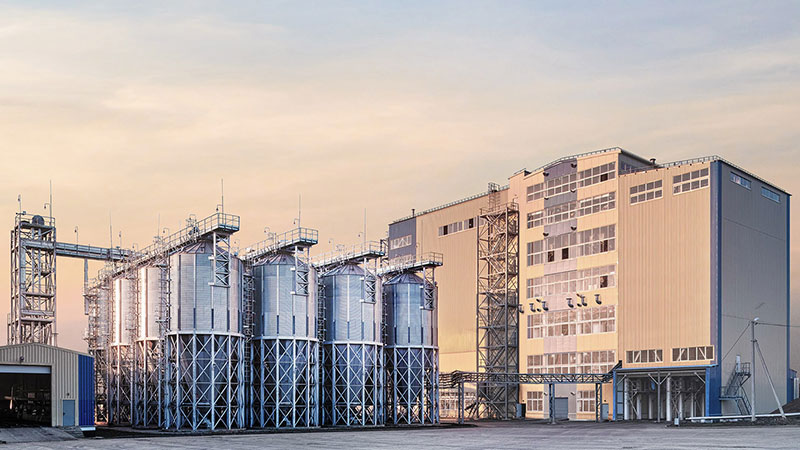
At RICHI, we go beyond project completion. With RICHI Servicee, we’re your dedicated partners in success. Count on us for expert guidance, minimal downtime, and optimized productivity. Choose RICHI for unmatched service and support.
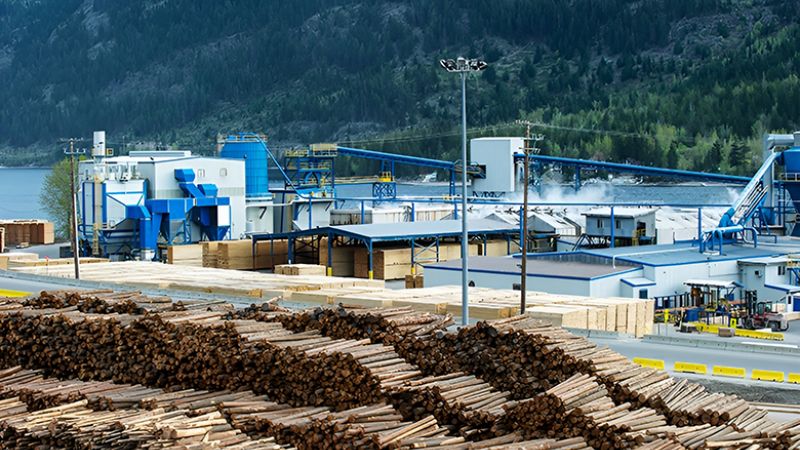


Meet global product demands and quality standards with industry-leading pellet plant design, engineering, equipment, and construction services for pellet processors.


Your Partner Beyond Project Completion
2000+ cases
RICHI is the leading designer, manufacturer and builder of pellet plants in the world, completing over 2000 projects in 140 countries across 6 continents.
Read More
Increase plant productivity, profitability, and safety by integrating high quality equipment into your pellet production line. Over the years, RICHI has become China's top pellet equipment manufacturer. At the same time, RICHI has established valuable partnerships with the world's leading component and raw material manufacturers to bring you the best there is in technology, automation, and efficiency in pelleting plant machinery.

For nearly 30 years, RICHI has been providing best-in-class pellet plant equipment and services to clients across a variety of industries, sizes, and needs. We pride ourselves on the knowledge and skill that each team member possesses – from our technical sales team to our process design engineers. You can count on RICHI Machinery to take your operation to the next level of innovation, quality, and success.
Need help with your pellet manufacturing plant project? Contact us today.
ANIMAL FEED
BIOMASS
WOOD
ORGANIC FERTILIZER
AQUA FEED
CAT LITTER
MUNICIPAL WASTE RECYCLING
SPECIAL PELLET PRODUCTION
RICHI Machinery continues to deliver world class pellet mill equipment, pellet plant engineering and project solutions that add value to our customers in the animal feed, wood waste, agriculture waste, organic fertilizer, cat litter and special pellet products industries. Throughout the years, we RICHI Machinery have built strong brand, becoming industry-leading pellet machine manufacturer. We value integrity, promise quality, and prioritize your success.
Learn MoreWith our expert team, we precisely implement your process engineering requirements in pellet mill and pelletizing plant systems. No matter which industry you’re in – we understand your needs and deliver solutions that meet the highest standards.
At RICHI, quality comes first. Our pellet making machine and related pellet line equipment undergo rigorous quality controls to ensure they meet the highest standards. Rely on products that are durable, safe, and efficient.
With decades of experience in pellet machine and pellet production line production, we have earned a reputation as a trusted partner in various industries. Our expertise allows us to cover a wide range of applications.
Not only do we offer premium pelleting equipment, but we are also experts at designing, building, installing, and maintaining facilities from the ground up. Our expertise is within pellt plant process design, discovering the most efficient, productive, and profitable way to handle your materials in an end-to-end cycle.
○ RICHI MACHINERY
Keeping in touch with us is an effective way to solve all your problems. If you have any needs or questions, please leave your contact information, then RICHI technical consultants will send design, quotation, videos to your mailbox. You can also contact us directly via WhatsApp: +86 13838389622
Copyright©2015-2026 by HENAN RICHI MACHINERY CO., LTD. All rights reserved.