
The Nigerian customer did not install a fertilizer granulator to compress fresh pig manure immediately after it left the farm. The project was built around a different problem: a regional organic fertilizer processor in southwestern Nigeria already collected manure and agricultural residues, composted them in batches and sold part of the stabilized material as loose compost, but powder products were difficult to transport, dusty during handling and inconvenient for dealers that preferred bagged granular fertilizer.
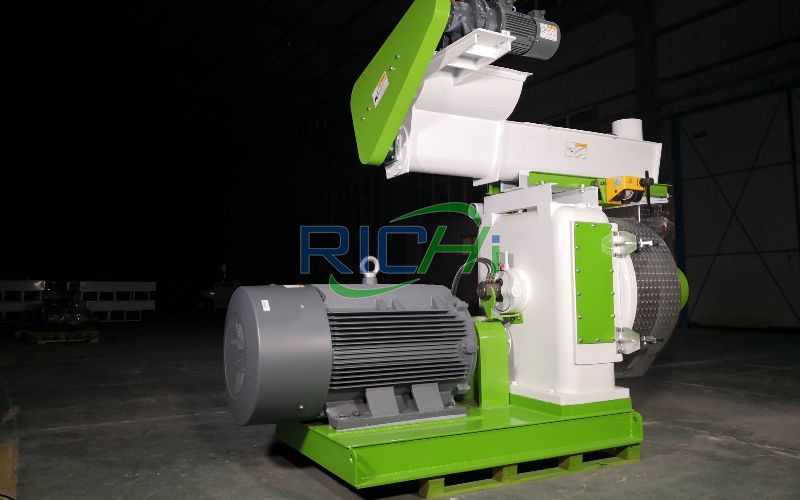
The Nigerian customer did not install a fertilizer granulator to compress fresh pig manure immediately after it left the farm. The project was built around a different problem: a regional organic fertilizer processor in southwestern Nigeria already collected manure and agricultural residues, composted them in batches and sold part of the stabilized material as loose compost, but powder products were difficult to transport, dusty during handling and inconvenient for dealers that preferred bagged granular fertilizer.
One FZLH350 corn straw pig manure fertilizer granulator in Nigeria was therefore added to the existing factory as a downstream densification upgrade. The customer retained its manure receiving, composting, crushing, mixing, drying and storage equipment and invested only in the granulation stage that had become the commercial bottleneck.
The machine converts properly composted and moisture-controlled pig-manure/crop-residue material into cylindrical organic fertilizer pellets that are easier to screen, bag, stack and distribute through agricultural supply channels.
Name:
Corn straw pig manure fertilizer granulator
Country:
Nigeria
Date:
2026
Capacity:
3–5 T/H
Model:
FZLH350
Main Motor Power:
37 kW
Ring Die Diameter:
350 mm
Pellet diameter:
6 mm
A 3–5 T/H fertilizer granulator machine requires a substantial and regular flow of prepared compost.
One medium-sized pig farm with approximately 1,200 animals would not realistically provide enough finished dry organic fertilizer material to keep a machine of this size commercially loaded throughout the working week, especially after water loss during composting and drying.
The Nigerian customer operates as a regional fertilizer processor rather than the fertilizer department of one pig farm.
It receives manure from several commercial pig farms and combines these contracts with crop residues collected from surrounding maize-producing areas.
Pig manure contributes organic matter and plant nutrients, but fresh manure arrives with variable moisture, bedding content and nutrient concentration.
The factory does not formulate fertilizer by assuming every truckload has the same nitrogen, phosphorus and potassium content.
Loads are received, inspected and incorporated into the composting system according to their condition.
The plant can later adjust the finished fertilizer formulation after compost maturity and nutrient testing.
Corn straw is not included merely to increase pellet hardness.
During the composting stage, shredded maize stalks and leaves provide carbonaceous fibrous material that can improve pile structure, absorb part of the manure moisture and help balance a manure-heavy compost mixture.
After decomposition, much of the original straw structure is already softened and partially broken down.
This makes the resulting compost much more suitable for crushing, mixing and ring-die granulation than a direct blend of long dry stalks and fresh pig manure.
Southwestern Nigeria combines substantial crop farming with commercial livestock activity and a large market for soil-fertility inputs.
Research conducted in the region has specifically evaluated composted pig manure as a soil amendment for maize production, confirming that pig-manure compost has genuine agricultural relevance rather than being an artificial raw material added only to create an equipment case.
The region also produces maize and other crops that generate carbon-rich residues suitable for composting and organic fertilizer processing.
The customer does not depend on one maize farm.
Crop straw is collected through agricultural cooperatives, local aggregators and larger farms after harvest.
Because loose maize stalks have very low bulk density, collection distance affects economics quickly.
The factory therefore prefers material available within a practical trucking radius and increasingly accepts baled or pre-chopped residue where suppliers can provide it.
This is the most important process rule in the project.
Fresh manure is biologically active, high in moisture and unsuitable for stable dry fertilizer pellet production.
If material of that condition were pushed directly into a ring die, feeding would become unstable, die holes could smear or block, and the resulting wet pellets would have poor storage stability.
More importantly, granulation should not be mistaken for composting or sanitization.
The customer first mixes manure with suitable carbonaceous materials and manages the material through an aerobic composting stage.
Temperature, moisture, aeration and turning are controlled until the compost reaches an acceptable level of stabilization and maturity.
Only after that biological treatment does the material move toward fertilizer finishing.
The FZLH350 therefore shapes mature fertilizer material; it does not convert raw livestock waste into finished fertilizer in one step.
Whole maize stalks are too long and structurally resistant for uniform mixing with manure.
The plant first reduces the stalks to manageable pieces.
The purpose is to improve mixing and expose more surface area to microbial decomposition, not to achieve the final granulator particle size immediately.
After composting, the stabilized material is crushed again where necessary before entering the fertilizer mixer.
Primary shredding prepares crop residues for composting.
Final crushing prepares mature compost for granulation.
Keeping these functions separate prevents the common mistake of requiring fresh corn stalks to be pulverized extremely finely before the composting stage.
Coarser fibre can actually help maintain pile porosity during biological decomposition.
The plant does not use one permanently fixed ratio of pig manure, corn straw, rice husk and sawdust.
That type of fixed formula is not technically reliable when raw-material moisture and nutrient composition are changing.
The customer instead adjusts carbonaceous material according to manure condition, composting behavior and final fertilizer specification.
A wetter manure batch may require more dry structural material; a bedding-rich batch may require less.
Rice husk can be a useful carbonaceous amendment where locally available.
It contributes structure and can help manage moisture in composting.
But it is relatively resistant to decomposition and contains substantial silica.
The Nigerian factory therefore uses it only when the formulation and local supply justify it rather than fixing it at 10% of every product.
Clean untreated sawdust can help absorb moisture and increase carbon content in manure compost.
The plant excludes painted furniture waste, laminated boards, MDF dust and chemically treated timber residues.
Only suitable clean wood-processing residue is accepted for the fertilizer route.
| Project Parameter | Specification |
|---|---|
| Equipment | Corn straw pig manure fertilizer granulator |
| Model | FZLH350 |
| Quantity | 1 unit |
| Main Motor | 37 kW |
| Arch-Breaking Feeder | 2.2 kW |
| Forced Feeder | 0.75 kW |
| Ring Die Diameter | 350 mm |
| Project Pellet Diameter | 6 mm |
| Reference Capacity | Approximately 3–5 T/H depending on compost density, moisture and formulation |
| Primary Feedstock | Composted pig manure and decomposed corn-straw-based organic material |
| Finished Product | Granular organic fertilizer |
The customer was not building a greenfield fertilizer plant.
Existing equipment already handled composting, crushing, mixing and material storage.
Installing one FZLH350 allowed the processor to test a higher-capacity commercial granulation route without replacing machines that were still functional.
The factory can add another granulator later if mature compost supply and product sales consistently exceed the first unit’s practical capacity.
This distinction prevents a major project-sizing error.
A machine rated around 3–5 T/H does not mean the factory needs only 3–5 tonnes of fresh manure per hour.
Fresh manure loses a substantial amount of water and organic mass during composting and drying.
Therefore the upstream wet-material requirement is considerably larger than the finished granule output.
Production planning starts from how many tonnes of saleable fertilizer are required each day.
The plant then works backward through screening losses, drying losses, compost mass reduction and incoming manure moisture.
This mass-balance approach gives a much more realistic estimate of how many farms and how much crop residue the factory needs.
The factory does not declare a pile finished simply because it has composted for a fixed number of days.
Composting time changes with particle size, pile dimensions, moisture, aeration, turning frequency and ambient conditions.
Material is assessed for stabilization before fertilizer finishing begins.
Active composting requires enough water to support microbial activity.
Ring-die fertilizer granulation requires a substantially different material condition.
After composting, excess moisture therefore has to be reduced before the mature compost enters the granulator.
This is why one fixed statement such as “18–20% throughout the entire process” is misleading.
For this type of dry or semi-dry ring-die organic fertilizer granulation, prepared compost normally enters at a relatively low moisture condition compared with fresh manure.
The exact target depends on fibre level, ash, particle size, bindability and die configuration.
RICHI establishes the working range during material testing instead of guaranteeing one number for all manure-compost formulas.
Composted straw contributes residual fibre.
A formula containing more fibrous material can behave differently under compression from a finely screened manure-rich compost.
Too much long fibre may reduce feeding uniformity, while extremely fine grinding can increase energy use and dust.
The customer therefore controls fibre size before the FZLH350 rather than relying on the ring die to solve all preparation problems.
Mature compost mixed with fibrous crop residue does not flow like a dense mineral fertilizer powder.
Light fibre can bridge above the feed zone.
The arch-breaking system helps maintain material movement in the hopper, while the forced feeder meters prepared fertilizer toward the granulation chamber.
Stable feeding is especially important when operating near the upper end of the machine’s capacity range.
The plant selected a 6 mm cylindrical pellet for its current bagged product.
The size is large enough for easy handling and sufficiently compact for bagging, transport and manual field application.
Other die diameters can be evaluated if distributors later request another product specification.
Other pellet diameters may be more suitable for different organic fertilizer formulations and distribution requirements.
A larger or smaller fertilizer pellet changes physical handling and dissolution behavior, but nutrient value is controlled by the formulation.
The customer therefore treats granule size and fertilizer grade as separate specifications.
Granulation reduces dust and makes bulk handling easier.
It can also reduce physical segregation of a properly mixed fertilizer.
However, nitrogen losses may already occur during manure storage and composting if those processes are poorly managed.
A granulator cannot recover nutrients that were lost upstream.
Excessively wet, anaerobic or poorly managed piles can lose nitrogen and generate strong odors.
The customer focuses on controlled aerobic decomposition before thinking about pellet appearance.
A beautiful granule made from poorly stabilized compost would still be a poor commercial fertilizer.
Once mature compost has been analyzed, the plant may blend suitable mineral or organic nutrient sources to achieve a more consistent commercial grade.
Micronutrients or other amendments can also be incorporated where agronomically justified.
This turns the granulator into a finishing machine for multiple fertilizer formulations rather than a device restricted to one manure ratio.
If microbial inoculants are included in a fertilizer product, their processing conditions require separate evaluation.
Live microorganisms are sensitive to temperature, moisture and mechanical processing.
If the customer develops a microbial fertilizer, strain viability and the point of inoculation have to be evaluated separately.
It should not be assumed that every microbial product survives ring-die compression unchanged.
Compression through the die increases material temperature.
Fresh fertilizer pellets are therefore allowed to stabilize before final bagging.
Cooling also helps the plant assess whether moisture is suitable for storage.
The granulator itself is not the final step before sealing the product in bags.
After cooling, the material passes through screening.
Qualified 6 mm fertilizer pellets move to packing, while loose fines can be returned to an appropriate part of the process rather than discarded automatically.
This improves raw-material utilization without claiming a physically impossible 100% granulation yield.
The finished fertilizer is sold through agricultural dealers and directly to commercial farms.
Bags must protect the product against moisture pickup during storage and transport, particularly during humid periods.
The customer therefore pays attention to bag material and warehouse conditions as well as pellet strength.
Reliable operation in tropical conditions depends on how the machine and surrounding system are configured for the site.
Ambient temperature and humidity influence motor ventilation, electrical protection, corrosion management, storage and maintenance.
These factors are addressed in project configuration and operating practice rather than through a vague tropical-duty claim.
The 37 kW main motor does not consume exactly 37 kWh for every tonne of fertilizer.
Actual electrical use depends on motor load, throughput, formulation and preparation quality.
Energy performance is evaluated from actual motor load, throughput, formulation and preparation quality during operation.
If wet compost, oversized fibre or poorly mixed material reaches the die, motor load can rise and throughput can fall.
Stable moisture and particle preparation therefore have a direct influence on operating efficiency.
The most useful energy-saving measure is often feeding the granulator material it was designed to process.
The FZLH350 provides mechanized granulation capacity for the fertilizer finishing stage.
Total factory output remains limited by compost maturity, drying, crushing, cooling and packaging.
Installing a 3–5 T/H granulator does not automatically make every upstream process operate at 5 T/H.
A fertilizer plant can only granulate material that has already completed biological processing.
The customer therefore expanded composting-area planning and raw-material contracts together with the granulation upgrade.
This prevents the FZLH350 from spending most of the week idle because insufficient mature compost is available.
The factory already owned suitable mixing equipment.
Before granulation, matured compost and any approved nutrient amendments are blended to reduce variation between batches.
Keeping the existing mixer was one reason a standalone machine purchase made more commercial sense than buying a complete new organic fertilizer production line.
The customer already had material-drying capacity from the previous fertilizer operation.
It was retained after confirming that it could reduce finished compost moisture to the granulator’s required range.
If production later expands beyond that dryer’s evaporation capacity, the drying section will need to be upgraded separately.
Retrofit projects often develop this way.
Once granulation becomes faster, drying, cooling, screening or packing may become the new constraint.
The customer therefore evaluates plant capacity as a chain rather than assuming the highest-capacity machine determines total factory output.
The company can add another FZLH350 if mature compost volume and sales justify it.
Adding a second machine only increases plant output when the upstream and downstream sections can support both granulators simultaneously.
First the factory must prove that raw-material supply, composting space, drying, mixing, cooling, screening and packing can support two granulators running simultaneously.
The fertilizer company maintains purchasing relationships with several pig producers rather than depending on one herd.
This lowers supply risk and creates enough wet material to support an industrial-scale composting operation.
It also means manure quality varies, so receiving control is an important part of production.
Manure scraped from a concrete pig house and manure mixed with sawdust bedding are not identical compost feedstocks.
Bedding already contributes carbon and lowers apparent moisture.
The customer therefore records whether loads include bedding before deciding how much corn straw or other dry material to add.
A truck carrying wet manure may deliver far less dry organic matter than a similar-weight truck carrying drier manure solids.
The factory therefore increasingly evaluates incoming material on moisture and dry-matter basis rather than only tonnes delivered.
This gives purchasing and production teams a more realistic raw-material cost.
Maize residues are concentrated around harvesting periods.
The plant therefore needs covered storage or contracted collection arrangements if it wants to use corn straw throughout the year.
A 3–5 T/H fertilizer operation cannot rely on last-minute purchasing from scattered small farms every day.
Soil, stones, plastic twine and excessive mold reduce the value of agricultural residue for fertilizer processing.
The customer specifies basic acceptance conditions to collection partners and removes obvious contaminants before shredding.
The plant is not technically locked to maize residue.
Other clean carbonaceous agricultural materials can be evaluated if their local supply and composting characteristics make sense.
The compost recipe is adjusted from carbon, moisture and physical structure rather than from the marketing name of one crop residue.
Once suitable organic materials have been properly composted, dried, crushed and mixed, the FZLH350 can process more than one finished fertilizer formulation.
The value of this flexibility is greater than claiming the machine can indiscriminately pellet every animal manure and biomass residue in fresh form.
The organic fertilizer production project is positioned to complement existing soil-fertility programs rather than replace mineral fertilizers across the market.
Organic amendments, composts and organo-mineral fertilizers can complement conventional soil-fertility programs, particularly where organic matter improvement and local waste utilization are priorities.
This is a more realistic market position than presenting organic and mineral fertilizer as mutually exclusive products.
Research in southwestern Nigeria has evaluated composted pig manure as a soil-fertility amendment in maize production.
This supports the customer’s commercial direction: stabilized swine manure can be converted into a useful soil amendment when it is properly processed and applied according to agronomic needs.
The granulation step then improves product form for commercial distribution.
Farmers ultimately need to know what nutrients and organic matter the product supplies.
The factory therefore cannot rely only on a label such as “pig manure + corn straw fertilizer.”
Finished batches should be analyzed and labeled according to applicable product requirements.
Loose compost is bulky and can separate during loading.
Granulated fertilizer is easier to meter into bags, stack on pallets and distribute through dealer networks.
Reduced dust during handling is also a meaningful commercial advantage.
Sanitation depends primarily on properly managed composting or another validated treatment process.
The brief mechanical heating that occurs during ring-die compression should not be presented as the primary pathogen-control stage.
This is why composting remains ahead of the FZLH350 in the process flow.
Using manure and crop straw does not by itself give the finished fertilizer an organic certification.
Certification depends on the applicable standard, raw-material eligibility, manufacturing controls, documentation and the intended market.
The customer can explore certification as a future commercial step, while certification itself depends on the applicable standard, eligible inputs, production controls and documentation.
The FZLH350 was prepared for export from Qingdao and shipped to the Lagos port area before inland transport to the customer’s southwestern Nigerian facility.
Lagos is a practical gateway for machinery serving this region.
The exact terminal, ocean transit and clearance time depend on the shipping arrangement rather than being fixed in the equipment case.
Because this was a standalone retrofit, the main engineering work involved connecting the existing mixer discharge to the FZLH350 feeding section and matching the granulator outlet with the customer’s cooling and conveying arrangement.
Electrical supply, foundation loads and maintenance clearance were checked against the final machine drawing.
The first trial did not use fresh manure and unprocessed corn stalks.
The team selected a mature, screened compost batch with a controlled amount of decomposed fibrous material.
This established normal feeding, motor load and pellet formation before more difficult formulations were introduced.
If the prepared compost fed inconsistently or pellets did not form cleanly, operators first checked moisture and particle condition.
Increasing machine load would not solve a preparation problem.
This commissioning logic helped the plant establish a repeatable production window.
“Our previous problem was not making compost. We already knew how to collect manure and manage the composting area. The difficult part was turning mature compost into a product that dealers could handle consistently. With the new granulator, we pay much more attention to moisture and final crushing before the material reaches the die. When the compost is prepared correctly, the production is much more stable.”
A pig manure fertilizer granulator is appropriate only after the manure has been stabilized and prepared for granulation.
Customers planning a similar project should calculate manure supply from dry matter and finished fertilizer output rather than simply quoting the number of pigs on one farm.
Corn straw can contribute valuable carbon and structure to manure compost, but the crop residue should normally pass through shredding and biological decomposition before final fertilizer pelletizing.
A corn straw organic fertilizer pellet machine therefore belongs near the end of the processing route, not directly after field collection.
The term manure compost pelletizer describes the FZLH350 application more accurately than “fresh manure pellet machine.”
The feed material is mature compost whose moisture and particle size have already been adjusted for ring-die compression.
For regional fertilizer processors in Nigeria, an organic fertilizer granulation machine can be added independently when composting and mixing infrastructure already exists.
This reduces unnecessary investment and allows the factory to expand the finishing stage first.
An animal manure pellet machine can process formulations based on pig, cattle or poultry manure after appropriate pretreatment, but those materials should not be assumed to require identical compost recipes or granulation settings.
Moisture, nutrient concentration and bedding content differ significantly.
A ring die organic fertilizer pellet machine is particularly useful where the processor wants dense cylindrical pellets rather than spherical drum-granulated particles.
Feed preparation is critical because the ring die requires a comparatively controlled powder or fine-fibre mixture.
The commercial advantage of an organic manure fertilizer pellet machine is primarily product standardization, densification and easier distribution.
The biological stabilization and nutrient management must already have occurred upstream.
This Corn Straw Pig Manure Fertilizer Granulator in Nigeria project uses one FZLH350 as a standalone finishing upgrade at a regional organic fertilizer factory in southwestern Nigeria.
The customer sources pig manure from multiple commercial farms rather than relying on one approximately 1,200-head unit. Corn straw is collected seasonally from maize farms and agricultural aggregators and is used mainly as a carbonaceous, fibrous component during compost preparation. Rice husk or clean sawdust can be added when required, but the plant does not operate one rigid 50:35:10:5 recipe for every incoming manure batch.
The process starts with manure receiving, crop-residue shredding and controlled aerobic composting. Once the material is mature, it is dried to a granulation-compatible condition, crushed, screened where required and mixed with the selected fertilizer components. The FZLH350 then compresses the prepared material into 6 mm organic fertilizer pellets before cooling, screening and packing.
The project machine uses a 37 kW main motor, 2.2 kW arch-breaking feeder, 0.75 kW forced feeder and 350 mm ring die, with a reference output of approximately 3–5 T/H depending on moisture, bulk density, residual fibre and fertilizer formulation. That figure describes prepared granulation material, not tonnes of fresh pig manure entering the factory.
For another processor comparing a corn straw pig manure fertilizer granulator in Nigeria, pig manure fertilizer granulator, manure compost pelletizer, corn straw organic fertilizer pellet machine, organic fertilizer granulation machine Nigeria, animal manure pellet machine or ring die organic fertilizer granulator, RICHI Machinery would first review manure source and volume, bedding content, incoming moisture, available corn residue, composting method, mature compost output, final nutrient specification, required pellet diameter, drying capacity and the customer’s existing crushing, mixing, cooling and packing equipment.
The granulator should be selected from the amount of mature fertilizer material available after composting and drying, not from the fresh weight of manure collected at the pig house.
Having the right mix of reliable, high-quality pellet machine and pelletizing systems and expert support is essential to your success. Watch how our end-to-end feed pellet plant solutions have helped our customers optimize their performance.
Our customized and future-proofed turnkey pellet plant solutions is designed with you at the core. From vision to reality and beyond, our team stays connected with yours. Giving you peace-of-mind with an expert at your side.
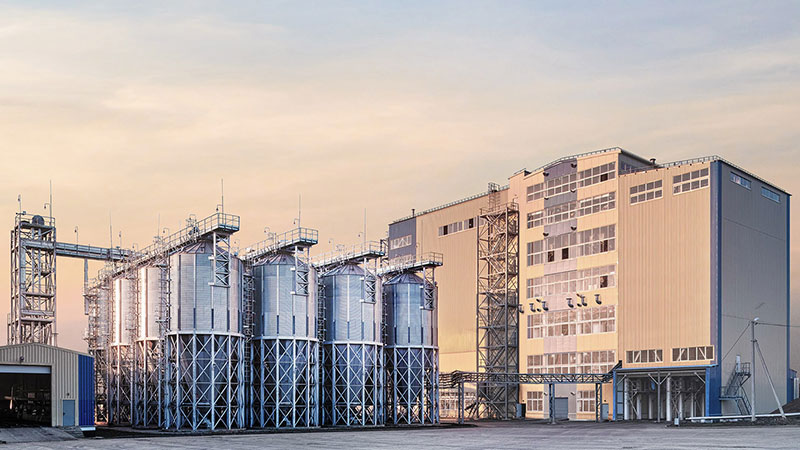
At RICHI, we go beyond project completion. With RICHI Servicee, we’re your dedicated partners in success. Count on us for expert guidance, minimal downtime, and optimized productivity. Choose RICHI for unmatched service and support.
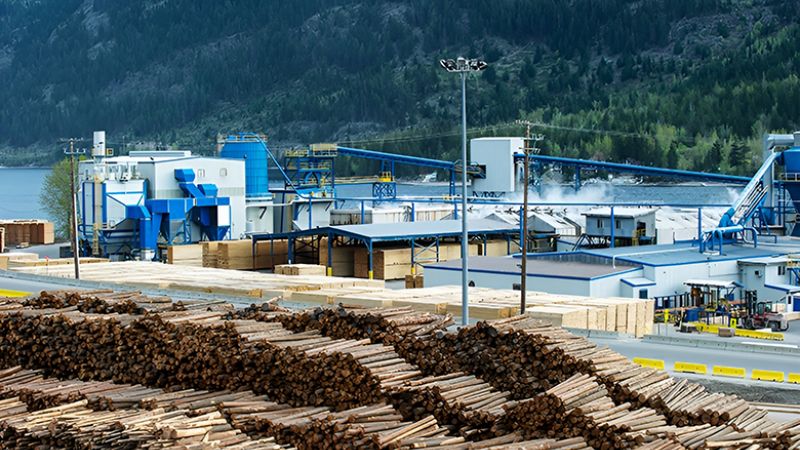


Meet global product demands and quality standards with industry-leading pellet plant design, engineering, equipment, and construction services for pellet processors.


Your Partner Beyond Project Completion
2000+ cases
RICHI is the leading designer, manufacturer and builder of pellet plants in the world, completing over 2000 projects in 140 countries across 6 continents.
Read More
Increase plant productivity, profitability, and safety by integrating high quality equipment into your pellet production line. Over the years, RICHI has become China's top pellet equipment manufacturer. At the same time, RICHI has established valuable partnerships with the world's leading component and raw material manufacturers to bring you the best there is in technology, automation, and efficiency in pelleting plant machinery.

For nearly 30 years, RICHI has been providing best-in-class pellet plant equipment and services to clients across a variety of industries, sizes, and needs. We pride ourselves on the knowledge and skill that each team member possesses – from our technical sales team to our process design engineers. You can count on RICHI Machinery to take your operation to the next level of innovation, quality, and success.
Need help with your pellet manufacturing plant project? Contact us today.
ANIMAL FEED
BIOMASS
WOOD
ORGANIC FERTILIZER
AQUA FEED
CAT LITTER
MUNICIPAL WASTE RECYCLING
SPECIAL PELLET PRODUCTION
RICHI Machinery continues to deliver world class pellet mill equipment, pellet plant engineering and project solutions that add value to our customers in the animal feed, wood waste, agriculture waste, organic fertilizer, cat litter and special pellet products industries. Throughout the years, we RICHI Machinery have built strong brand, becoming industry-leading pellet machine manufacturer. We value integrity, promise quality, and prioritize your success.
Learn MoreWith our expert team, we precisely implement your process engineering requirements in pellet mill and pelletizing plant systems. No matter which industry you’re in – we understand your needs and deliver solutions that meet the highest standards.
At RICHI, quality comes first. Our pellet making machine and related pellet line equipment undergo rigorous quality controls to ensure they meet the highest standards. Rely on products that are durable, safe, and efficient.
With decades of experience in pellet machine and pellet production line production, we have earned a reputation as a trusted partner in various industries. Our expertise allows us to cover a wide range of applications.
Not only do we offer premium pelleting equipment, but we are also experts at designing, building, installing, and maintaining facilities from the ground up. Our expertise is within pellt plant process design, discovering the most efficient, productive, and profitable way to handle your materials in an end-to-end cycle.
○ RICHI MACHINERY
Keeping in touch with us is an effective way to solve all your problems. If you have any needs or questions, please leave your contact information, then RICHI technical consultants will send design, quotation, videos to your mailbox. You can also contact us directly via WhatsApp: +86 13838389622
Copyright©2015-2026 by HENAN RICHI MACHINERY CO., LTD. All rights reserved.