
The economics of the grinding section changed for this Hungarian biogas operator every time another truckload of baled corn residue arrived. Renting a mobile grinder had solved the problem temporarily, but the plant could not control when the machine would be available, how uniformly the material would be processed, or what the grinding cost would look like during the busiest collection periods. Owning the size-reduction equipment became more attractive as corn straw developed into a regular part of the plant’s substrate supply.
The economics of the grinding section changed for this Hungarian biogas operator every time another truckload of baled corn residue arrived. Renting a mobile grinder had solved the problem temporarily, but the plant could not control when the machine would be available, how uniformly the material would be processed, or what the grinding cost would look like during the busiest collection periods. Owning the size-reduction equipment became more attractive as corn straw developed into a regular part of the plant’s substrate supply.
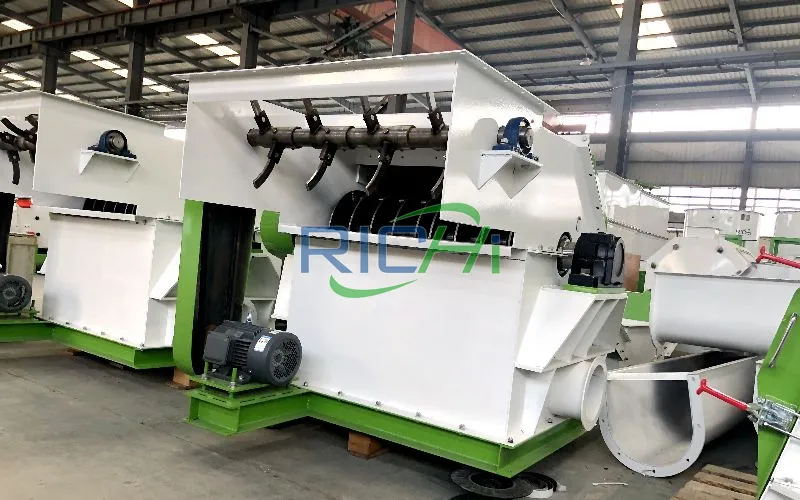
For this reason, the customer installed one SFSP66×100 corn straw hammer mill grinder in Hungary near Debrecen. The 110 kW machine works after the plant’s existing bale-opening and coarse-preparation equipment and uses interchangeable 10 mm, 12 mm and 15 mm screens, allowing the operator to adjust the processed straw according to moisture, stalk condition and the requirements of the anaerobic digestion system rather than purchasing an entire new biomass processing line.
Name:
straw hammer mill
Country:
Hungary
Date:
2026
Capacity:
Flexible
Model:
SFSP66×100
Main Motor Power:
110 kW
Project Screen Options:
10 mm, 12 mm and 15 mm
Raw Material:
corn straw
The biogas plant is located in eastern Hungary, where maize is an established field crop and agricultural residues can be collected from surrounding farms. The customer already processed maize silage, manure and other suitable organic materials, so introducing corn straw did not mean developing a completely new biogas business.
The challenge was physical preparation.
After grain harvesting, the collected corn straw contained stalks, leaves, husks and occasional cob fractions. Much of the material arrived in bales, which are convenient for collection and storage but unsuitable for direct feeding into a wet anaerobic digestion system.
Long stalks can entangle around feeding equipment, create irregular bulk density and make automated dosing more difficult. Very large fibrous pieces also provide a lower specific surface area for microbial attack than appropriately size-reduced material.
The plant had previously hired a mobile grinder when sufficient residue accumulated. That avoided purchasing equipment initially, but increasingly conflicted with the plant’s operating schedule. If the contractor was unavailable during a busy collection period, baled material waited in storage even though the digester required a steady feedstock supply.
The customer eventually decided that grinding had become a permanent process requirement rather than an occasional service.
This project did not require two grinders or a complete straw-processing factory.
The plant already owned a bale-opening system, material conveyors and the downstream equipment used to prepare and introduce substrate into the digestion process. The missing stage was controlled secondary size reduction after the bales had been opened and the long straw had been loosened.
One SFSP66×100 therefore matched the actual production arrangement.
The customer could operate the grinder during scheduled substrate-preparation periods instead of running it continuously. This is particularly useful for a biogas plant because annual feedstock volume does not necessarily translate into twenty-four-hour hammer-mill operation.
The machine can process material ahead of demand, allowing a prepared feedstock buffer to be maintained without oversizing the grinding section.
Whole compressed bales do not enter the SFSP66×100 directly.
The customer first opens the bales and loosens the material. Long, tangled bundles are reduced to a form that can be metered consistently onto the feeding conveyor. Ferrous contamination from baling wire or maintenance debris must also be removed before the straw reaches the high-speed grinding chamber.
This separation between bale opening and hammer milling is important. A hammer mill works most consistently when material reaches it at a reasonably controlled size and feed rate. Expecting the machine to tear apart densely compressed bales and perform precise secondary grinding at the same time would create unnecessary load fluctuations.
The principal material includes corn stalks, leaves and husks, with a smaller amount of cob residue depending on harvesting and collection conditions.
These fractions do not grind identically. Dry leaves break readily and can generate more fines, while thick stalk sections and cob pieces require considerably more impact energy. This natural variability is one reason actual capacity cannot be represented by one permanent tonnes-per-hour figure.
| Project Item | Configuration |
|---|---|
| Equipment | Corn straw hammer mill grinder |
| Model | SFSP66×100 |
| Quantity | 1 unit |
| Main Motor Power | 110 kW |
| Project Screen Options | 10 mm, 12 mm and 15 mm |
| Main Raw Material | Opened and pre-conditioned corn straw |
| Primary Application | Size reduction before anaerobic digestion |
| Installation Type | Standalone grinder integrated with existing biogas feedstock equipment |
| Export Port | Qingdao Port, China |
| European Arrival Port | Port of Koper, Slovenia |
The 110 kW configuration gives the customer sufficient power for fibrous agricultural residue while remaining compatible with the scale of the existing substrate-preparation system.
RICHI did not select the machine simply by matching the annual tonnage of the entire biogas plant. Manure and maize silage, for example, do not need to pass through this hammer mill. Only the portion of feedstock requiring this type of dry mechanical size reduction determines the actual grinder workload.
The customer initially considered 10 mm, 12 mm and 15 mm screens rather than ordering one screen and treating it as permanently correct.
The reason was practical. Screen opening affects both the discharged particle distribution and the resistance inside the grinding chamber.
A smaller opening generally keeps material in the chamber longer, producing a finer fraction but requiring more grinding work. A larger opening normally improves throughput but allows a coarser product to leave the machine.
During the initial production trials, the 12 mm configuration provided a useful working balance for the customer’s main corn-straw batches. That does not mean a 12 mm screen is universally optimal for every anaerobic digester.
Digesters differ in mixing system, substrate composition, solids content, hydraulic retention time and feeding equipment. A plant processing wet slurry in a continuously stirred reactor may have different physical-preparation requirements from another plant using a different digestion configuration.
Reducing corn straw size can help make fibrous biomass easier to meter, mix and expose to biological degradation. But the original assumption that all particles above 20 mm remain undigested and all particles below 5 mm cause digester foaming is too absolute.
Anaerobic digestion performance depends on considerably more than particle length.
Lignocellulosic structure, retention time, digester loading, inoculum condition, temperature, mixing intensity and the proportion of other substrates all influence degradation and methane production.
Mechanical grinding can increase available surface area and improve physical handling, but finer is not automatically better. Producing unnecessary fines requires additional electricity and can alter slurry behavior without guaranteeing a proportional increase in methane yield.
The Hungarian customer therefore chooses a grinding specification that supports feeding and digestion while avoiding unnecessary size-reduction energy.
The customer purchased the grinder to improve substrate preparation, not to buy a guaranteed percentage increase in methane output.
If gas production changes after grinding conditions are modified, the result has to be interpreted together with feedstock composition, volatile-solids loading, retention time, temperature and other operating variables.
For example, replacing part of the substrate mix with a different batch of maize silage can change gas yield even when corn-straw grinding remains unchanged.
The plant therefore assesses the grinder through measurable process indicators that belong directly to the grinding stage: feeding stability, particle distribution, hourly throughput, power load and ease of handling at the digester feed system.
This provides a much stronger engineering basis than attributing a fixed methane increase directly to one hammer mill.
Corn straw moisture changes during harvesting, storage and weather exposure.
Dry material breaks relatively easily but produces more dust. Wetter fibrous straw can become tougher and more difficult to fracture, and throughput may decline as screen passage becomes less efficient.
This is why the plant does not use one fixed capacity value for every batch.
The original project figures of 2.5 T/H, 3.0 T/H and 3.5 T/H for three different screens may be useful as test references if measured under defined material conditions, but they should not be presented as guaranteed outputs without stating moisture, initial chop size and straw composition.
For new projects, RICHI prefers to evaluate a representative raw-material sample or obtain detailed information about baling, storage and moisture before confirming expected capacity.
The SFSP66×100 straw crusher machine is positioned between bale preparation and substrate mixing.
The typical route is:
Baled Corn Straw → Bale Opening → Foreign-Material Removal → Controlled Feeding → Hammer Milling → Dust Separation → Prepared Straw Storage or Buffering → Mixing with Other Substrates → Digester Feeding
The ground straw is subsequently combined with other materials according to the plant’s digestion recipe. These can include maize silage, manure and suitable organic feedstocks.
RICHI does not prescribe a fixed 40% corn straw, 35% maize silage, 15% manure and 10% organic waste recipe because digester formulation must be based on dry matter, volatile solids, nutrient balance, loading rate and biological performance rather than simple wet-weight percentages.
Dry corn straw can generate considerable lightweight dust and fibrous fines during hammer milling.
The customer therefore treats aspiration and filtration as part of the grinder installation rather than relying only on the main machine.
A cyclone can separate a substantial portion of entrained material from the conveying air, while suitable downstream filtration handles finer dust according to the airflow and environmental requirements of the installation.
The original statement that the baghouse captures exactly 99% of dust was removed because filtration performance depends on the filter design, media, particle distribution and operating condition.
Good dust collection also reduces loss of usable biomass and helps prevent material from accumulating around motors, bearings and working areas.
Baled agricultural residues can contain wire and other ferrous contamination from collection and handling.
A metal-removal point before the hammer mill is therefore important.
High-speed grinding equipment should not be expected to accept pieces of baling wire simply because the machine is designed for fibrous biomass.
The customer includes magnetic separation and visual inspection in the preparation process. This protects hammers, screens and the rotor assembly and also reduces the possibility of metal entering the biogas feed system later.
Hammers and screens naturally wear when processing crop residues.
The rate depends on soil contamination, mineral content, incoming material size, screen opening and total tonnes processed. Field residues carrying more dust and soil can be considerably more abrasive than cleaner material.
The original claim that hammers should always be turned at 600 hours therefore does not make a reliable maintenance rule.
The Hungarian plant instead monitors hammer edges, screen condition, machine vibration and changes in grinding output. When a known feedstock requires more power or produces a noticeably different particle distribution under the same operating conditions, wear inspection becomes one of the first maintenance checks.
The customer also keeps critical wear components in stock because the grinder has become part of the regular substrate-preparation process.
The strongest business case for this project was operational independence.
With rented grinding equipment, the plant had to coordinate substrate preparation around contractor availability. Large volumes might be processed during a short rental period even if the digester did not immediately need that much material.
After purchasing the corn straw hammer mill grinder in Hungary, the customer could process residue according to actual inventory and feedstock demand.
Grinding can be scheduled during suitable shifts, and maintenance can be planned around substrate reserves. The plant also gains direct information about electricity use, wear-part consumption and actual processing cost instead of paying an external daily rental charge whose economics change with utilization.
The decision between owning and renting therefore depends on annual tonnes requiring grinding, contractor availability, labor, electricity and equipment utilization. It should not be reduced to an unsupported fixed payback period.
Hungary is landlocked, so the machine was shipped from Qingdao Port in China to the Port of Koper in Slovenia, an established Adriatic gateway serving Central European hinterland markets.
Before dispatch, RICHI supplied equipment dimensions, foundation requirements, motor data and installation information so the plant could prepare the grinding area and electrical connection.
The final routing is always confirmed when an order ships because vessel schedules and inland logistics can change. For this project, Koper provided a practical European arrival point for equipment ultimately destined for eastern Hungary.
The most useful commissioning result was not one magic screen size.
Operators learned how strongly incoming straw condition affected the machine. Dry, well-opened stalks could be fed much more consistently than tangled material containing compacted sections from damaged bales.
They also found that making the product finer than required came with a real capacity and energy penalty.
For the normal corn-straw stream, the 12 mm screen became the preferred starting configuration. The 10 mm screen remains available when finer preparation is justified, while the 15 mm screen gives the plant another option when throughput is more important and the downstream system can accept a coarser material.
This flexibility is more useful than presenting one screen as universally correct for biogas plants.
A hammer mill is most relevant when a plant has a recurring supply of relatively dry fibrous residues that require controlled secondary size reduction.
If the feedstock arrives as whole bales, a separate bale-opening or coarse-preparation stage should be considered. If the substrate is already wet and chopped, another handling or pretreatment system may be more appropriate than dry hammer milling.
Capacity should also be calculated from the tonnes of corn straw that actually require grinding, not from the total annual mass of manure, silage and other feedstocks processed by the digester.
For the Debrecen-area customer, these conditions justified one SFSP66×100 rather than a larger or duplicated grinding system.
The corn straw hammer mill grinder in Hungary project shows how a biogas plant can add its own size-reduction capacity without rebuilding the rest of the substrate-processing system.
The customer already had bale handling, conveying and anaerobic digestion infrastructure. The investment addressed one recurring operational problem: transforming opened, irregular corn straw into a more manageable and repeatable feedstock before it entered the digestion process.
For another biogas operator, RICHI would first need to know how many tonnes of straw require grinding per hour and per day, whether the material is baled or loose, approximate moisture, maximum stalk length after bale opening, desired particle range and the type of digester feed system already installed.
Information about existing bale breakers, conveyors, metal separators, dust-control equipment and available electrical power is also useful.
With these details, RICHI Machinery can determine whether the SFSP66×100 used in this corn straw hammer mill grinder in Hungary project is appropriate, what screen sizes should be supplied and whether the proposed grinder capacity matches the real volume of fibrous residue entering the plant.
The objective is not to grind corn straw as finely as possible. It is to create a stable, controllable substrate-preparation step that reduces dependence on rented equipment, works with the existing digestion system and allows the customer to process agricultural residues according to the plant’s own operating schedule.
Having the right mix of reliable, high-quality pellet machine and pelletizing systems and expert support is essential to your success. Watch how our end-to-end feed pellet plant solutions have helped our customers optimize their performance.
Our customized and future-proofed turnkey pellet plant solutions is designed with you at the core. From vision to reality and beyond, our team stays connected with yours. Giving you peace-of-mind with an expert at your side.
At RICHI, we go beyond project completion. With RICHI Servicee, we’re your dedicated partners in success. Count on us for expert guidance, minimal downtime, and optimized productivity. Choose RICHI for unmatched service and support.


Meet global product demands and quality standards with industry-leading pellet plant design, engineering, equipment, and construction services for pellet processors.


Your Partner Beyond Project Completion
2000+ cases
RICHI is the leading designer, manufacturer and builder of pellet plants in the world, completing over 2000 projects in 140 countries across 6 continents.
Read More
Increase plant productivity, profitability, and safety by integrating high quality equipment into your pellet production line. Over the years, RICHI has become China's top pellet equipment manufacturer. At the same time, RICHI has established valuable partnerships with the world's leading component and raw material manufacturers to bring you the best there is in technology, automation, and efficiency in pelleting plant machinery.

For nearly 30 years, RICHI has been providing best-in-class pellet plant equipment and services to clients across a variety of industries, sizes, and needs. We pride ourselves on the knowledge and skill that each team member possesses – from our technical sales team to our process design engineers. You can count on RICHI Machinery to take your operation to the next level of innovation, quality, and success.
Need help with your pellet manufacturing plant project? Contact us today.
ANIMAL FEED
BIOMASS
WOOD
ORGANIC FERTILIZER
AQUA FEED
CAT LITTER
MUNICIPAL WASTE RECYCLING
SPECIAL PELLET PRODUCTION
RICHI Machinery continues to deliver world class pellet mill equipment, pellet plant engineering and project solutions that add value to our customers in the animal feed, wood waste, agriculture waste, organic fertilizer, cat litter and special pellet products industries. Throughout the years, we RICHI Machinery have built strong brand, becoming industry-leading pellet machine manufacturer. We value integrity, promise quality, and prioritize your success.
Learn MoreWith our expert team, we precisely implement your process engineering requirements in pellet mill and pelletizing plant systems. No matter which industry you’re in – we understand your needs and deliver solutions that meet the highest standards.
At RICHI, quality comes first. Our pellet making machine and related pellet line equipment undergo rigorous quality controls to ensure they meet the highest standards. Rely on products that are durable, safe, and efficient.
With decades of experience in pellet machine and pellet production line production, we have earned a reputation as a trusted partner in various industries. Our expertise allows us to cover a wide range of applications.
Not only do we offer premium pelleting equipment, but we are also experts at designing, building, installing, and maintaining facilities from the ground up. Our expertise is within pellt plant process design, discovering the most efficient, productive, and profitable way to handle your materials in an end-to-end cycle.
○ RICHI MACHINERY
Keeping in touch with us is an effective way to solve all your problems. If you have any needs or questions, please leave your contact information, then RICHI technical consultants will send design, quotation, videos to your mailbox. You can also contact us directly via WhatsApp: +86 13838389622
Copyright©2015-2026 by HENAN RICHI MACHINERY CO., LTD. All rights reserved.