
The Corn Straw Bale Chopper in Mexico was commissioned for a medium-sized agricultural waste processing business located in the state of Jalisco, Mexico's second-largest corn-producing region.
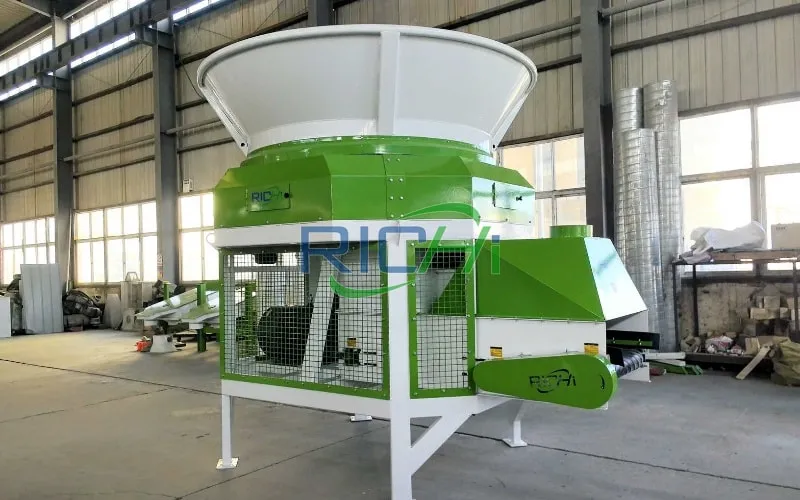
The Corn Straw Bale Chopper in Mexico was commissioned for a medium-sized agricultural waste processing business located in the state of Jalisco, Mexico's second-largest corn-producing region.
Mexico harvests approximately 27 million tons of corn annually, generating an estimated 18 million tons of corn straw (stover) left in fields after grain harvest. The client, a former livestock feedlot operator who transitioned into agricultural byproduct management, had been collecting corn straw bales from surrounding farms but struggled to process them efficiently.
His existing equipment consisted of a small tractor-mounted hammer mill that constantly jammed when fed whole bales, requiring workers to manually pull apart each bale before feeding. This labor-intensive process limited his throughput to only 3 tons per day and created significant dust problems.
After watching a RICHI equipment demonstration at the Expo Agroalimentaria in Guadalajara, the client decided to purchase a single YPPK-2600 bale chopper as a standalone unit to replace his outdated system. This Corn Straw Bale Chopper in Mexico now processes 6 to 8 tons of compacted corn straw bales per hour, reducing them to uniform 20-30mm particles, transforming an inefficient manual operation into a streamlined, one-pass processing system.
Name:
Corn Straw Bale Crusher
Country:
Mexico
Date:
2025
Capacity:
6-8 tons per hour
Model:
YPPK-2600
Main Motor Power:
55 kW
Raw Materials:
Corn straw (stover) bale
Final product size:
20-30mm
This particular Corn Straw Bale Chopper in Mexico was selected after the client evaluated three competing bale processors from North American and European manufacturers.
His raw material consists of round corn straw bales measuring 1.8 meters in diameter and 1.5 meters in width, each weighing approximately 500-600 kg at 12-15% moisture content. The bales are produced by five local corn farmers who use standard round balers with net wrap binding.
The client had been stockpiling these bales for over a year, accumulating nearly 2,000 tons, but could not process them fast enough to supply a growing demand from a mushroom substrate producer and a biogas plant.
He purchased only the bale chopper as a single machine because he already owned a conveyor belt system for moving material and a storage silo for the chopped product. The missing piece was a robust, high-capacity bale breaking and chopping unit that could handle whole round bales without pre-shredding or manual intervention.
The client deliberately avoided buying a full processing line because he wanted to first solve the bottleneck at the intake stage, then later add a hammer mill for finer grinding if the market demanded particle sizes below 10mm.
Client Identity and Operational Context
The client is a former feedlot operator from Tepatitlán, Jalisco, who spent fifteen years raising beef cattle. During those years, he purchased corn straw bales as low-quality roughage for his animals. He noticed that the straw, which cost him 400 pesos per bale delivered, was being burned by many farmers simply to clear their fields for the next planting season. This seemed wasteful to him.
In 2022, he sold his feedlot operation and invested in a used hydraulic bale shredder, but that machine proved unreliable, breaking down every two to three weeks due to the heavy workload. He then switched to a PTO-driven bale processor powered by his tractor, but it required constant supervision and consumed large amounts of diesel. After attending the Expo Agroalimentaria in Guadalajara in late 2023, he saw the RICHI YPPK-2600 in operation and immediately recognized the difference in build quality and throughput capacity.
Why a Single Chopper Instead of a Complete Line?
The client specifically chose to purchase only the bale chopper as a standalone machine for four reasons. First, he already owned a used conveyor system salvaged from a closing feed mill, which could be adapted to feed material into the chopper. Second, his primary customer – a mushroom farm in the nearby town of Zapopan – only required 20-30mm particle size, which the chopper produces directly without further grinding.
Third, his available workshop space was limited; a full processing line including a hammer mill, cyclone, and bagging station would not fit. Fourth, and most importantly, he wanted to test the market demand for coarsely chopped corn straw before investing in finer grinding and pelletizing equipment. If the mushroom farm and the biogas plant prove to be reliable long-term buyers, he plans to add a RICHI hammer mill to produce 5-8mm particles for animal feed applications, and possibly a RICHI pellet mill for fuel pellet production.
Corn straw (stover) in Jalisco is typically harvested in October and November after the grain has been combined. Farmers use either New Holland or John Deere round balers to form bales that average 1.8 meters in diameter and 1.5 meters in width.
The client collects bales from within a 50-kilometer radius of his yard, paying farmers 200 pesos per bale delivered to his site. He stores the bales outdoors on concrete pads covered with tarps to prevent moisture absorption from the frequent Jalisco rains.
Bale specifications:
The client estimates he can source 5,000 to 7,000 tons of corn straw bales annually from his existing network of farmers. This is more than enough to justify the YPPK-2600 investment.
After analyzing the client's bale dimensions, throughput requirements, and the fibrous nature of corn straw, RICHI recommended the YPPK-2600 model. Below are the full specifications:
This model was selected over the larger YPPK-2800 because the client's bales do not exceed 1800mm in diameter. The YPPK-2800 is designed for bales up to 2050mm, which would be oversized and more expensive without providing additional benefit. The 55 kW motor is sufficient for corn straw at 15% moisture; if the client later processes higher-moisture material (above 25%) or denser bales like alfalfa, the motor has enough reserve capacity to handle occasional overloads.
Optional equipment not purchased yet but planned:
Mexico has been actively promoting agricultural waste utilization through its National Strategy for Circular Economy, launched in 2022. The Corn Straw Bale Chopper in Mexico plays a direct role in this national effort by enabling the client to supply processed corn straw to three distinct markets:
Mushroom cultivation substrate: A commercial mushroom farm in Zapopan produces 15 tons of oyster mushrooms weekly. Their substrate formula is 70% corn straw (chopped to 25mm), 20% wheat bran, and 10% gypsum. Before the chopper, the farm had to import pre-chopped straw from the United States at 1,200 pesos per 500kg bale equivalent. The client now supplies locally processed corn straw at 900 pesos per 500kg, saving the farm 25% on raw material costs while providing a steady revenue stream for himself.
Biogas plant feedstock: A small-scale biogas facility in Lagos de Moreno, operated by a dairy cooperative, accepts corn straw as a co-digestion substrate along with cow manure. The plant requires particle sizes under 40mm for optimal bacterial activity. The client supplies 30 tons of chopped corn straw monthly to this facility, generating 18,000 pesos in revenue per month.
Animal bedding (equine and poultry): Several horse stables in the Guadalajara suburbs use chopped corn straw as bedding for stables. The 20-30mm particle size is absorbent yet easy to muck out. This market is seasonal but provides an outlet for any material that does not meet the mushroom farm's strict specifications.
The client notes that the revenue from the mushroom farm alone covers the monthly financing payment for the YPPK-2600. The biogas and bedding revenues are pure profit after operating costs.
The client chose RICHI over cheaper bale processors from domestic Mexican manufacturers and imported units from the United States for several specific technical reasons.
Heavy-Duty Damping Plate for Aggressive Material Intake
One of the most common problems with bale choppers is that the rotor simply bats the bale away instead of pulling it into the cutting chamber. The YPPK-2600 includes a damping plate (also called a stripper plate or anvil) mounted inside the crushing zone. This plate creates a pinch point that grabs the bale material and forces it toward the rotating hammers.
For corn straw, which can be slippery and springy, this feature increases feeding efficiency by approximately 40% compared to choppers without a damping plate. The client confirmed that his machine pulls bales in aggressively without the operator needing to push or prod the material.
Thickened Drive Chain for Extended Service Life
Standard bale choppers use #120 or #140 chain that stretches after 500-800 hours of operation, requiring frequent tensioning and eventual replacement. The RICHI YPPK-2600 uses a heavy-duty #160 chain with a 2.5-inch pitch, which is typically found on much larger industrial shredders. The chain links are heat-treated and include hardened pins. The client's machine has operated for 650 hours with only one tensioning adjustment. He expects the chain to last at least 2,500 hours before replacement is needed.
Heavy-Duty Welded Steel Housing
The machine body is constructed from 12mm thick steel plate on the lower half (where wear is highest) and 8mm plate on the upper half. Many competitor machines use 6mm or 8mm throughout, which leads to cracking and deformation when processing dense corn straw bales at 6-8 tons per hour. The client inspected the housing after 500 hours and found no cracks, dents, or deformation. The total machine weight of 2.2 tons reflects this robust construction.
65Mn Manganese Steel Hammers with Carbide Hardfacing
The hammers are the most critical wear component on any bale chopper. RICHI manufactures hammers from 65Mn manganese steel, which work-hardens under impact. After the hammers are shaped and heat-treated, the leading edges receive a tungsten carbide hardfacing deposit using a specialized welding process. This hardfacing layer is 3-4mm thick and provides extremely high abrasion resistance. The client checked his hammers after 400 hours of operation; the hardfacing had worn only 1.5mm, and the underlying steel showed no significant wear. He expects the hammer set to last 1,200-1,500 hours before requiring rotation or replacement. For comparison, the client's previous bale processor required new hammers every 400 hours.
High Rotor Inertia for Consistent Throughput
The YPPK-2600 rotor weighs approximately 600 kg including the hammer holders and shaft. This high inertia means that when a particularly dense or wet bale enters the chamber, the rotor does not slow down significantly. The client measured rotor speed drop under maximum load at only 8% (from 1480 rpm to 1360 rpm), compared to 20-25% drop on his previous machine. This consistent speed translates directly into consistent particle size and throughput.
The RICHI YPPK-2600 bale chopper was manufactured at our Qingdao, China, factory and shipped in three major components: the main machine body (with rotor pre-installed), the drive motor and base frame, and a box of hammers, pins, and spare parts. The machine is not fully assembled for shipping because the overall dimensions would exceed standard container limits. The main body (3800mm x 2600mm x 2650mm) required a 40-foot open-top container. The motor and spares were packed into a standard 20-foot container. Total shipping weight was 2.8 metric tons including packaging.
The cargo departed Qingdao Port and arrived at Manzanillo Port on Mexico's Pacific coast after 22 days of sea freight. Manzanillo is Mexico's busiest container port and the primary gateway for agricultural machinery entering the country from Asia. It is located in the state of Colima, approximately 400 kilometers southwest of the client's facility in Jalisco.
From Manzanillo, the equipment traveled by flatbed truck to Tepatitlán, Jalisco, a journey of approximately eight hours on highways 110 and 80. RICHI provided full customs documentation including the commercial invoice, packing list, bill of lading, and a certificate of origin to qualify for Mexico's preferential tariff under the Comprehensive and Progressive Agreement for Trans-Pacific Partnership (CPTPP), reducing the import duty from 15% to 5%.
The client provided detailed feedback during a routine check-in call with RICHI's after-sales team. His comments have been summarized and anonymized below:
"I bought this corn straw bale chopper in August of last year. We started operating in September, right at the beginning of the corn harvest season. The first month was just learning how to feed bales efficiently. At first, we were dropping bales from the loader bucket straight down onto the rotor. That worked, but sometimes the bale would bounce off. Then we read the manual again and realized we should tip the bale in at a shallow angle so the damping plate could grab it first. Now we feed 8-10 bales per hour without stopping.
The machine is loud, but no louder than any other industrial chopper. We built a small shelter around it to contain the noise and dust. The dust control system I rigged up with garden sprinklers works fine, but I will probably buy the official RICHI dust hood next year.
The only problem we had was a broken hammer pin after 300 hours. One of the pins snapped because we hit a piece of steel that was wrapped inside a bale – probably a broken baler needle or something from the field. RICHI sent four replacement pins by air freight within a week, and we were back in operation the same day because I had bought the spare parts kit. That kit also included extra hammers and belt guards. Good thing I bought it.
The particle size is very consistent. We test every hour by taking a handful and passing it through a sieve set. At 25mm setting, about 85% of the material falls between 20mm and 30mm. The mushroom farm is happy because they don't have to re-grind anything. They used to reject about 15% of my material from the old chopper because it had long strands that tangled in their mixing equipment. Now they accept everything.
If any other farmer or processor in Mexico asks me about this equipment, I tell them to buy the RICHI YPPK-2600 but also buy the optional chain feeder. Manual feeding with a loader works, but a feeder would allow one worker to operate the whole system instead of two. I will buy the feeder next year when I expand."
The client also reported that his monthly revenue from chopped corn straw has reached 45,000 pesos, which covers the machine payment, electricity, and labor, with 15,000 pesos remaining as profit. He expects to fully recover his investment within 14 months.
The RICHI YPPK series bale crusher machine is not limited to corn straw. Mexico produces a wide variety of baled agricultural residues that require size reduction. The client has already tested or considered the following applications:
This versatility means the client is not dependent on a single crop or season. When corn straw bales become scarce between March and June, he can process wheat straw or sorghum stover to keep his machine operating year-round.
Before the client signed the purchase agreement for his Corn Straw Bale Chopper in Mexico, RICHI provided several services that demonstrated our expertise and built his confidence:
After installation, RICHI has continued to support the client through a dedicated WhatsApp group that includes our after-sales engineers and the client's two shift operators. The average response time for technical questions has been under six hours, considering the time difference between Mexico and China.
The market for processed corn straw and other cereal straws in Mexico is expanding rapidly, driven by three factors:
The client plans to expand his operation by adding a second YPPK-2600 or possibly a larger YPPK-2800 within the next two years. He has identified three additional mushroom farms and two biogas projects within a 150-kilometer radius that would accept his processed corn straw.
He is also exploring the pellet market: by adding a RICHI hammer mill to reduce particles to 5mm, and a RICHI pellet mill, he could produce biomass fuel pellets for the cement industry and the textile factories in Guadalajara.
Beyond corn straw bales, the RICHI YPPK series bale chopper is finding applications in other sectors of Mexican agriculture:
RICHI has now supplied bale choppers to customers in eleven Mexican states, with installations ranging from small-scale YPPK-2600 units to large YPPK-2800 machines processing alfalfa bales for export to the United States.
The Corn Straw Bale Chopper in Mexico – specifically the RICHI YPPK-2600 – has transformed the client's business from a struggling manual processing operation into an efficient, profitable agricultural waste valorization enterprise.
By purchasing a single bale chopper rather than a full processing line, the client minimized his initial capital risk while gaining the ability to serve three distinct markets: mushroom substrate, biogas feedstock, and animal bedding. The machine's robust construction, heavy-duty hammers with carbide hardfacing, and aggressive damping plate make it uniquely suited for the dense, fibrous corn straw bales that are abundant in Jalisco and throughout Mexico.
If you operate a farm, a feedlot, a mushroom production facility, or any business that generates or requires processed baled agricultural residues anywhere in Mexico or Latin America, contact RICHI Machinery. We can arrange a video demonstration with your local material, provide free site layout consultation, and deliver a machine that will process your bales reliably for years.
You do not need a complete processing line to start. A single RICHI bale chopper can be the foundation of a profitable agricultural byproduct business. We have delivered equipment to over 60 countries, and every machine comes with our commitment to practical, hands-on support that helps you succeed from day one.
Having the right mix of reliable, high-quality pellet machine and pelletizing systems and expert support is essential to your success. Watch how our end-to-end feed pellet plant solutions have helped our customers optimize their performance.
Our customized and future-proofed turnkey pellet plant solutions is designed with you at the core. From vision to reality and beyond, our team stays connected with yours. Giving you peace-of-mind with an expert at your side.
At RICHI, we go beyond project completion. With RICHI Servicee, we’re your dedicated partners in success. Count on us for expert guidance, minimal downtime, and optimized productivity. Choose RICHI for unmatched service and support.


Meet global product demands and quality standards with industry-leading pellet plant design, engineering, equipment, and construction services for pellet processors.


Your Partner Beyond Project Completion
2000+ cases
RICHI is the leading designer, manufacturer and builder of pellet plants in the world, completing over 2000 projects in 140 countries across 6 continents.
Read More
Increase plant productivity, profitability, and safety by integrating high quality equipment into your pellet production line. Over the years, RICHI has become China's top pellet equipment manufacturer. At the same time, RICHI has established valuable partnerships with the world's leading component and raw material manufacturers to bring you the best there is in technology, automation, and efficiency in pelleting plant machinery.

For nearly 30 years, RICHI has been providing best-in-class pellet plant equipment and services to clients across a variety of industries, sizes, and needs. We pride ourselves on the knowledge and skill that each team member possesses – from our technical sales team to our process design engineers. You can count on RICHI Machinery to take your operation to the next level of innovation, quality, and success.
Need help with your pellet manufacturing plant project? Contact us today.
ANIMAL FEED
BIOMASS
WOOD
ORGANIC FERTILIZER
AQUA FEED
CAT LITTER
MUNICIPAL WASTE RECYCLING
SPECIAL PELLET PRODUCTION
RICHI Machinery continues to deliver world class pellet mill equipment, pellet plant engineering and project solutions that add value to our customers in the animal feed, wood waste, agriculture waste, organic fertilizer, cat litter and special pellet products industries. Throughout the years, we RICHI Machinery have built strong brand, becoming industry-leading pellet machine manufacturer. We value integrity, promise quality, and prioritize your success.
Learn MoreWith our expert team, we precisely implement your process engineering requirements in pellet mill and pelletizing plant systems. No matter which industry you’re in – we understand your needs and deliver solutions that meet the highest standards.
At RICHI, quality comes first. Our pellet making machine and related pellet line equipment undergo rigorous quality controls to ensure they meet the highest standards. Rely on products that are durable, safe, and efficient.
With decades of experience in pellet machine and pellet production line production, we have earned a reputation as a trusted partner in various industries. Our expertise allows us to cover a wide range of applications.
Not only do we offer premium pelleting equipment, but we are also experts at designing, building, installing, and maintaining facilities from the ground up. Our expertise is within pellt plant process design, discovering the most efficient, productive, and profitable way to handle your materials in an end-to-end cycle.
○ RICHI MACHINERY
Keeping in touch with us is an effective way to solve all your problems. If you have any needs or questions, please leave your contact information, then RICHI technical consultants will send design, quotation, videos to your mailbox. You can also contact us directly via WhatsApp: +86 13838389622
Copyright©2015-2026 by HENAN RICHI MACHINERY CO., LTD. All rights reserved.