
For a corn-growing cooperative in Vinnytsia Oblast, the value of the harvest did not end when the grain left the field. Every season also produced large volumes of corn stalks, husks, leaves, and cobs. Some residues could remain on the land, but the recoverable fraction collected around harvesting and grain-handling operations represented a potential biomass fuel source. The cooperative therefore introduced a RICHI MZLH420 corn biomass pellet machine in Ukraine to turn prepared corn residues into dense 8 mm fuel pellets.
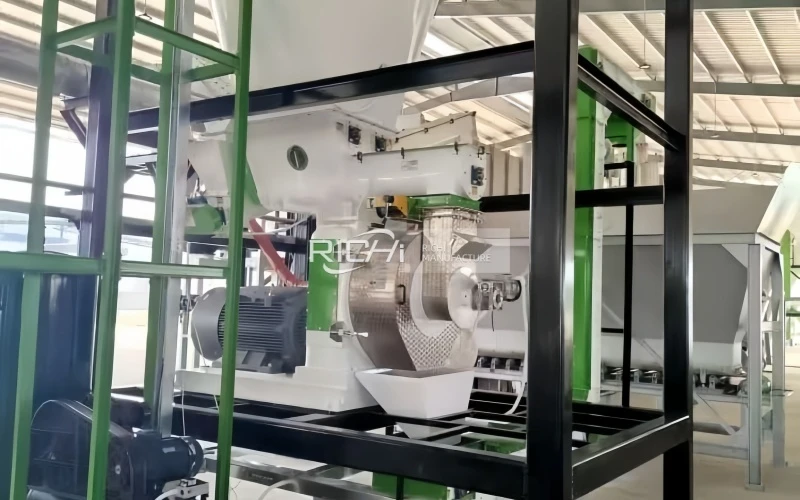
For a corn-growing cooperative in Vinnytsia Oblast, the value of the harvest did not end when the grain left the field. Every season also produced large volumes of corn stalks, husks, leaves, and cobs.
Some residues could remain on the land, but the recoverable fraction collected around harvesting and grain-handling operations represented a potential biomass fuel source. The cooperative therefore introduced a RICHI MZLH420 corn biomass pellet machine in Ukraine to turn prepared corn residues into dense 8 mm fuel pellets.
This was a single-machine purchase rather than a complete new pellet plant. The cooperative already had equipment for handling, size reduction, and moisture adjustment, so the MZLH420 was integrated as the pelletizing section. With a rated output of approximately 1.0–1.2 t/h on suitable biomass feedstock, the machine gave the customer a practical way to begin commercial pellet production without replacing useful upstream equipment.
Name:
Corn Waste Pelletizer
Country:
Ukraine
Date:
2025
Capacity:
1.0–1.2 T/H
Model:
MZLH420
Main Motor Power:
90 kW
Raw Materials:
Corn Stalks, Husks And Cobs
Pellet diameter:
8 mm
Vinnytsia is an important agricultural region where corn is grown alongside wheat, sunflower, rapeseed, and other crops. For the customer, this meant that biomass availability was closely connected to an existing farming business rather than dependent on purchasing all feedstock from the open market.
The project had a clear purpose: produce biomass fuel. The cooperative wanted to use part of the pellets in its own solid-fuel heating systems and sell the remaining production to nearby users equipped with boilers capable of handling agricultural biomass pellets.
Starting with one pellet mill also reduced the risk of immediately committing to a large dedicated factory. During the first production stage, the customer could establish realistic electricity consumption, die wear, pellet durability, feedstock preparation costs, and seasonal raw-material availability before deciding whether additional pelletizing capacity was justified.
The principal feedstock is corn residue recovered from the cooperative's own agricultural operations. Stalks and leaves provide the largest fibrous fraction, while husks and crushed cobs are incorporated according to seasonal availability.
These materials cannot simply be collected and fed directly into the MZLH420. Corn stalks are long and fibrous, cobs are considerably harder, and freshly collected residues may contain too much moisture for stable pellet formation. Soil, stones, wire, and other foreign material also need to be controlled before fine grinding.
For this project, baled or loose stalk material is opened and reduced in size before entering the fine-grinding stage. Corn cobs are crushed separately when necessary. The material is then ground to approximately 3–5 mm, with the actual distribution adjusted according to the condition of the stalk-and-cob mixture.
Moisture management is equally important. Instead of treating one moisture figure as suitable for every batch, operators adjust the prepared biomass according to its actual composition. A practical target before pelletizing is generally around 12–15%, with trial adjustments made when the proportion of cobs, leaves, and stalk fiber changes.
The cooperative selected one MZLH420 because its capacity corresponded better to the amount of prepared biomass that could be supplied continuously by the existing system. Installing a much larger biomass pellet mill would have provided little benefit if grinding, drying, or feeding could not maintain the required material flow.
The arch-breaking and forced-feeding arrangement is particularly useful with low-density agricultural fibers. Ground corn stalk does not flow like grain meal; without controlled feeding, fibrous material can bridge above the pelletizing chamber and cause unstable motor load. Maintaining an even feed rate helps the pellet mill operate closer to its intended load while reducing unnecessary fluctuations in pellet quality.
The existing preparation section was retained rather than replaced. Collected residues first pass through primary size reduction. After moisture adjustment, a hammer mill produces material sufficiently fine for ring-die pelletizing. A magnetic separation point ahead of the fine grinder and pellet mill helps protect the downstream equipment from metallic contaminants that can enter with baled agricultural residues.
The prepared powder is then transferred to a buffer section before entering the MZLH420. This intermediate storage is important because harvesting, shredding, drying, and grinding do not always deliver material at exactly the same instantaneous rate. A controlled buffer helps prevent the pellet mill from alternating between starvation and overfeeding.
Inside the pellet mill, the rotating rollers force the prepared corn biomass through the 8 mm die holes. Friction and compression raise the material temperature and consolidate the loose fibers into cylindrical pellets. The pellets leaving the die are still warm and comparatively soft, so they must be cooled before screening, storage, or bagging.
The cooperative standardized this project around 8 mm pellets because the product is intended for fuel rather than animal feed or another application. The larger diameter gives the agricultural-fiber pellet sufficient mechanical strength while remaining suitable for many industrial and farm-scale biomass combustion systems.
Pellet quality is controlled by more than diameter. Operators also monitor fines, bulk density, mechanical durability, moisture, and ash behavior. Corn residues generally contain more mineral matter than clean debarked wood, and contamination with soil during collection can increase ash further. For that reason, the customer does not market the product as a direct equivalent to premium wood pellets.
Instead, the 8 mm corn pellets are positioned for combustion systems whose fuel specifications permit agricultural biomass. This distinction is important because boiler design, ash-removal capability, combustion temperature, and fuel standards all influence whether a particular corn-residue pellet is suitable for an end user.
The MZLH420 was not purchased as an isolated machine expected to perform drying, crushing, pelletizing, and cooling by itself. Its role is specific: pellet formation. The cooperative retained its available material-handling and preparation equipment and adapted the interfaces around the new pelletizer.
This made the investment more practical. It also allowed the customer to concentrate engineering attention on the stages that directly affect pellet-mill performance: stable particle size, controlled moisture, continuous feeding, dust management, and cooling after pelletization.
During commissioning, the operators did not immediately push the machine to maximum feed rate. The initial batches were used to establish a stable relationship between feed moisture, feeder speed, die resistance, motor load, and pellet appearance. Once these conditions were repeatable, throughput was increased progressively toward the expected 1.0–1.2 t/h range.
One of the practical challenges in this project is that agricultural residue is not a standardized industrial raw material. A batch containing a high proportion of dry stalk fiber behaves differently from one containing more cob particles. Residues collected immediately after harvest may also behave differently from material stored under cover for several months.
The cooperative therefore treats 1.0–1.2 t/h as an operating range under properly prepared conditions rather than assuming that every batch will automatically achieve exactly the same output. When moisture increases, particle size becomes coarser, or the proportion of hard cob material changes, operators adjust feeding and preparation accordingly.
This approach has been more useful than attempting to compensate for poor feedstock preparation by simply increasing pressure at the pellet mill. Stable raw material generally produces more stable amperage, better pellet formation, and more predictable wear of the ring die and roller assemblies.
The project has one defined finished-product direction: biomass fuel. Part of the production is retained by the cooperative for suitable farm and agricultural heating applications. Surplus pellets can be supplied to nearby commercial or rural users operating biomass boilers designed for agricultural pellets.
Pelletizing makes the recovered corn residues substantially easier to store, meter, transport, and feed automatically than loose stalk material. It also creates a standardized physical form that is easier for the cooperative to sell by weight and handle through conventional bulk or bagged-fuel logistics.
The customer nevertheless keeps fuel quality separate from the pellet mill's nominal capacity. If a buyer requires a particular ash content, moisture level, mechanical durability, or other fuel specification, representative finished pellets must be tested. Machine selection alone cannot guarantee compliance with every biomass fuel standard because the characteristics of the original corn residue remain important.
Once the feeding parameters had been established, the customer found that consistency upstream had the greatest influence on daily operation. Uniformly ground stalk-and-cob material entered the die smoothly, while poorly shredded fibrous pieces produced noticeable changes in load. The operators therefore paid more attention to screen condition in the hammer mill and to the actual moisture of material entering the pelletizer.
Wear management was another consideration. Agricultural residues can carry dust and mineral contaminants from the field, so the customer established routine inspection of the ring die, rollers, feeder, and magnetic separation points. Rather than waiting for pellet quality to deteriorate significantly, maintenance personnel inspect wear surfaces at scheduled intervals and keep normal consumable parts available.
The single-machine arrangement also makes production planning straightforward. When sufficient prepared material has accumulated, the pelletizing section can operate in concentrated production shifts. During periods when residue supply is lower, the cooperative does not need to keep an oversized pelletizing system running below an efficient load.
“Our main concern was whether corn stalk and cob material would feed consistently enough for stable pellet production. After we standardized grinding and moisture control, the MZLH420 became much easier to operate. The 8 mm pellets are dense enough for handling and storage, and we can now use a residue that previously had much less value to the farm. Starting with one pellet mill also gave us time to understand the real production cost before considering any expansion.”
The MZLH420 biomass pellet machine was prepared for export from Qingdao, China. Because Ukraine's international freight conditions and available transport corridors can change, the final delivery route needs to be selected according to the shipping environment at the time of dispatch rather than assuming that a particular Ukrainian Black Sea port will always be available for machinery imports.
For this project, the logistics plan therefore considered a European seaport and onward road transport into Ukraine as the practical routing structure. RICHI supplied the machine with the required packing documents, technical documentation, electrical information, and installation guidance so the customer's team could prepare the foundation and connections before arrival.
The commissioning work focused on the customer's actual material rather than applying settings developed for sawdust. RICHI Machinery provided guidance on grinding size, moisture adjustment, feeder operation, ring-die selection, startup procedures, lubrication, and the relationship between feed rate and main-motor load.
Operators were also trained not to evaluate the process only by tons per hour. Excessive pursuit of instantaneous output can increase fines, raise power consumption, accelerate die wear, or destabilize pellet formation. For the cooperative, maintaining a repeatable production window is more valuable than briefly reaching a higher number with unsuitable feedstock.
The economics begin with feedstock control. Because the cooperative already grows corn and manages its own residues, it has a different cost structure from a pellet producer that must purchase and transport all biomass from third parties. Existing crushing and moisture-control equipment also reduced the amount of new machinery required.
At the same time, the project does not assume that every tonne of field residue should be removed for pellet production. Some crop residue may need to remain on agricultural land for soil protection and nutrient management. The recoverable quantity depends on farming practice, collection method, soil requirements, competing uses, and the economics of gathering and transporting low-density biomass.
For this customer, the MZLH420 therefore represents a targeted use of recoverable residue rather than an attempt to collect every stalk from every hectare. That makes the raw-material plan more realistic and gives the cooperative room to adjust annual pellet production according to harvest conditions.
The first expansion decision will depend on the amount of prepared material consistently available to the MZLH420. If the pelletizer becomes the production bottleneck while drying and grinding retain spare capacity, adding another pellet mill or moving to a larger model can be evaluated. If upstream preparation is already fully loaded, increasing pellet-mill capacity alone would not solve the constraint.
This staged approach is one reason the cooperative began with a standalone corn biomass pellet machine in Ukraine. It allows future investment to be based on measured production data—actual residue recovery, electricity consumption, maintenance cost, pellet sales, and equipment utilization—rather than theoretical capacity alone.
For this Vinnytsia agricultural cooperative, the MZLH420 created a practical connection between two existing activities: corn production and thermal-energy demand. Stalks, husks, leaves, and cobs that can be sustainably recovered are prepared to approximately 3–5 mm, adjusted to a workable pelletizing moisture range, and compressed into 8 mm agricultural biomass fuel pellets.
The project also shows why successful corn pellet production depends on more than purchasing a pellet press. Raw-material cleanliness, moisture, grinding, feeding stability, cooling, and the requirements of the intended boiler market all influence the final result. With those conditions controlled, the MZLH420 provides the cooperative with approximately 1.0–1.2 t/h of practical pelletizing capacity and a scalable starting point for converting local agricultural residues into commercial fuel.
Having the right mix of reliable, high-quality pellet machine and pelletizing systems and expert support is essential to your success. Watch how our end-to-end feed pellet plant solutions have helped our customers optimize their performance.
Our customized and future-proofed turnkey pellet plant solutions is designed with you at the core. From vision to reality and beyond, our team stays connected with yours. Giving you peace-of-mind with an expert at your side.
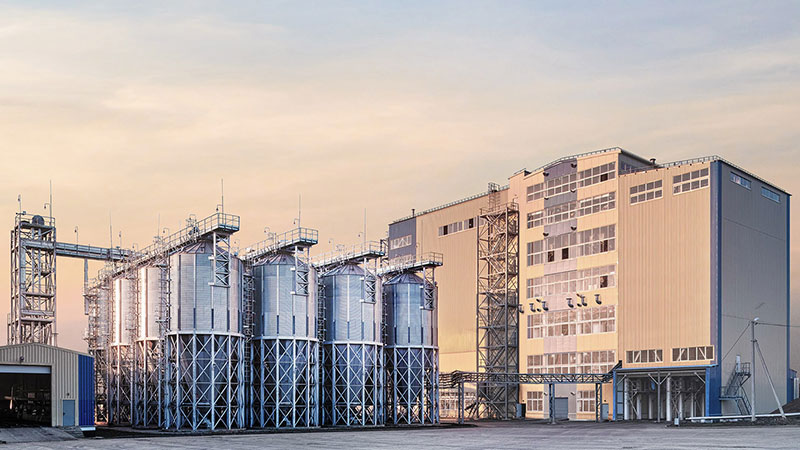
At RICHI, we go beyond project completion. With RICHI Servicee, we’re your dedicated partners in success. Count on us for expert guidance, minimal downtime, and optimized productivity. Choose RICHI for unmatched service and support.
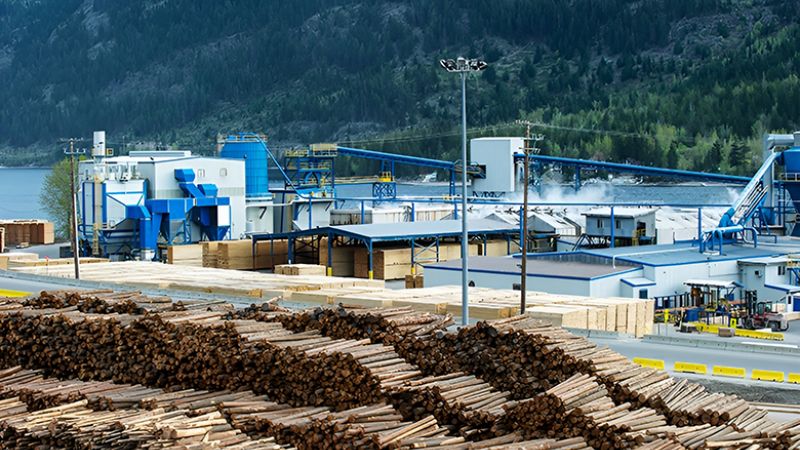


Meet global product demands and quality standards with industry-leading pellet plant design, engineering, equipment, and construction services for pellet processors.


Your Partner Beyond Project Completion
2000+ cases
RICHI is the leading designer, manufacturer and builder of pellet plants in the world, completing over 2000 projects in 140 countries across 6 continents.
Read More
Increase plant productivity, profitability, and safety by integrating high quality equipment into your pellet production line. Over the years, RICHI has become China's top pellet equipment manufacturer. At the same time, RICHI has established valuable partnerships with the world's leading component and raw material manufacturers to bring you the best there is in technology, automation, and efficiency in pelleting plant machinery.

For nearly 30 years, RICHI has been providing best-in-class pellet plant equipment and services to clients across a variety of industries, sizes, and needs. We pride ourselves on the knowledge and skill that each team member possesses – from our technical sales team to our process design engineers. You can count on RICHI Machinery to take your operation to the next level of innovation, quality, and success.
Need help with your pellet manufacturing plant project? Contact us today.
ANIMAL FEED
BIOMASS
WOOD
ORGANIC FERTILIZER
AQUA FEED
CAT LITTER
MUNICIPAL WASTE RECYCLING
SPECIAL PELLET PRODUCTION
RICHI Machinery continues to deliver world class pellet mill equipment, pellet plant engineering and project solutions that add value to our customers in the animal feed, wood waste, agriculture waste, organic fertilizer, cat litter and special pellet products industries. Throughout the years, we RICHI Machinery have built strong brand, becoming industry-leading pellet machine manufacturer. We value integrity, promise quality, and prioritize your success.
Learn MoreWith our expert team, we precisely implement your process engineering requirements in pellet mill and pelletizing plant systems. No matter which industry you’re in – we understand your needs and deliver solutions that meet the highest standards.
At RICHI, quality comes first. Our pellet making machine and related pellet line equipment undergo rigorous quality controls to ensure they meet the highest standards. Rely on products that are durable, safe, and efficient.
With decades of experience in pellet machine and pellet production line production, we have earned a reputation as a trusted partner in various industries. Our expertise allows us to cover a wide range of applications.
Not only do we offer premium pelleting equipment, but we are also experts at designing, building, installing, and maintaining facilities from the ground up. Our expertise is within pellt plant process design, discovering the most efficient, productive, and profitable way to handle your materials in an end-to-end cycle.
○ RICHI MACHINERY
Keeping in touch with us is an effective way to solve all your problems. If you have any needs or questions, please leave your contact information, then RICHI technical consultants will send design, quotation, videos to your mailbox. You can also contact us directly via WhatsApp: +86 13838389622
Copyright©2015-2026 by HENAN RICHI MACHINERY CO., LTD. All rights reserved.