
Discover a commercial leaf pellet machine in Portugal for processing olive leaves and agricultural pruning residues into biomass fuel pellets. Explore the RICHI MZLH520, raw material preparation, technical specifications, and customized biomass pelletizing solutions.
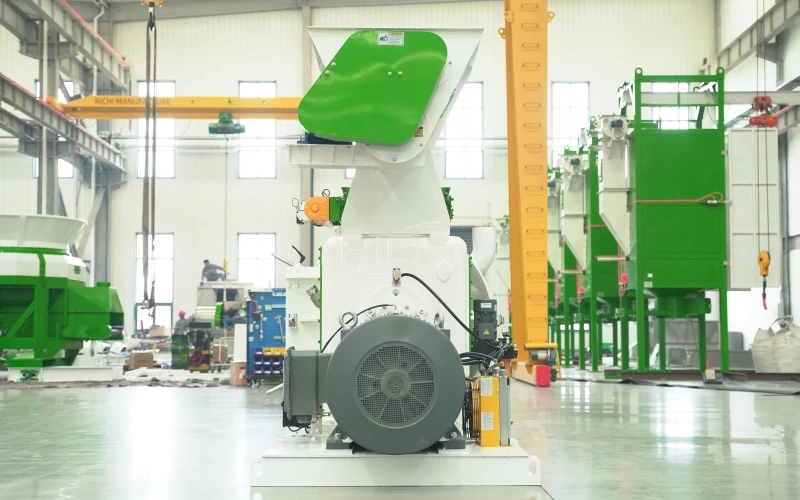
A commercial leaf pellet machine in Portugal was selected for an agricultural residue processing project designed to turn olive leaves and fine orchard pruning residues into biomass fuel pellets. The customer is a commercial agricultural by-product processor serving olive-growing areas in southern Portugal.
Rather than investing in an entirely new production line, the business decided to purchase one RICHI MZLH520 ring die biomass pellet machine and integrate it with existing material preparation equipment. With a rated capacity of 1.5–2.0 T/H and a 132 kW main motor, the machine is intended to support regular commercial production using locally collected agricultural residues.
The project addresses a specific operational issue: olive leaves and small pruning residues are generated during orchard maintenance and olive processing, but loose material is bulky, inconsistent, and inconvenient to store in large quantities.
The customer plans to produce approximately 6 mm biomass fuel pellets from prepared, dried leaf-rich material for potential sale to suitable solid-fuel users. The investment is an additional processing stage, not a replacement of the entire facility. Existing grinding, drying, and conveying equipment will be retained where it meets the requirements of the selected pellet machine.
Name:
Leaf Pellet Mill
Country:
Portugal
Date:
2026
Capacity:
1.5–2.0 T/H
Model:
MZLH520
Main Motor Power:
132 kW
Raw Materials:
Olive Leaves And Fine Orchard Residues
Pellet diameter:
6mm
Olive cultivation is an established part of Portugal's agricultural sector, particularly in the Alentejo region, where large olive-growing operations and olive oil production generate substantial volumes of agricultural by-products. Leaves are removed during pruning, harvesting, and the separation of olives from branches. Smaller quantities of fine plant residues can also be recovered during orchard maintenance and subsequent material sorting.
The customer in this project is an agricultural residue recovery and biomass processing business working with local orchard operators and agricultural service providers. Its existing activities include collecting, sorting, and preparing plant residues for different commercial outlets. Until this investment, the business had limited capacity to turn fine, leaf-rich residues into a standardized solid product. Loose material required considerable storage space, and its irregular structure made transport and handling less convenient than those of a compact product.
The proposed investment is intended to improve the commercial value of suitable residues without forcing the business to rebuild its existing operation. The customer already has access to equipment for preliminary cutting, grinding, and drying. The missing component is a ring die pellet machine capable of compressing prepared material into a more uniform form.
This purchasing decision also reflects the seasonal nature of agricultural residues. Collection volumes can change during pruning and harvesting periods, so the customer needs to prepare and store raw materials when they are available, then process suitable batches according to production schedules and market demand. A commercial leaf pellet machine provides a way to turn that prepared material into a product that is easier to weigh, package, store, and transport.
The principal feedstock is dried olive leaf material collected from orchard maintenance and olive-processing activities. The proposed preliminary blend contains approximately 75% olive leaves and 25% fine, suitably prepared olive pruning residues. This formulation is a starting point for process evaluation, not a fixed recipe guaranteed to produce a particular output. The actual blend will depend on the condition of the incoming material, its fiber structure, contamination level, moisture content, and pellet-forming behavior.
Olive leaves are relatively thin, while small branches and leaf stalks have a different structure and can be more difficult to compress consistently. A suitable blend must therefore be prepared carefully. Oversized woody pieces cannot simply be mixed with leaves and fed directly into the pellet machine. They must first be reduced to an appropriate size, and material that is too coarse or too fibrous may need to be screened out or processed separately.
The preparation process begins with sorting and removing stones, soil, metal, plastic, and other contaminants. Leaves and suitable pruning residues are then cut and ground to create a more uniform material. An initial particle-size target of approximately 3 mm or smaller can be used for grinding trials, with the final setting determined by the actual material and its feeding performance.
Moisture control is another important part of the project. The proposed target for prepared material is approximately 10–15% moisture, subject to testing. If incoming leaves or pruning residues have a moisture content above 20%, the customer's existing dryer will be used before pelletizing. Material that already meets the agreed moisture range can bypass unnecessary drying, reducing avoidable energy consumption.
The moisture target must be confirmed through trials rather than treated as a universal setting for every agricultural residue. Material that is too wet can reduce pellet stability and increase the likelihood of production interruptions. Material that is excessively dry may generate more fines or fail to form sufficiently durable pellets. A consistent preparation process is therefore central to the project's expected performance.
The customer selected the RICHI MZLH520 because its rated capacity fits the intended scale of the commercial operation. The business needs more output than a small pilot installation can provide, but it also wants to make productive use of its existing raw material preparation equipment rather than purchase a complete new line immediately.
The MZLH520 has a ring die with an inner diameter of 520 mm and a 132 kW main motor. Its listed production capacity is 1.5–2.0 T/H. Actual throughput will depend on the raw material blend, moisture content, particle size, die configuration, and operating conditions. The listed capacity is therefore an equipment rating, not a guarantee that every leaf-based material will achieve the same output.
The MZLH520 is a biomass pelletizing machine, not a conventional animal feed pellet machine. It does not include the conditioning system required for standard conditioned feed pellet production. In this project, its role is to compress appropriately prepared agricultural residues into solid biomass pellets for potential use in compatible fuel applications.
The equipment choice also takes the upstream process into account. A pellet machine cannot maintain a steady operating rate if the grinder, dryer, conveyors, and storage system cannot supply prepared material consistently. The selected model provides a defined production range around which the customer can plan raw material preparation, labor, electrical infrastructure, and downstream cooling.
The project's processing route is built around the physical characteristics of leaf-rich biomass. Unlike uniform sawdust, olive leaves and fine pruning residues can differ significantly in particle shape, fiber length, bulk density, and moisture. The purpose of pretreatment is to reduce these variations before the material enters the pelletizing chamber.
After collection, the material is inspected and sorted. Suitable leaves and small pruning residues are separated from unsuitable waste and foreign contaminants. Oversized branches are cut down and ground using suitable size-reduction equipment. The prepared material is then checked for particle size and moisture before being transferred to the pellet machine.
Drying is applied when required by the incoming moisture content. If the material exceeds the target range, the existing dryer reduces moisture before pelletizing. If a batch is already adequately dry, it can bypass the dryer. This batch-based approach helps the customer avoid unnecessary energy consumption while maintaining more consistent material conditions.
The prepared material is then conveyed to the MZLH520. Its arch-breaking feeder helps address bridging and material accumulation above the feeding outlet, while the forced feeder supports a more controlled supply into the pelletizing section. These functions are particularly relevant when handling lightweight leaves that may not flow as freely as uniform granular materials.
Inside the machine, the ring die and rollers compress the prepared biomass into cylindrical pellets. The proposed finished diameter is 6 mm, within the MZLH series' stated 4–12 mm product range. Pellet length can be adjusted through the cutting arrangement, while durability and fines content should be evaluated using representative samples of the actual olive leaf blend.
Freshly formed pellets should be cooled before extended storage or packaging. Cooling helps remove retained heat and stabilizes the product for handling. Screening can then separate excessive fines, which may be returned to the process where appropriate. Since the customer is purchasing a single pellet machine, the cooling and screening stages can use suitable existing equipment or be added as separate units after the layout and throughput requirements have been confirmed.
The principal benefit of the commercial leaf pellet machine in Portugal is the ability to convert a bulky agricultural by-product into a more standardized form. Loose olive leaves are difficult to store efficiently because of their irregular shape and relatively low bulk density. Pelletizing reduces the volume occupied by the material and creates a product that is easier to weigh, package, and transport.
The finished product is intended for biomass fuel applications. Its suitability will depend on characteristics such as moisture content, ash content, durability, calorific value, and the requirements of the combustion equipment used by the buyer. Not every biomass boiler or heating system can accept every type of leaf-based pellet, so the customer must match the finished product to the intended application.
The project may also improve how the business organizes seasonal raw material supplies. Suitable residues can be collected and prepared during periods of high availability, then pelletized according to production schedules and market demand. This can make inventory handling more systematic, although the commercial benefit depends on collection costs, drying energy, electricity consumption, maintenance, and the price obtained for the finished pellets.
The customer is not relying on the pellet machine alone to solve every raw material handling issue. Instead, the investment is part of a coordinated process in which sorting, grinding, moisture management, controlled feeding, pelletizing, cooling, and storage all contribute to the final product. That approach provides a more realistic basis for assessing output and operating costs than selecting equipment by rated capacity alone.
Ring die biomass pellet mills are used to process suitable agricultural and forestry residues, including sawdust, wood shavings, straw, grass, selected crop residues, and other prepared fibrous materials. The correct equipment configuration depends on the raw material and intended product. Leaf-rich olive residues require particular attention to particle size and moisture because their structure differs from that of conventional wood-based feedstock.
The MZLH series incorporates an arch-breaking feeder and a forced feeder to support material delivery. These components are useful when lightweight biomass tends to accumulate or bridge in the feeding area. Consistent feeding helps the operator maintain more stable production conditions and reduces avoidable interruptions caused by irregular material flow.
The ring die system compresses prepared biomass into cylindrical pellets. When the raw material is appropriately prepared and operating conditions are suitable, the process can produce a more consistent product than handling loose residues. For the customer, this provides a practical way to standardize agricultural by-products without immediately installing a complete new production line.
Wear-part management is also important. Agricultural residues may contain abrasive mineral contamination, and unsuitable foreign materials can accelerate wear on the die and rollers. Effective cleaning, correct operating settings, regular inspection, and appropriate maintenance practices help protect the pelletizing components and support stable operation.
Before selecting a biomass pellet machine, a customer needs more than a motor rating and a nominal capacity. The suitability of the equipment depends on how the material will be collected, prepared, dried, conveyed, and cooled. RICHI can take these factors into account when recommending a machine for a specific raw material and production target.
For this project, the technical review focuses on the physical form of the olive leaves, the proportion of fine pruning residues, the intended moisture range, the target particle size, and the required pellet diameter. These details help determine whether the existing preparation equipment can support the planned operating rate or whether additional machinery will be required.
RICHI supplies individual biomass pellet machines as well as complete biomass pellet production lines. Businesses that already own grinders, dryers, conveyors, or cooling equipment can purchase a single machine to complement their existing assets. Customers planning a new facility can request a customized process design covering raw material preparation, drying, grinding, pelletizing, cooling, screening, and packaging.
For leaf-based materials, representative raw material testing is particularly useful. It can help establish suitable particle size, moisture conditions, pellet diameter, and expected operating performance. Testing also helps identify whether different batches should be processed separately or blended to achieve a more consistent feedstock.
The equipment is planned for sea shipment from Qingdao Port, China, to the Port of Sines in Portugal. Sines is an established deep-water commercial port handling international cargo and is a suitable port option for an industrial equipment shipment to Portugal.
Before dispatch, the equipment configuration, electrical requirements, packing arrangements, and shipping documentation should be checked against the purchase specifications. Advance installation planning can also help the customer prepare the foundation, electrical supply, raw material feeding arrangement, and discharge area before the machine arrives.
The customer's main concern was how to add pellet production without replacing equipment that was still suitable for the existing operation. The MZLH520 provided a defined capacity range and allowed the business to plan around its available raw material preparation equipment.
The project also reinforced the importance of separating raw material preparation from pelletizing performance. Olive leaves, stalks, and fine pruning residues do not behave identically, so the business planned to assess the prepared material before fixing the final blend and operating settings. This approach gives the operator a clearer basis for evaluating pellet quality and understanding the factors that influence output.
For a commercial biomass processor, the practical value lies in building a repeatable process around a defined raw material and product specification. Further investment can then be considered using operating data, product test results, and actual customer demand rather than relying solely on nominal machine capacity.
The commercial leaf pellet machine in Portugal project demonstrates how a single ring die pellet machine can become the central component of a staged agricultural residue utilization plan. By using the MZLH520 with suitable existing preparation equipment, the customer can develop a biomass fuel pellet product from olive leaves and fine orchard residues without immediately investing in a complete new production line.
The proposed 6 mm pellets are intended for biomass fuel applications, with their final suitability determined by product testing and buyer requirements. Consistent grinding, moisture management, controlled feeding, and adequate cooling are central to achieving reliable results. These requirements are especially important for leaf-rich agricultural residues, which cannot be processed in exactly the same way as every other biomass material.
RICHI Machinery provides both individual pelletizing equipment and complete biomass processing solutions. For customers evaluating olive leaves, straw, grass, sawdust, or other agricultural and forestry residues, the equipment configuration can be tailored to the available raw material, intended pellet size, required output, and existing machinery.
Businesses planning a similar project can contact RICHI with details of their raw materials, moisture content, target pellet diameter, and expected hourly output. These details provide a practical starting point for selecting a suitable commercial leaf pellet machine and developing a process that fits the project's actual requirements.
Having the right mix of reliable, high-quality pellet machine and pelletizing systems and expert support is essential to your success. Watch how our end-to-end feed pellet plant solutions have helped our customers optimize their performance.
Our customized and future-proofed turnkey pellet plant solutions is designed with you at the core. From vision to reality and beyond, our team stays connected with yours. Giving you peace-of-mind with an expert at your side.

At RICHI, we go beyond project completion. With RICHI Servicee, we’re your dedicated partners in success. Count on us for expert guidance, minimal downtime, and optimized productivity. Choose RICHI for unmatched service and support.



Meet global product demands and quality standards with industry-leading pellet plant design, engineering, equipment, and construction services for pellet processors.


Your Partner Beyond Project Completion
2000+ cases
RICHI is the leading designer, manufacturer and builder of pellet plants in the world, completing over 2000 projects in 140 countries across 6 continents.
Read More
Increase plant productivity, profitability, and safety by integrating high quality equipment into your pellet production line. Over the years, RICHI has become China's top pellet equipment manufacturer. At the same time, RICHI has established valuable partnerships with the world's leading component and raw material manufacturers to bring you the best there is in technology, automation, and efficiency in pelleting plant machinery.

For nearly 30 years, RICHI has been providing best-in-class pellet plant equipment and services to clients across a variety of industries, sizes, and needs. We pride ourselves on the knowledge and skill that each team member possesses – from our technical sales team to our process design engineers. You can count on RICHI Machinery to take your operation to the next level of innovation, quality, and success.
Need help with your pellet manufacturing plant project? Contact us today.
ANIMAL FEED
BIOMASS
WOOD
ORGANIC FERTILIZER
AQUA FEED
CAT LITTER
MUNICIPAL WASTE RECYCLING
SPECIAL PELLET PRODUCTION
RICHI Machinery continues to deliver world class pellet mill equipment, pellet plant engineering and project solutions that add value to our customers in the animal feed, wood waste, agriculture waste, organic fertilizer, cat litter and special pellet products industries. Throughout the years, we RICHI Machinery have built strong brand, becoming industry-leading pellet machine manufacturer. We value integrity, promise quality, and prioritize your success.
Learn MoreWith our expert team, we precisely implement your process engineering requirements in pellet mill and pelletizing plant systems. No matter which industry you’re in – we understand your needs and deliver solutions that meet the highest standards.
At RICHI, quality comes first. Our pellet making machine and related pellet line equipment undergo rigorous quality controls to ensure they meet the highest standards. Rely on products that are durable, safe, and efficient.
With decades of experience in pellet machine and pellet production line production, we have earned a reputation as a trusted partner in various industries. Our expertise allows us to cover a wide range of applications.
Not only do we offer premium pelleting equipment, but we are also experts at designing, building, installing, and maintaining facilities from the ground up. Our expertise is within pellt plant process design, discovering the most efficient, productive, and profitable way to handle your materials in an end-to-end cycle.
○ RICHI MACHINERY
Keeping in touch with us is an effective way to solve all your problems. If you have any needs or questions, please leave your contact information, then RICHI technical consultants will send design, quotation, videos to your mailbox. You can also contact us directly via WhatsApp: +86 13838389622
Copyright©2015-2026 by HENAN RICHI MACHINERY CO., LTD. All rights reserved.