
The Liechtenstein customer did not operate a large poultry farm capable of supplying an FZLH250 continuously with manure from its own birds. The country’s agricultural sector is far too small for that scenario. In 2023, Liechtenstein had about 20,431 poultry in total, spread across 127 poultry keepers, while the entire country had only 97 registered farms. More than one-third of those farms were certified organic.
The Liechtenstein customer did not operate a large poultry farm capable of supplying an FZLH250 continuously with manure from its own birds. The country’s agricultural sector is far too small for that scenario. In 2023, Liechtenstein had about 20,431 poultry in total, spread across 127 poultry keepers, while the entire country had only 97 registered farms. More than one-third of those farms were certified organic.
For that reason, this chicken dung organic fertilizer pellet machine in Liechtenstein project was built around a regional organic-fertilizer processor rather than a 6,000-hen farm. The customer aggregates processed poultry manure and composted organic material from several suppliers in Liechtenstein and the neighboring Rhine Valley, then produces small commercial batches of pelletized soil amendment for horticulture, landscaping, vineyards, orchards, nurseries and specialty crop users.
Name:
Chicken dung pelletizer
Country:
Liechtenstein
Date:
2026
Capacity:
1–1.5 T/H
Model:
FZLH250
Main Motor Power:
22 kW
Raw Materials:
poultry manure
Pellet diameter:
6 mm
Liechtenstein’s domestic poultry population alone could not support a continuously loaded 1–1.5 T/H fertilizer pelletizer.
The customer therefore does not depend on one poultry house or even on Liechtenstein alone.
Its business model is based on collecting or purchasing compliant processed manure and composted organic material from multiple farms and agricultural processors within a practical cross-border radius.
This is more realistic for a country of Liechtenstein’s size and also fits the way agricultural businesses in the Alpine Rhine Valley often operate across a much larger economic area than the national boundary itself.
Fresh poultry manure is not fed directly into the ring-die pellet machine.
The material first has to pass through the customer’s manure treatment and stabilization process.
Depending on the supplier and incoming condition, that can include controlled composting, hygienic treatment, maturation, drying and screening before pelletizing.
This distinction is essential because processed manure used in organic fertilisers and soil improvers is subject to animal-by-product and fertiliser requirements. EU rules applicable to processed manure define specific manufacturing-chain conditions before the material can reach the relevant end point for use in fertilising products.
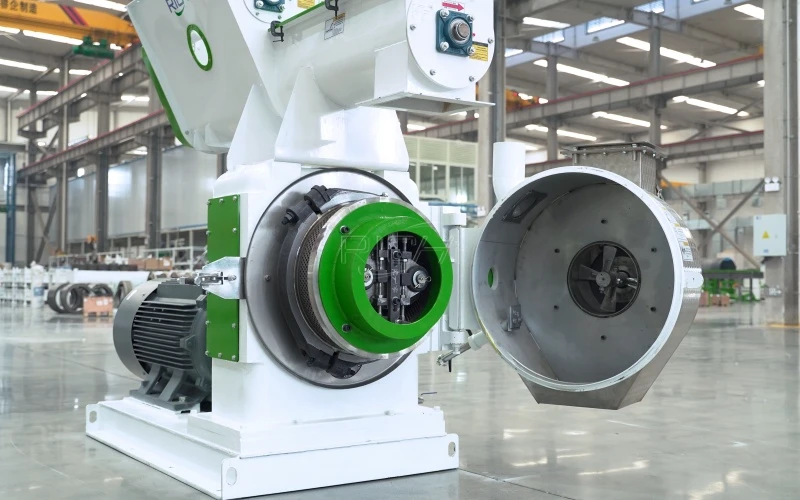
The FZLH250 chicken manure pellet machine is used for densification and product shaping.
It is not presented as the machine that makes untreated chicken manure microbiologically safe.
Required hygienization or other compliant manure-processing steps must occur before the material is treated as suitable processed manure for the intended fertilizer route.
Pelletizing can improve handling, bulk density, storage behavior and spreading consistency, but it should not be used as a substitute for the upstream treatment required by regulation.
The key is utilization pattern.
The customer does not run the machine continuously at 1–1.5 T/H every working day.
Instead, the FZLH250 fertilizer granulator machine operates in production campaigns. Processed manure and other approved organic fertilizer components are accumulated, blended into a defined formulation, pelletized in batches and then packed for seasonal sales.
This makes a small industrial ring-die pelletizer workable even in a limited domestic market.
| Project Parameter | Configuration |
|---|---|
| Equipment | Chicken dung organic fertilizer pellet machine |
| Model | FZLH250 |
| Quantity | 1 unit |
| Main Motor Power | 22 kW |
| Anti-Bridging Feeder | 2.2 kW |
| Forced Feeder | 0.75 kW |
| Ring Die Inner Diameter | 250 mm |
| Available Pellet Diameter | 4–12 mm |
| Project Pellet Diameter | 6 mm |
| Reference Capacity | Approximately 1–1.5 T/H under suitable prepared-material conditions |
| Production Mode | Batch campaigns rather than continuous full-load operation |
The customer standardized the main product at 6 mm, which is easier to support with a conventional ring-die specification and is suitable for bagged organic fertilizer distributed through horticultural and agricultural channels.
The pellet is small enough for controlled mechanical spreading while still being large enough to reduce loose dust compared with a fine powder.
Other die diameters can be used later if a contract requires a different product.
Liechtenstein is dominated by grassland and forage agriculture, but that does not mean a manure fertilizer should automatically contain large percentages of hay.
In 2023, 63% of Liechtenstein’s agricultural area was permanent grassland and another 21% was used for forage crops.
Those figures describe the agricultural landscape, not an ideal fertilizer formulation.
The customer therefore does not consume high-value Alpine hay merely to make manure pellets stronger.
Where a structural carbon component is needed, lower-value plant residues, screened compost fractions or other approved organic materials are selected according to nutrient analysis, moisture and pellet-forming behavior.
Clean untreated wood fibre can sometimes be incorporated in an organic fertilizer blend, but the customer does not add a fixed 15% spruce sawdust to every batch.
Too much woody material would dilute nutrient concentration and could alter nitrogen availability after application.
If wood fibre is used, the inclusion rate is kept within the formulation requirements for the intended soil product and is based on actual C:N balance, moisture control and pellet durability.
Painted, treated or contaminated wood residues are excluded.
Each production campaign begins with representative testing of the processed manure and other organic components.
The customer checks parameters relevant to commercial fertilizer production, including moisture, dry matter, organic matter and nutrient composition.
Mineral additions are only introduced where there is a clear agronomic and regulatory reason.
Calcium, magnesium or other nutrients are not added simply because they sound beneficial for plants.
The final formulation has to correspond to the declared product specification.
The commercial opportunity is not based on Liechtenstein becoming a high-volume manure-fertilizer market.
The country has a small agricultural sector, but a comparatively strong organic orientation: more than one-third of its registered farms were certified organic in 2023.
That creates a niche for well-characterized, traceable soil amendments and organic fertilizer products, especially when they can be supplied in convenient pellet form.
The customer therefore competes on product consistency and local/regional service rather than tonnes alone.
The finished pellets are marketed across several horticultural and agricultural channels.
Potential users include nurseries, ornamental plant growers, vineyards, orchards, vegetable farms, landscaping contractors and farms seeking pelletized organic soil amendments.
The product is not limited to one imagined greenhouse market inside Liechtenstein.
This broader regional customer base is necessary for a commercially sensible project.
Prepared manure that is too wet does not flow or pelletize consistently.
The customer therefore controls moisture after stabilization and before densification.
The exact target is adjusted according to the blend rather than fixed at 18–20% for every batch.
If the material is too wet, die loading increases and pellet quality can become unstable. If it is too dry, feeding and binding behavior can also deteriorate.
Operators use motor load, pellet appearance, fines and cooling behavior to confirm that the material is within a workable range.
Depending on the upstream composting and manure-processing method, moisture can be reduced through a combination of mechanical separation, controlled aeration, covered maturation, low-temperature drying or other appropriate equipment.
The FZLH250 organic fertilizer production project begins only after the material has already reached the correct condition for pelletizing.
Processed manure and compost blends do not flow as freely as grain.
Fine organic material can compact above the feeder or form arches inside the hopper.
The FZLH250 therefore uses an anti-bridging feeder to keep the material moving and a forced feeder to deliver it steadily into the ring-die section.
Stable feeding is especially important when the formulation contains fibrous compost fractions or organic matter with variable bulk density.
Fertilizer pellets need to survive cooling, bagging, storage and spreading.
They do not need the same physical durability target as industrial biomass fuel pellets.
A pellet that is compressed excessively may handle well but break down too slowly after field application.
The customer therefore balances mechanical strength with soil-disintegration behavior.
Ring-die compression is selected around the intended fertilizer use rather than maximum density.
Fresh pellets leave the FZLH250 warm and are not bagged immediately.
They first pass through a cooling stage so the product can stabilize.
Screening then removes loose fines and broken particles.
Suitable clean fines can be returned to production where the process specification allows.
The finished 6 mm pellets are then packed and stored in dry conditions until dispatch.
The FZLH250 does not create nitrogen, phosphorus or potassium.
The nutrient value already exists in the processed manure and any approved formulation components.
Pelletizing changes the physical form.
The customer gains a denser product that is easier to package, transport, meter and spread than loose composted manure.
This distinction keeps the product claims technically credible.
Using an FZLH250 does not automatically make the finished pellets compliant with European organic standards.
Organic eligibility depends on the origin and treatment of the materials, the applicable production rules, documentation, traceability and the certification system under which the final product will be marketed.
The organic fertilizer pellet machine only performs densification.
Regulatory compliance belongs to the complete manure-processing and fertilizer-manufacturing system.
European rules now specifically recognize processed manure as a component material in EU fertilising products, subject to the applicable conditions. Regulation (EU) 2024/1682 added processed manure to the relevant component-material framework, while Regulation (EU) 2023/1605 defines manufacturing-chain end points for qualifying processed manure and other derived organic fertiliser materials.
This makes pelletized processed manure a technically credible product category, but only when upstream processing and product compliance are handled correctly.
Because the raw material comes from several suppliers, each incoming batch is recorded separately.
The processor tracks supplier, material type, treatment status and production campaign.
This is particularly important for animal-derived fertilizer materials.
Combining multiple sources without documentation would make product verification and quality control much more difficult.
The customer did not need a second pelletizer as backup.
Production is planned in campaigns, so maintenance can be scheduled between batches.
The FZLH250 also has more nominal hourly capacity than the regional market requires on an everyday basis.
One machine therefore provides enough headroom for seasonal orders without creating unnecessary capital investment or idle equipment.
A plant physically located in Liechtenstein can still serve customers across the surrounding Alpine Rhine Valley.
This is the practical way to support a small industrial fertilizer project in such a compact country.
The machine location remains Liechtenstein, but neither raw-material sourcing nor finished-product sales need to stop at the border.
This regional approach also allows the customer to smooth seasonal variation in manure supply and fertilizer demand.
Liechtenstein is landlocked, so the FZLH250 was exported from Qingdao Port through a European seaport and then transported inland by road.
The final entry port was selected according to the freight service, customs arrangement and inland delivery route available at the time of shipment rather than hard-coding Rotterdam as the only logical gateway.
For a compact machine such as the FZLH250, the inland leg is relatively straightforward once customs clearance and delivery scheduling are confirmed.
During initial testing, the customer found that the pelletizer behaved differently when the blend contained more fine compost than when it contained more fibrous organic matter.
The first adjustment was therefore made to feeder speed and blend consistency rather than immediately changing the ring die.
Once bulk density and moisture were stabilized, the machine produced much more predictable pellets.
“Our biggest lesson was that the pellet machine cannot correct an unstable fertilizer blend. When moisture and material composition are consistent, the FZLH250 runs steadily. When the upstream compost changes, we have to adjust the preparation first rather than expecting the die to solve everything.”
The customer now treats raw-material preparation as part of product quality control rather than simply as a step before pelletizing.
Because the machine does not run continuously, inspection is scheduled between production campaigns.
The operator checks the ring die, rollers, feeder, bearings and product-contact areas before the next batch begins.
Organic fertilizer material can cake if residues are allowed to remain in the machine under humid conditions, so cleaning receives particular attention.
Wear parts are replaced based on actual condition rather than a fixed tonnage promise.
This chicken dung organic fertilizer pellet machine in Liechtenstein project is intentionally small and regional.
The customer is not a 6,000-hen farm attempting to operate a 1–1.5 T/H fertilizer pelletizer from its own manure supply. It is an organic-fertilizer processor aggregating compliant processed poultry manure and other approved organic materials from Liechtenstein and the surrounding region.
One FZLH250 with a 22 kW main motor, 2.2 kW anti-bridging feeder, 0.75 kW forced feeder and 250 mm ring die is used to produce 6 mm fertilizer pellets in scheduled campaigns. Reference capacity is approximately 1–1.5 T/H under suitable prepared-material conditions, but annual utilization is deliberately much lower than continuous industrial operation.
The machine is only the final densification stage. Fresh manure treatment, hygienization where required, composting or stabilization, moisture management, nutrient analysis, formulation, cooling, screening, traceability and regulatory compliance remain separate parts of the complete fertilizer process.
For another customer evaluating a chicken dung organic fertilizer pellet machine in Liechtenstein, RICHI Machinery would first calculate the real annual quantity of processed manure available, number and location of suppliers, regulatory treatment status, moisture, nutrient analysis, existing composting and drying equipment, target pellet diameter, seasonal sales volume, storage capacity and whether the intended market is Liechtenstein alone or the wider Alpine Rhine region.
That calculation is more important than nominal hourly capacity. In a country this small, the right machine is the one that matches a regional raw-material network and seasonal fertilizer market rather than one sized around an unrealistic single poultry farm.
Having the right mix of reliable, high-quality pellet machine and pelletizing systems and expert support is essential to your success. Watch how our end-to-end feed pellet plant solutions have helped our customers optimize their performance.
Our customized and future-proofed turnkey pellet plant solutions is designed with you at the core. From vision to reality and beyond, our team stays connected with yours. Giving you peace-of-mind with an expert at your side.
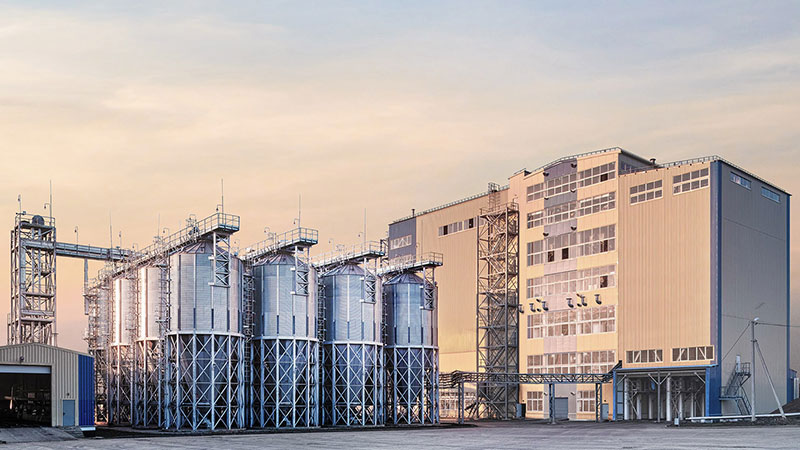
At RICHI, we go beyond project completion. With RICHI Servicee, we’re your dedicated partners in success. Count on us for expert guidance, minimal downtime, and optimized productivity. Choose RICHI for unmatched service and support.
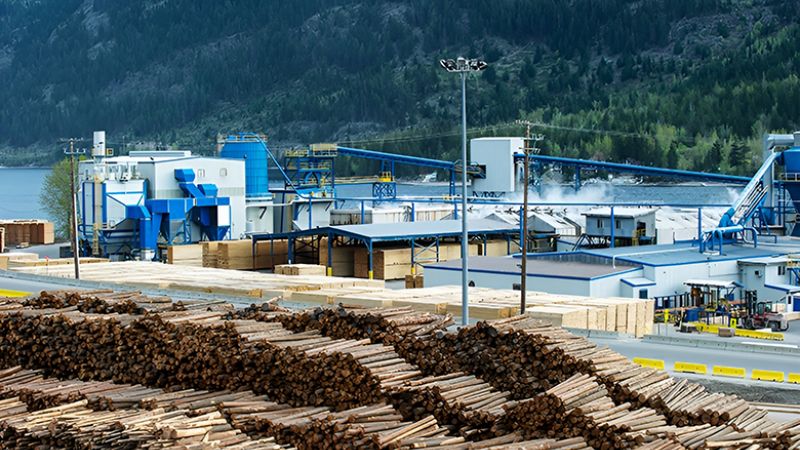


Meet global product demands and quality standards with industry-leading pellet plant design, engineering, equipment, and construction services for pellet processors.

Your Partner Beyond Project Completion
2000+ cases
RICHI is the leading designer, manufacturer and builder of pellet plants in the world, completing over 2000 projects in 140 countries across 6 continents.
Read More
Increase plant productivity, profitability, and safety by integrating high quality equipment into your pellet production line. Over the years, RICHI has become China's top pellet equipment manufacturer. At the same time, RICHI has established valuable partnerships with the world's leading component and raw material manufacturers to bring you the best there is in technology, automation, and efficiency in pelleting plant machinery.

For nearly 30 years, RICHI has been providing best-in-class pellet plant equipment and services to clients across a variety of industries, sizes, and needs. We pride ourselves on the knowledge and skill that each team member possesses – from our technical sales team to our process design engineers. You can count on RICHI Machinery to take your operation to the next level of innovation, quality, and success.
Need help with your pellet manufacturing plant project? Contact us today.
ANIMAL FEED
BIOMASS
WOOD
ORGANIC FERTILIZER
AQUA FEED
CAT LITTER
MUNICIPAL WASTE RECYCLING
SPECIAL PELLET PRODUCTION
RICHI Machinery continues to deliver world class pellet mill equipment, pellet plant engineering and project solutions that add value to our customers in the animal feed, wood waste, agriculture waste, organic fertilizer, cat litter and special pellet products industries. Throughout the years, we RICHI Machinery have built strong brand, becoming industry-leading pellet machine manufacturer. We value integrity, promise quality, and prioritize your success.
Learn MoreWith our expert team, we precisely implement your process engineering requirements in pellet mill and pelletizing plant systems. No matter which industry you’re in – we understand your needs and deliver solutions that meet the highest standards.
At RICHI, quality comes first. Our pellet making machine and related pellet line equipment undergo rigorous quality controls to ensure they meet the highest standards. Rely on products that are durable, safe, and efficient.
With decades of experience in pellet machine and pellet production line production, we have earned a reputation as a trusted partner in various industries. Our expertise allows us to cover a wide range of applications.
Not only do we offer premium pelleting equipment, but we are also experts at designing, building, installing, and maintaining facilities from the ground up. Our expertise is within pellt plant process design, discovering the most efficient, productive, and profitable way to handle your materials in an end-to-end cycle.
○ RICHI MACHINERY
Keeping in touch with us is an effective way to solve all your problems. If you have any needs or questions, please leave your contact information, then RICHI technical consultants will send design, quotation, videos to your mailbox. You can also contact us directly via WhatsApp: +86 13838389622
Copyright©2015-2026 by HENAN RICHI MACHINERY CO., LTD. All rights reserved.