
An Algeria poultry integrator uses an SZLH420 chick feed pelletizer in a dedicated starter-feed section, producing conditioned pellets for controlled crumbling and early-stage broiler feeding.
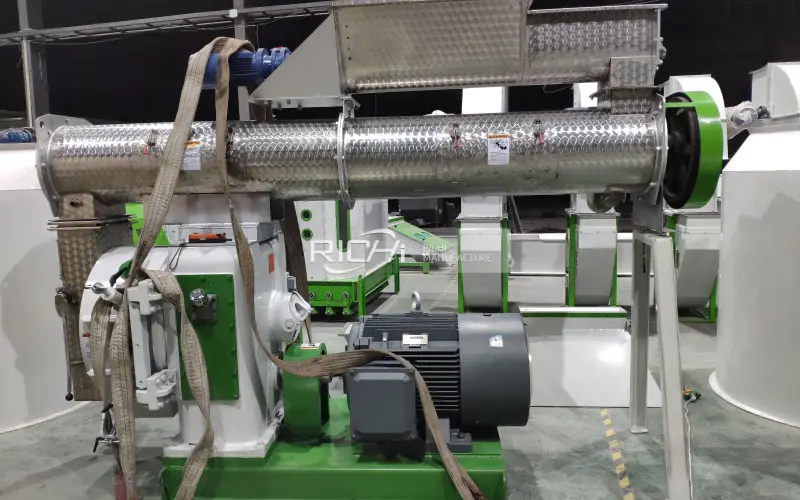
A poultry integration company in the Sétif region selected an SZLH420 chick feed pelletizer for early stage poultry feeding in Algeria for a dedicated starter-feed section in its centralized feed mill. The company manages broiler production from hatchery supply through grow-out and requires a stable volume of starter feed for newly placed chicks.
The project was designed around approximately 18,000 tonnes of starter feed per year. Rather than asking one pellet mill to cover every poultry feed stage, the customer assigned a dedicated machine to the more demanding early-stage feed program. This gives the production team tighter control over conditioning, pellet formation, crumbling and final particle distribution.
The SZLH420 does not produce the complete finished chick feed by itself. It forms conditioned pellets that continue through cooling, crumbling and screening before entering finished-product storage. For the youngest broilers, the final feed is primarily a controlled crumble rather than a full-size pellet.
Name:
Chick starter feed pelletizer
Country:
Algeria
Date:
2025
Capacity:
10–12 T/H
Model:
SZLH420
Main Motor Power:
110 kW
Main Product:
Pellets for broiler starter crumble production
Pellet diameter:
3 mm
Starter feed represents a smaller share of total broiler feed consumption than grower and finisher feed, but a large integrated poultry business can still require substantial annual volume. The machine therefore had to provide enough hourly capacity to support centralized production without becoming a bottleneck during starter-feed campaigns.
The SZLH420 poultry feed pellet machine provides a reference capacity of approximately 10–12 T/H under suitable poultry-feed conditions. This gives the plant enough capacity margin to produce the required annual starter volume within a practical operating schedule while allowing time for sanitation, maintenance, product changeovers and die inspection.
Actual starter-feed output can be lower than the upper reference value when the plant uses a small ring-die opening, a demanding formula or a tighter pellet-quality specification. The customer therefore sizes production from usable operating capacity rather than the catalogue maximum alone.
| Project Parameter | Configuration |
|---|---|
| Equipment | Chick starter feed pelletizer |
| Model | SZLH420 |
| Quantity | 1 unit |
| Main Motor Power | 110 kW |
| Feeder Power | 1.5 kW |
| Conditioner Power | 7.5 kW |
| Ring Die Inner Diameter | 420 mm |
| Available Pellet Diameter | 2–12 mm |
| Main Project Die | Approximately 3 mm |
| Reference Capacity | 10–12 T/H under suitable feed conditions |
| Main Product | Pellets for broiler starter crumble production |
| Installation Type | Dedicated pelletizer inside a centralized poultry feed mill |
The 110 kW main drive provides the capacity required for commercial starter-feed production, while the feeder and conditioner regulate the flow of prepared mash before it reaches the ring die. The selected machine is large enough for the annual production program without forcing the starter section to depend on continuous operation at maximum load.
Young chicks need a physical feed form they can locate and consume easily. The smallest birds also have limited ability to handle large complete pellets, so the mill uses pelleting and crumbling as two separate processing stages.
The feed pellet machine first compresses conditioned mash into structurally stable pellets. After cooling, these pellets enter the crumbler, where roll clearance is adjusted to produce smaller particles for the starter stage.
The downstream screener then separates material that falls outside the required particle distribution. Excessive fines reduce the useful coarse fraction of chick feed, while oversized pieces can be difficult for very young birds to consume.
This process gives the feed mill more control than trying to create the final chick particle size only through an extremely small ring-die hole.
The project uses an approximately 3 mm die for its principal starter-feed route. That dimension describes the pellet leaving the die before downstream size reduction.
The final chick feed specification depends on several additional factors:
A smaller die is therefore not automatically the better choice. Very small die holes can reduce usable throughput, increase sensitivity to mash preparation and make blockage more likely if particle size or conditioning is poorly controlled.
The production team evaluates the complete route from mash preparation to finished crumble rather than judging starter-feed quality from ring-die diameter alone.
The Algeria feed mill works with commercial poultry-feed ingredients sourced through the regional grain and protein supply chain. Maize and soybean meal form an important part of many broiler formulations, while wheat-based ingredients and other approved materials can be used according to nutritional specification, availability and delivered cost.
The starter-feed ingredient system can include:
The nutrition team adjusts inclusion rates according to raw-material analysis and broiler requirements. The pelletizer is selected to handle the physical behavior of the formulated mash; it does not determine the nutritional recipe.
The ingredients entering the pelletizer must have a reasonably consistent particle distribution. Large grain fragments can interfere with mixing uniformity and become difficult to pass through a relatively small die opening, while excessive fine powder increases dust and can complicate material handling.
The grinding section therefore prepares cereal ingredients to a specification suitable for both mixing and starter-feed pelleting.
Materials already supplied in suitable meal or powder form do not need unnecessary secondary grinding. Premix, minerals and other micro-ingredients also follow their own dosing route rather than being sent through the grain hammer mill simply because they are part of the final formula.
This reduces needless grinding energy and helps the plant maintain better control over ingredient segregation and dust.
Before entering the ring die, mixed starter mash passes through the SZLH420 conditioner. Steam raises material temperature and moisture, softens the mash and improves its response to compression.
The working condition is adjusted according to the product being manufactured. Important variables include:
The mill does not operate every starter formula at one fixed temperature, steam-addition percentage or residence time. Operators establish a stable window during commissioning and continue adjusting it when the formula or raw-material condition varies.
Early-stage broiler feeds are nutritionally dense, and oil may form an important part of the energy system. From a mechanical perspective, however, liquid fat also changes the way mash behaves in the pellet mill.
Higher free-oil inclusion before the ring die can increase lubrication between the material and the die surface. This can reduce compression resistance and may affect pellet strength if the complete formulation is not balanced for pelleting.
The feed mill therefore coordinates liquid addition with the required pellet quality. Depending on the formula and production arrangement, the amount and point of oil application can be adjusted rather than treating all liquid addition as a fixed pre-pelleting step.
Pellets leave the ring die warm and relatively soft. They must be conditioned by the downstream cooling stage before the plant relies on them for stable crumbling.
The cooler is therefore sized to handle the real working output of the SZLH420. Airflow, retention and discharge have to be sufficient to prepare the pellets for the next mechanical step without creating a bottleneck behind the pellet mill.
Once cooled, the pellets pass through the crumbler. Roll spacing is adjusted according to the required chick-feed texture. If the rolls are too aggressive, the plant creates excessive fines; if the gap is too wide, too many large pieces remain.
The screening section provides the final physical-quality check before starter feed is sent to storage or packing.
The customer uses other production capacity for higher-volume broiler feeds. Keeping one pelletizer focused on the starter program reduces the number of changes required between substantially different product specifications.
This arrangement supports tighter control of:
The advantage is particularly useful for an integrated poultry company because hatchery placement schedules create recurring starter-feed demand. The feed mill can plan production around chick placement instead of allowing starter batches to compete continuously with large grower and finisher runs.
The dedicated starter-feed section gives the company better control over the physical quality of feed supplied during the first stage of broiler production.
That contribution should be understood within the wider production system. Early chick performance is also influenced by chick quality, brooding temperature, ventilation, water availability, stocking management, health status and nutritional formulation.
The feed mill therefore monitors manufacturing indicators that it can control directly, including particle distribution, fines, pellet formation, conditioner stability and crumbling performance.
These production measurements provide a more reliable basis for adjusting the feed process than assigning biological flock results to one machine alone.
Starter-feed pelleting can place demanding conditions on the ring die and rollers. Operators monitor machine load and feed behavior closely because relatively small die openings are more sensitive to coarse mash, unstable moisture and poor conditioning.
Routine maintenance includes:
Ring-die service life is evaluated from actual production conditions rather than one fixed number of running hours. Formula composition, mineral content, operating load and maintenance practice can all affect wear.
Because the SZLH420 operates inside a larger centralized feed factory, machine selection also depends on how it connects with the surrounding equipment.
The engineering review includes the mash-bin discharge, feeder inlet, steam connection, pelletizer foundation, hot-pellet discharge, cooler capacity, crumbler position, screening equipment and conveying route.
Maintenance clearance around the ring die and drive section is also important. Installing a machine with sufficient hourly capacity is of little value if operators cannot safely access wear parts or if the downstream equipment cannot receive its output.
The SZLH420 was prepared for ocean shipment from Qingdao, China, with Béjaïa providing a practical entry route for equipment serving the Sétif area.
Before shipment, the project team received machine dimensions, foundation information, electrical requirements and process-interface data so the pelletizing section could be prepared in advance.
Final ocean and inland schedules depend on vessel routing, customs procedures and local transport arrangements, so logistics planning is coordinated with the actual shipment rather than treated as a fixed number of days.
The principal duty of this machine is broiler starter feed, but the same pelletizer can also be configured for other poultry products when production planning requires it.
Possible applications include duckling starter or turkey poult feed, provided the formulation, die selection, conditioning conditions and downstream particle-size requirements are adjusted for the target product.
The customer does not simply copy the broiler starter settings to another species. Each feed program is evaluated according to nutritional formulation, required physical form and production schedule.
This chick feed pelletizer for early stage poultry feeding in Algeria is configured around commercial starter-feed volume, small-die pelleting and downstream crumble production. The important design question is not simply how small the pelletizer can make a pellet. It is whether grinding, conditioning, pelleting, cooling, crumbling and screening work together to produce a suitable early-stage feed.
For a similar Algeria poultry project, RICHI Machinery would review annual starter-feed demand, required hourly output, chick feeding program, major ingredients, mash particle size, steam conditions, required finished crumble distribution, existing cooler and crumbler capacity, plant layout and available operating hours.
Smaller farm applications may use an SZLH250 or SZLH320, while centralized commercial production can require an SZLH350, SZLH420 or another model according to the actual duty. Matching the chick feed pelletizer to the complete starter-feed process is more important than selecting equipment from pellet diameter alone.
Having the right mix of reliable, high-quality pellet machine and pelletizing systems and expert support is essential to your success. Watch how our end-to-end feed pellet plant solutions have helped our customers optimize their performance.
Our customized and future-proofed turnkey pellet plant solutions is designed with you at the core. From vision to reality and beyond, our team stays connected with yours. Giving you peace-of-mind with an expert at your side.
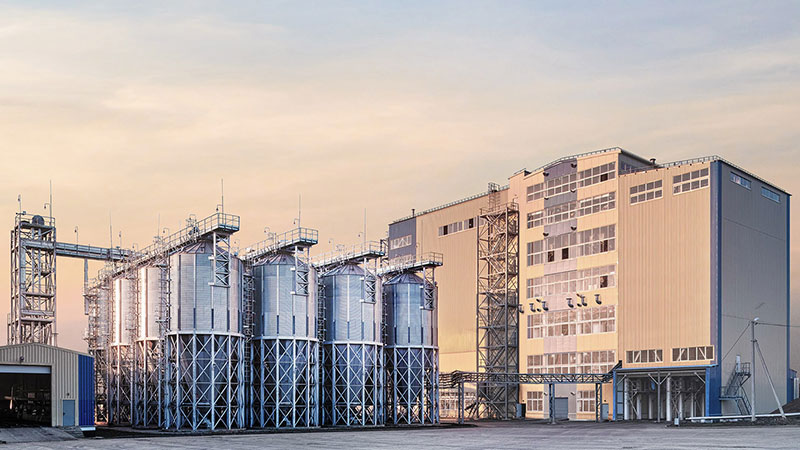
At RICHI, we go beyond project completion. With RICHI Servicee, we’re your dedicated partners in success. Count on us for expert guidance, minimal downtime, and optimized productivity. Choose RICHI for unmatched service and support.
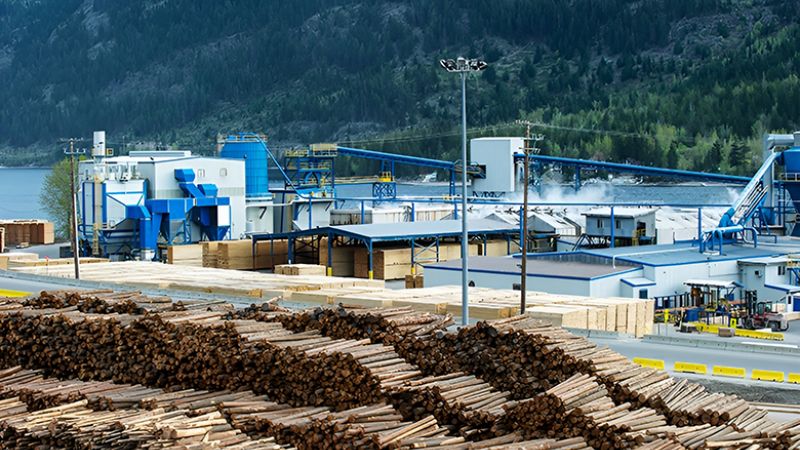


Meet global product demands and quality standards with industry-leading pellet plant design, engineering, equipment, and construction services for pellet processors.


Your Partner Beyond Project Completion
2000+ cases
RICHI is the leading designer, manufacturer and builder of pellet plants in the world, completing over 2000 projects in 140 countries across 6 continents.
Read More
Increase plant productivity, profitability, and safety by integrating high quality equipment into your pellet production line. Over the years, RICHI has become China's top pellet equipment manufacturer. At the same time, RICHI has established valuable partnerships with the world's leading component and raw material manufacturers to bring you the best there is in technology, automation, and efficiency in pelleting plant machinery.

For nearly 30 years, RICHI has been providing best-in-class pellet plant equipment and services to clients across a variety of industries, sizes, and needs. We pride ourselves on the knowledge and skill that each team member possesses – from our technical sales team to our process design engineers. You can count on RICHI Machinery to take your operation to the next level of innovation, quality, and success.
Need help with your pellet manufacturing plant project? Contact us today.
ANIMAL FEED
BIOMASS
WOOD
ORGANIC FERTILIZER
AQUA FEED
CAT LITTER
MUNICIPAL WASTE RECYCLING
SPECIAL PELLET PRODUCTION
RICHI Machinery continues to deliver world class pellet mill equipment, pellet plant engineering and project solutions that add value to our customers in the animal feed, wood waste, agriculture waste, organic fertilizer, cat litter and special pellet products industries. Throughout the years, we RICHI Machinery have built strong brand, becoming industry-leading pellet machine manufacturer. We value integrity, promise quality, and prioritize your success.
Learn MoreWith our expert team, we precisely implement your process engineering requirements in pellet mill and pelletizing plant systems. No matter which industry you’re in – we understand your needs and deliver solutions that meet the highest standards.
At RICHI, quality comes first. Our pellet making machine and related pellet line equipment undergo rigorous quality controls to ensure they meet the highest standards. Rely on products that are durable, safe, and efficient.
With decades of experience in pellet machine and pellet production line production, we have earned a reputation as a trusted partner in various industries. Our expertise allows us to cover a wide range of applications.
Not only do we offer premium pelleting equipment, but we are also experts at designing, building, installing, and maintaining facilities from the ground up. Our expertise is within pellt plant process design, discovering the most efficient, productive, and profitable way to handle your materials in an end-to-end cycle.
○ RICHI MACHINERY
Keeping in touch with us is an effective way to solve all your problems. If you have any needs or questions, please leave your contact information, then RICHI technical consultants will send design, quotation, videos to your mailbox. You can also contact us directly via WhatsApp: +86 13838389622
Copyright©2015-2026 by HENAN RICHI MACHINERY CO., LTD. All rights reserved.