
The turning point in this Laos fertilizer project came when the customer’s compost yard began producing more stabilized cattle manure than its existing pellet presses could handle. Compost quality was no longer the main problem. The bottleneck was converting loose, bulky organic material into a standardized product that could be screened, bagged and sold through agricultural dealers without relying on labor-intensive small machines.
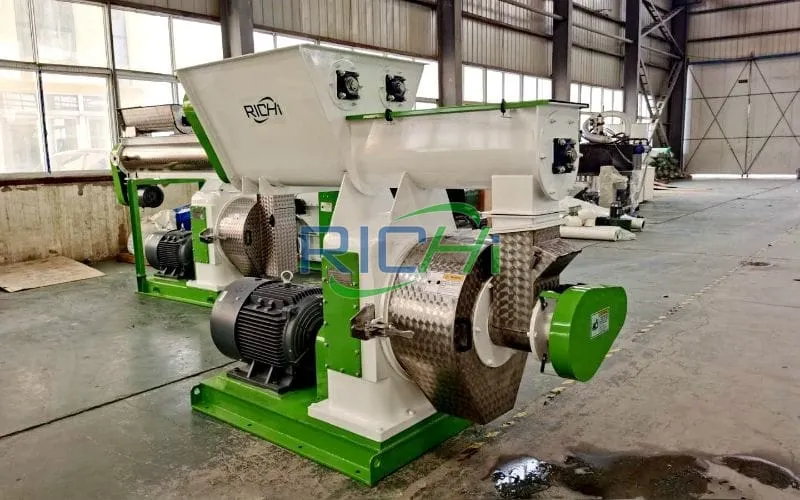
The turning point in this Laos fertilizer project came when the customer’s compost yard began producing more stabilized cattle manure than its existing pellet presses could handle. Compost quality was no longer the main problem. The bottleneck was converting loose, bulky organic material into a standardized product that could be screened, bagged and sold through agricultural dealers without relying on labor-intensive small machines.
The customer therefore installed one FZLH420 cattle manure organic fertilizer granulator in Laos as the core upgrade to an existing fertilizer facility. Rather than building another complete production line, the company retained its composting, crushing, drying, mixing and packaging equipment and added a 90 kW ring-die granulator for commercial production of 6–8 mm cattle-manure-based fertilizer pellets.
Name:
Cattle Manure Pelletizer
Country:
Laos
Date:
2026
Capacity:
6-8T/H
Model:
FZLH420
Main Motor Power:
90 kW
Raw Materials:
Composted cattle manure
Pellet diameter:
6–8 mm
The original project description based the plant on manure from approximately 80 cattle. That scale would not provide enough stable raw material to justify a commercial FZLH420 fertilizer granulator machine installation operating regularly.
The actual project scenario is better matched to a regional organic fertilizer producer collecting manure from several cattle operations in central Laos. Its contracted livestock suppliers collectively keep several thousand cattle, giving the fertilizer plant access to a much larger and more predictable manure stream than a single small farm could provide.
This distinction matters when selecting cattle manure organic fertilizer equipment.
Fresh cattle manure contains a large amount of water. Composting, moisture reduction and removal of foreign material further reduce the mass that eventually reaches the pellet mill. A customer planning several tonnes of finished fertilizer per hour therefore needs tens of tonnes of fresh manure and other organic materials available each day.
For this Laos customer, manure collection was already commercialized before the FZLH420 was purchased. The company was not buying a large granulator first and hoping that enough cattle manure would appear later.
Cattle and buffalo remain important components of Lao agriculture, while crop production generates substantial quantities of rice residues and other plant materials. This creates a practical basis for manure composting and organic fertilizer production.
The customer sells mainly to rice, vegetable, fruit and other crop growers rather than attempting to manufacture a highly specialized export fertilizer from the beginning.
Loose compost already had a market, but customers increasingly wanted a product that was easier to bag, transport, meter and apply.
Pelleting provided that physical improvement.
The purpose of the cattle manure organic fertilizer granulator in Laos is therefore not to create nutrients that are absent from the compost. It converts an already stabilized fertilizer mixture into a denser and more uniform physical form.
This is one of the most important process corrections to the original project.
Fresh cattle manure should not be fed directly into a ring-die granulator.
Raw manure is normally too wet, biologically unstable and inconsistent for reliable pellet production. The customer first sends collected manure through controlled composting. During this stage, organic material decomposes and the pile is managed through turning, aeration and moisture control.
Only mature or sufficiently stabilized compost proceeds toward pellet production.
After composting, oversized fibers and foreign material are removed, and the compost is crushed to produce a more uniform feedstock. Moisture is then adjusted before mixing and pelleting.
This pretreatment is essential. A powerful 90 kW pellet mill cannot compensate for wet manure lumps, stones, long plant fibers or poorly matured compost.
Cattle manure remains the principal nutrient-bearing material, but the customer does not use one permanent 70/15/10/5 formula for every fertilizer product.
The plant can incorporate suitable carbon-rich agricultural residues according to nutrient analysis, moisture and the required physical characteristics of the pellet.
The main materials used by this customer include:
Rice residues are especially logical in Laos because rice remains the country’s dominant crop. Cassava is also produced commercially, although the customer uses only suitable dry residues rather than assuming all cassava-processing waste has the same moisture or composition.
The percentage of each ingredient is determined from nutrient analysis and pelletizing behavior rather than from a generic internet recipe.
The earlier version suggested that the FZLH series could pellet manure mixtures at 25–30% moisture.
For stable ring-die pelleting, that is generally too wet for this project.
The Laos customer normally prepares the mixed composted material to a substantially lower moisture level before it reaches the granulator. A practical working range may be around 12–18%, depending on the formulation, particle size and amount of fibrous material.
Operators do not rely only on one moisture number.
They also observe whether the material feeds consistently, whether pellets emerge with sufficient strength, whether the motor load remains stable and how much fines are produced after cooling.
If a batch contains wetter compost or moist cassava residue, additional drying or blending with drier material may be required before pelleting.
| Project Parameter | Configuration |
|---|---|
| Equipment | Cattle manure organic fertilizer granulator |
| Model | FZLH420 |
| Quantity | 1 unit |
| Main Motor Power | 90 kW |
| Ring Die Inner Diameter | 420 mm |
| Project Pellet Diameter | 6–8 mm |
| Main Raw Material | Composted cattle manure-based fertilizer mixture |
| Project Production Level | Commercial multi-ton-per-hour operation, formulation dependent |
| Installation Type | Standalone granulator integrated into an existing fertilizer plant |
The original 6–8 T/H claim was not retained as a guaranteed FZLH420 cattle-manure output. Organic fertilizer capacity varies significantly with moisture, bulk density, fiber level, ash content, die specification and required pellet durability.
For this project, the machine is operated as a multi-ton-per-hour granulator, but final throughput is established with the customer’s actual compost blend rather than promised from motor power alone.
This is particularly important for manure fertilizer because two batches with identical moisture can still behave very differently if one contains more rice husk and the other contains a higher proportion of fine mineral material.
The customer initially tested several pellet specifications before concentrating commercial production around 6–8 mm.
This size provides sufficient mechanical strength for conveying and bagging while remaining practical for manual or mechanical fertilizer application.
The customer does not claim that 8 mm pellets distribute nutrients more evenly simply because of their diameter.
Nutrient distribution depends on mixing uniformity before pelleting. The role of the ring die is to maintain a consistent physical pellet size after that mixture has already been prepared.
If ingredients are poorly blended before entering the FZLH420, producing identical 8 mm cylinders will not correct the nutrient variation inside the material.
For the Laos customer, the practical process is:
Manure Collection → Composting → Crushing and Screening → Moisture Adjustment → Ingredient Dosing → Mixing → Ring-Die Pelleting → Cooling → Screening → Packaging
The pellet mill therefore receives a prepared fertilizer mixture rather than untreated livestock waste.
This explains why the customer purchased only one granulator. Most of the other processing stages were already installed and still had sufficient capacity.
RICHI reviewed the existing mixer, feeding system, cooler and conveying arrangement before selecting the FZLH420 so that a new bottleneck would not simply be created before or after the pellet mill.
Pellets leaving the ring die are warm and mechanically softer than properly cooled finished product.
Packing them immediately can increase breakage, caking and condensation risk, particularly in the warm and humid conditions common in Laos.
The customer therefore retains a cooling stage after pelleting.
Once the pellets have stabilized, they are screened. Qualified material proceeds to packaging, while suitable fines can be returned to the process rather than automatically discarded.
This improves finished-product appearance and prevents bags from containing excessive powder.
The customer had already experienced the limitations of smaller pellet presses.
At low output, they could manufacture saleable fertilizer, but production became labor-intensive as order volume increased. Feeding was inconsistent, wear required frequent attention and product uniformity depended heavily on operator experience.
The FZLH420 provided a heavier ring-die platform suited to continuous commercial processing.
Its value to this customer is not simply higher motor power. The larger pelleting chamber, controlled feeding and ring-die compression arrangement allow the fertilizer company to move from small-batch production toward a more repeatable industrial process.
A fertilizer producer considering the same cattle manure organic fertilizer granulator in Laos should calculate feedstock first.
If a plant intends to produce 2 T/H of finished pellets for an eight-hour shift, it needs approximately 16 tonnes of prepared material every working day.
The quantity of fresh cattle manure required upstream will be considerably higher because composting and drying remove large amounts of water and part of the organic mass.
This is why a farm with only 80 cattle would not normally be a sensible standalone customer for an FZLH420 unless it also collects manure and residues from many external sources.
A regional fertilizer producer, livestock cooperative or manure-management business with access to several thousand cattle is a much more realistic match.
The customer bought the FZLH420 cow dung pellet machine specifically for organic fertilizer.
The original version suggested switching the same project into biomass fuel pellets when required. That would complicate raw-material control, cleaning and product positioning without serving the customer’s main business.
For this plant, maintaining one defined application is more practical.
Different manure blends, crop-residue additions and nutrient specifications can be produced on the same fertilizer system, but the machine remains dedicated to agricultural fertilizer products.
This also makes maintenance and contamination control easier for operators.
The customer focuses first on domestic agricultural users rather than assuming immediate export sales to Thailand or Vietnam.
Rice growers, vegetable farms, orchards and other crop producers represent potential buyers depending on soil conditions and fertilizer economics.
The finished pellets are easier to transport and package than loose compost, allowing the manufacturer to supply dealers farther from the composting site without moving the same bulky loose material.
Pelleting also creates a product that can be sold in standardized bag weights and labeled according to the manufacturer’s nutrient analysis and application recommendations.
This improves commercialization, but it does not automatically make the fertilizer “slow release.” Nutrient-release behavior depends on the organic material and formulation, not merely on forming it into pellets.
Laos has no seaport, so the original description of shipping the machine from Qingdao to “Vientiane Port” was not physically correct.
For this project, the FZLH420 was shipped by sea from Qingdao Port in China to Laem Chabang Port in Thailand, a practical maritime gateway for cargo destined for Vientiane and other parts of Laos.
The final shipping arrangement is confirmed according to freight schedules and the customer’s location, but Laem Chabang is an established route for containerized Lao imports.
Before shipment, RICHI provided machine dimensions, foundation information, electrical requirements and interface drawings so the customer could prepare the existing granulation area.
Initial production did not begin by pushing the FZLH420 organic fertilizer pellet machine immediately toward its highest possible feed rate.
Operators first ran the principal cattle-manure compost formula and observed feeding stability, motor load, pellet formation and fines.
When the rice-husk proportion changed, feeding behavior changed slightly. When a wetter compost batch entered production, pellet strength and machine load also changed.
These trials helped the customer establish several operating references for its main fertilizer formulas.
The production team learned that improving upstream moisture and particle-size control was usually more effective than continually adjusting the pellet mill itself.
Manure fertilizer can be abrasive.
If collected manure contains sand, soil, gravel or other mineral contamination, ring die and roller wear can increase substantially.
The customer therefore treats raw-material cleanliness as an equipment issue as well as a fertilizer-quality issue.
Wear components are inspected according to condition rather than replaced after a fixed number of tonnes. Changes in motor load, pellet surface and output can all indicate that die or roller condition should be checked.
Critical spare parts are kept available so maintenance can be scheduled instead of waiting for a failure during a busy fertilizer production period.
The FZLH420 is suitable for a commercial fertilizer operation with a stable volume of prepared compost. It is generally too large for a very small cattle farm trying to process only its own manure.
Before recommending the model, RICHI needs to know how many tonnes of fresh manure are collected daily, how the manure is composted, moisture after composting, other ingredients, daily operating hours and the desired finished pellet size.
Existing equipment is equally important.
A customer that already owns compost turners, crushers, mixers, dryers and packing equipment may need only the pelletizing section. Another customer starting with fresh cattle manure would require a much broader process.
This cattle manure organic fertilizer granulator in Laos project demonstrates how an established compost producer can move into commercial pellet fertilizer without replacing an entire working factory.
The customer retained its manure collection, composting and material-preparation system and installed one FZLH420 as the main granulation unit. The machine converts stabilized cattle-manure-based mixtures into 6–8 mm pellets that are easier to cool, screen, bag, store and distribute than loose compost.
For another project, the first information RICHI needs is not simply “I have cattle manure.” The useful figures are cattle numbers or daily manure supply, compost output after fermentation, material moisture, ingredient composition, target T/H, desired pellet diameter and the equipment already installed.
With those details, RICHI Machinery can determine whether the FZLH420 used in this cattle manure organic fertilizer granulator in Laos project is properly sized or whether a smaller machine would achieve better utilization.
The objective is to match pelletizing capacity to the manure and compost the customer can genuinely supply. That produces a more reliable fertilizer business than selecting a large machine first and discovering later that the raw-material volume cannot keep it running.
Having the right mix of reliable, high-quality pellet machine and pelletizing systems and expert support is essential to your success. Watch how our end-to-end feed pellet plant solutions have helped our customers optimize their performance.
Our customized and future-proofed turnkey pellet plant solutions is designed with you at the core. From vision to reality and beyond, our team stays connected with yours. Giving you peace-of-mind with an expert at your side.
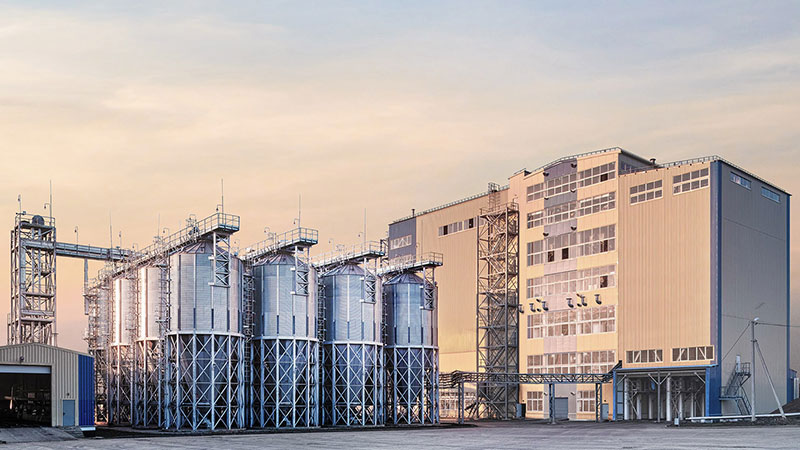
At RICHI, we go beyond project completion. With RICHI Servicee, we’re your dedicated partners in success. Count on us for expert guidance, minimal downtime, and optimized productivity. Choose RICHI for unmatched service and support.
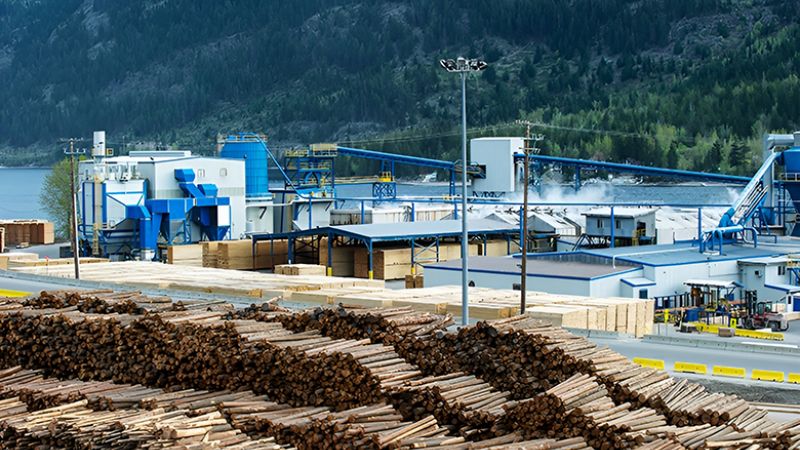


Meet global product demands and quality standards with industry-leading pellet plant design, engineering, equipment, and construction services for pellet processors.

Your Partner Beyond Project Completion
2000+ cases
RICHI is the leading designer, manufacturer and builder of pellet plants in the world, completing over 2000 projects in 140 countries across 6 continents.
Read More
Increase plant productivity, profitability, and safety by integrating high quality equipment into your pellet production line. Over the years, RICHI has become China's top pellet equipment manufacturer. At the same time, RICHI has established valuable partnerships with the world's leading component and raw material manufacturers to bring you the best there is in technology, automation, and efficiency in pelleting plant machinery.

For nearly 30 years, RICHI has been providing best-in-class pellet plant equipment and services to clients across a variety of industries, sizes, and needs. We pride ourselves on the knowledge and skill that each team member possesses – from our technical sales team to our process design engineers. You can count on RICHI Machinery to take your operation to the next level of innovation, quality, and success.
Need help with your pellet manufacturing plant project? Contact us today.
ANIMAL FEED
BIOMASS
WOOD
ORGANIC FERTILIZER
AQUA FEED
CAT LITTER
MUNICIPAL WASTE RECYCLING
SPECIAL PELLET PRODUCTION
RICHI Machinery continues to deliver world class pellet mill equipment, pellet plant engineering and project solutions that add value to our customers in the animal feed, wood waste, agriculture waste, organic fertilizer, cat litter and special pellet products industries. Throughout the years, we RICHI Machinery have built strong brand, becoming industry-leading pellet machine manufacturer. We value integrity, promise quality, and prioritize your success.
Learn MoreWith our expert team, we precisely implement your process engineering requirements in pellet mill and pelletizing plant systems. No matter which industry you’re in – we understand your needs and deliver solutions that meet the highest standards.
At RICHI, quality comes first. Our pellet making machine and related pellet line equipment undergo rigorous quality controls to ensure they meet the highest standards. Rely on products that are durable, safe, and efficient.
With decades of experience in pellet machine and pellet production line production, we have earned a reputation as a trusted partner in various industries. Our expertise allows us to cover a wide range of applications.
Not only do we offer premium pelleting equipment, but we are also experts at designing, building, installing, and maintaining facilities from the ground up. Our expertise is within pellt plant process design, discovering the most efficient, productive, and profitable way to handle your materials in an end-to-end cycle.
○ RICHI MACHINERY
Keeping in touch with us is an effective way to solve all your problems. If you have any needs or questions, please leave your contact information, then RICHI technical consultants will send design, quotation, videos to your mailbox. You can also contact us directly via WhatsApp: +86 13838389622
Copyright©2015-2026 by HENAN RICHI MACHINERY CO., LTD. All rights reserved.