
A 0.3–0.5 T/H MZLH350 biochar pelletizer in Indonesia processes selected coconut-shell char fines into uniform carbon pellets within an existing charcoal plant.
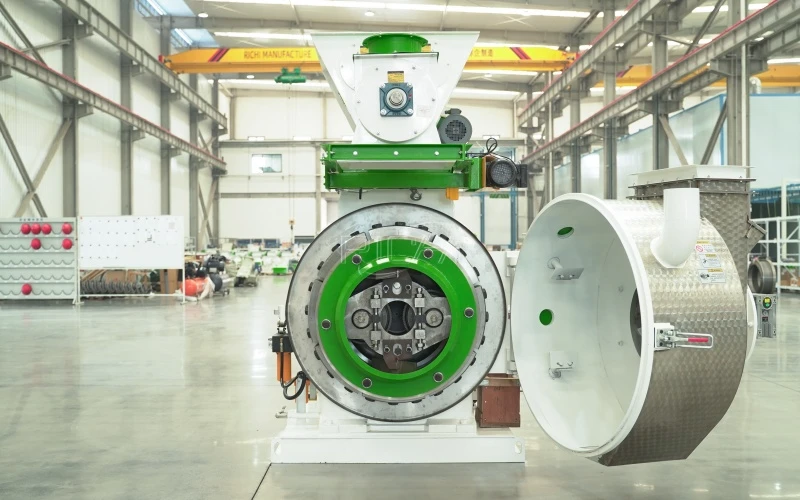
The biochar pelletizer in Indonesia was supplied to a coconut-shell charcoal processor that wanted to develop a pelletized product from the fine carbon material generated during crushing and screening. The company already had access to coconut shells, carbonization equipment and an established charcoal-processing operation, so its requirement was not a complete biochar plant. The investment focused on finding a controlled way to densify a selected portion of coconut-shell char fines.
RICHI Machinery matched the project with one MZLH350 ring die pelletizer rated at 0.3–0.5 t/h. The smaller capacity was deliberate. The customer continued selling other coconut-char products through its existing channels and only diverted a limited, prepared fine fraction to the new pelletizing section. Installing a multi-ton-per-hour machine would therefore have been poorly matched to the amount of material actually available for this product.
Name:
Biochar pelletizer
Country:
Indonesia
Date:
2025
Capacity:
0.3–0.5 t/h
Model:
MZLH350
Main Motor Power:
37 kW
Raw Materials:
Coconut-shell biochar / char fines
Pellet diameter:
6 mm
Indonesia has a substantial coconut-processing industry, and coconut shells are already used commercially for charcoal and related carbon products. For this customer, the raw material did not begin as purchased biochar powder.
Coconut shells were collected through the company's existing supply network and carbonized before entering further processing. After cooling, crushing and grading, part of the carbonized material met the specifications of existing products, while another portion remained as smaller particles and fines.
The customer wanted to separate a controlled quantity of this material for pellet production rather than changing the entire charcoal business.
That made the project different from a greenfield biochar facility. Carbonization capacity, shell sourcing and most raw-material handling functions already existed. The new biochar pelletizer had to work downstream of those operations.
Coconut shell produces a relatively hard carbonized material, so the forming strategy could not simply copy the eucalyptus-biochar settings used in a woody-residue project.
Once the shell has been carbonized and crushed, the resulting particles have little of the natural binding behavior associated with untreated biomass. The fine carbon fraction therefore needs controlled preparation before ring die pelletizing.
The customer screened the material and reduced remaining oversized particles before mixing. Moisture was then adjusted together with a small binder addition selected according to the required finished-product properties.
RICHI did not specify an arbitrary universal binder percentage.
Binder demand depends on char fineness, carbonization condition, moisture and the strength required after pelletizing. The correct proportion is the lowest practical level that allows the pellets to survive cooling, screening, packaging and normal transport without unnecessarily changing the carbon product.
The amount of char fines selected for pelletization was relatively small compared with the customer's total charcoal output.
For that reason, RICHI selected the MZLH350 instead of sizing the machine according to the capacity of the carbonization plant.
| Project ItemConfiguration | |
|---|---|
| Equipment | Biochar pelletizer |
| Model | MZLH350 |
| Quantity | 1 unit |
| Main Motor Power | 37 kW |
| Rated Capacity | 0.3–0.5 t/h |
| Main Material | Coconut-shell biochar / char fines |
| Project Type | Existing charcoal plant upgrade |
| Forming Method | Ring die pelletizing |
| Main Objective | Densification of selected coconut-shell char fines |
The MZLH350 gave the customer enough capacity to establish a separate pellet product without creating pressure to divert material away from more established charcoal products merely to keep a large pellet mill full.
This is particularly important in by-product projects. Total factory output and pelletizable fine-material output are not the same number.
Indonesia already has an established coconut-shell charcoal briquette industry, but this project was not written around conventional barbecue or shisha briquettes.
The customer was testing a smaller cylindrical pelletized carbon product produced through ring die densification.
That distinction matters because a briquette press and a ring die pelletizer create different product geometries and can serve different handling and end-use requirements.
The customer selected pelletizing because it wanted continuous production of relatively small, uniform carbon pellets from prepared fines. It did not need the larger pillow, cube or hexagonal forms commonly associated with charcoal briquette products.
RICHI therefore evaluated the equipment around the required pellet form rather than treating every densified coconut-char product as the same thing.
The existing plant already handled the major carbonization steps, but the pelletizing feed still required preparation.
Screened coconut-shell char fines were collected separately. Remaining coarse pieces were reduced so they would not interrupt feeding or create an uneven material bed inside the pelletizing chamber.
The prepared carbon powder then entered mixing, where moisture and binder could be distributed more evenly.
Adding liquid directly onto poorly mixed carbon powder would create local wet and dry zones. The wet fraction could feed badly, while the dry fraction might leave the die with insufficient pellet strength.
Uniform preparation was therefore more important than simply adding more binder.
Once prepared, the mixture was metered steadily into the MZLH350. The ring die and rollers applied mechanical compression, and the formed strands were cut to the required length before downstream stabilization and screening.
The customer wanted pellets that would remain intact during bagging and normal transport, but maximum hardness was not the goal.
A carbon pellet can be made mechanically stronger by changing formulation and compression conditions, yet those changes can also affect cost, ash characteristics and the way the product behaves in its final application.
RICHI therefore treated durability as a product specification rather than a competition to produce the hardest possible pellet.
During trial operation, the customer checked the material after pelletizing, cooling and screening instead of evaluating only fresh strands leaving the die.
This provided a more realistic indication of how much saleable pellet remained after normal handling.
Broken material and suitable screened fines could be returned to the preparation stage at a controlled rate rather than discarded.
One practical concern was present before the pellet mill even started: coconut-shell char powder can generate dust during crushing, screening, transfer and mixing.
Pelletizing reduces the amount of loose powder in the finished product, but the upstream fine-char area still requires suitable control.
RICHI therefore considered enclosed transfer, dust collection at relevant points and good housekeeping as part of the integration discussion.
The customer also needed to apply appropriate fire and dust-risk controls according to its actual carbon material, plant conditions and local requirements.
This was especially relevant because the new machine was being installed inside an existing charcoal-processing environment rather than an isolated new workshop.
The strongest reason for purchasing only one biochar pellet making machine was that the customer already owned the expensive upstream assets.
There was no reason to replace the shell-carbonization system, char crusher or existing grading equipment simply because a new pellet product was being added.
RICHI instead reviewed where the new machine would enter the process.
Feeding position, foundation, electrical supply, discharge arrangement, access for ring die and roller maintenance, and connection with downstream handling were considered before installation.
This kept the project focused on the missing function: pelletization.
After commissioning, the customer considered the smaller capacity an advantage rather than a limitation.
The new section could process selected batches of prepared coconut-shell char without disrupting the factory's established charcoal production.
The production team commented:
"We did not want to put all of our charcoal into one new product. The smaller pelletizing section lets us use selected fine material and adjust the product while the rest of the factory continues its normal production."
This is why the MZLH350 made more sense than a larger machine for this particular customer.
Capacity was matched to the new product stream, not to the size of the company.
The MZLH350 was manufactured and inspected before being packed for sea shipment from Qingdao Port, China, to Surabaya, Indonesia.
Because the pelletizer was being added to an operating plant, RICHI Machinery supplied the technical information required for foundation and connection preparation before equipment arrival.
The service scope also covered installation guidance, commissioning assistance, operating instruction and troubleshooting support.
Operators were trained to pay attention to changes in char particle condition, feeding stability, motor load, die discharge and fines generation rather than relying on one permanent machine setting.
The biochar pelletizer in Indonesia was configured for predominantly coconut-shell char, so the MZLH series was appropriate for this densification route.
That would change if the finished product changed.
A manufacturer mixing coconut-shell biochar with composted poultry manure, livestock manure or another organic fertilizer base would be producing a biochar-based fertilizer rather than predominantly densified char. RICHI would then evaluate the FZLH fertilizer pellet machine series and the surrounding fertilizer process.
Capacity can also change substantially.
The MZLH350 used here provides 0.3–0.5 t/h. A customer with a larger continuous char-fines stream may require the MZLH420, MZLH520 or a higher-capacity model, provided the upstream preparation system can actually supply it.
For this Indonesian processor, however, one MZLH350 was the more practical choice. It allowed an existing coconut-shell charcoal business to convert selected fine material into a uniform pelletized carbon product without rebuilding the plant or oversizing the new production section.
Having the right mix of reliable, high-quality pellet machine and pelletizing systems and expert support is essential to your success. Watch how our end-to-end feed pellet plant solutions have helped our customers optimize their performance.
Our customized and future-proofed turnkey pellet plant solutions is designed with you at the core. From vision to reality and beyond, our team stays connected with yours. Giving you peace-of-mind with an expert at your side.
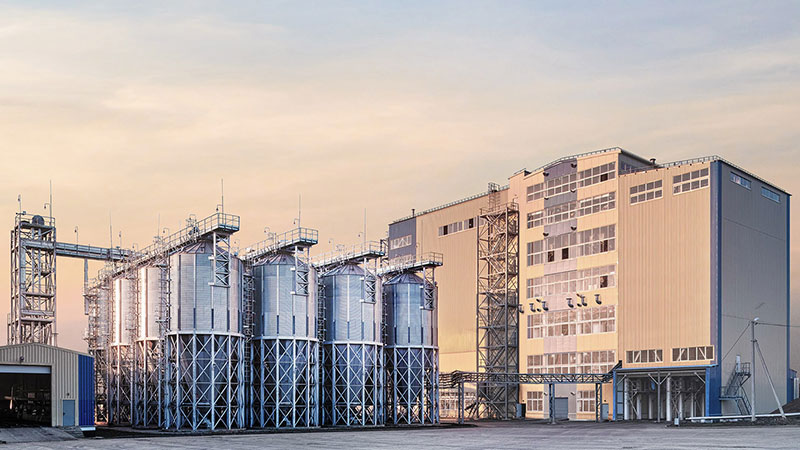
At RICHI, we go beyond project completion. With RICHI Servicee, we’re your dedicated partners in success. Count on us for expert guidance, minimal downtime, and optimized productivity. Choose RICHI for unmatched service and support.
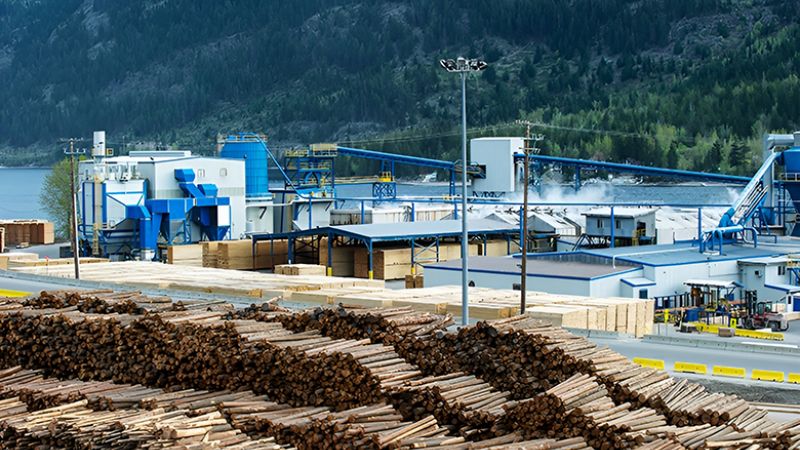


Meet global product demands and quality standards with industry-leading pellet plant design, engineering, equipment, and construction services for pellet processors.

Your Partner Beyond Project Completion
2000+ cases
RICHI is the leading designer, manufacturer and builder of pellet plants in the world, completing over 2000 projects in 140 countries across 6 continents.
Read More
Increase plant productivity, profitability, and safety by integrating high quality equipment into your pellet production line. Over the years, RICHI has become China's top pellet equipment manufacturer. At the same time, RICHI has established valuable partnerships with the world's leading component and raw material manufacturers to bring you the best there is in technology, automation, and efficiency in pelleting plant machinery.

For nearly 30 years, RICHI has been providing best-in-class pellet plant equipment and services to clients across a variety of industries, sizes, and needs. We pride ourselves on the knowledge and skill that each team member possesses – from our technical sales team to our process design engineers. You can count on RICHI Machinery to take your operation to the next level of innovation, quality, and success.
Need help with your pellet manufacturing plant project? Contact us today.
ANIMAL FEED
BIOMASS
WOOD
ORGANIC FERTILIZER
AQUA FEED
CAT LITTER
MUNICIPAL WASTE RECYCLING
SPECIAL PELLET PRODUCTION
RICHI Machinery continues to deliver world class pellet mill equipment, pellet plant engineering and project solutions that add value to our customers in the animal feed, wood waste, agriculture waste, organic fertilizer, cat litter and special pellet products industries. Throughout the years, we RICHI Machinery have built strong brand, becoming industry-leading pellet machine manufacturer. We value integrity, promise quality, and prioritize your success.
Learn MoreWith our expert team, we precisely implement your process engineering requirements in pellet mill and pelletizing plant systems. No matter which industry you’re in – we understand your needs and deliver solutions that meet the highest standards.
At RICHI, quality comes first. Our pellet making machine and related pellet line equipment undergo rigorous quality controls to ensure they meet the highest standards. Rely on products that are durable, safe, and efficient.
With decades of experience in pellet machine and pellet production line production, we have earned a reputation as a trusted partner in various industries. Our expertise allows us to cover a wide range of applications.
Not only do we offer premium pelleting equipment, but we are also experts at designing, building, installing, and maintaining facilities from the ground up. Our expertise is within pellt plant process design, discovering the most efficient, productive, and profitable way to handle your materials in an end-to-end cycle.
○ RICHI MACHINERY
Keeping in touch with us is an effective way to solve all your problems. If you have any needs or questions, please leave your contact information, then RICHI technical consultants will send design, quotation, videos to your mailbox. You can also contact us directly via WhatsApp: +86 13838389622
Copyright©2015-2026 by HENAN RICHI MACHINERY CO., LTD. All rights reserved.