
Biochar pelleting machine in Vietnam for coffee-husk-derived biochar. One MZLH520 was supplied for 1.5–2 t/h commercial biochar pellet production.
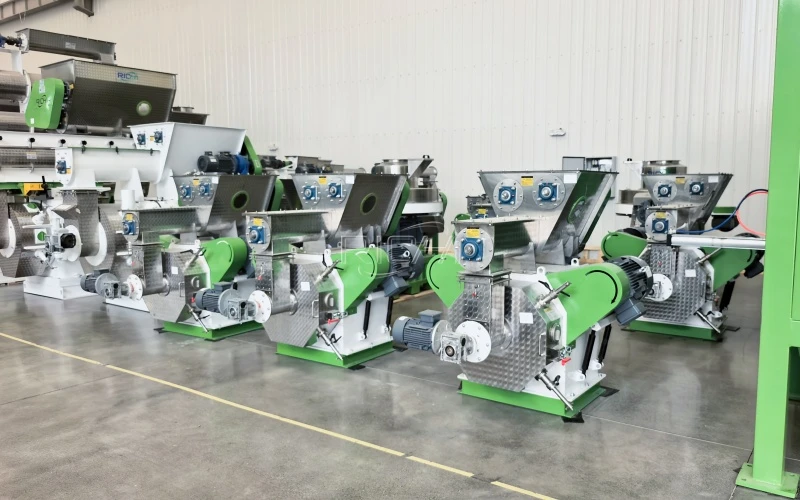
A bag of biochar sold this month should not behave completely differently from the one delivered next month. That was the commercial requirement behind this biochar pelleting machine in Vietnam. The customer worked with coffee-processing residues and had developed a route for converting coffee husks into biochar, but moving from loose char to a repeatable pellet product required tighter control over the material entering the forming stage.
RICHI Machinery supplied one MZLH520 with a capacity of 1.5–2 t/h. The machine became the point where prepared coffee-husk biochar was converted into a defined physical product, while the customer's existing pyrolysis and raw-material operations remained outside the equipment scope.
Name:
Biochar Pelleting Machine
Country:
Vietnam
Date:
2025
Capacity:
1.5–2 t/h
Model:
MZLH520
Main Motor Power:
132 kW
Raw Materials:
Coffee husk
Pellet diameter:
6 mm
Coffee husk may have one name, but the char produced from it does not automatically have one set of properties.
Incoming husks can vary. Pyrolysis conditions matter as well. Changes in thermal treatment can alter the structure and characteristics of the resulting biochar. Research involving Vietnamese agricultural residues has likewise shown that pyrolysis temperature affects biochar properties.
For a loose product, some physical variation may be manageable.
A commercial pellet is less forgiving.
Changes in particle size, moisture or char behavior can appear as unstable feeding, changing machine load, poor extrusion or excessive breakage. The customer's production plan therefore introduced a preparation specification before the biochar reached the MZLH520.
That specification was more important than trying to make the pelletizer compensate for every upstream variation.
The material route needs to be described correctly.
Coffee husk was first collected as an agricultural processing residue. Suitable material was prepared and subjected to pyrolysis. Only after carbonization, cooling and subsequent size preparation did it become feedstock for the biochar pelleting section.
The MZLH520 was therefore not processing raw coffee husk.
Nor was the customer making conventional coffee-husk biomass pellets and then carbonizing the finished pellets.
Its route was:
Keeping these stages separate prevents a common misunderstanding when discussing coffee-residue pellet projects.
The planned pellet product represented a regular commercial output rather than a laboratory trial, but the customer did not have enough prepared char allocated to pelletizing to justify the largest MZLH models.
The 1.5–2 t/h range provided the required middle ground.
| Project DetailSelected Plan | |
|---|---|
| Equipment | Biochar pelleting machine |
| Model | MZLH520 |
| Number | 1 unit |
| Main Motor | 132 kW |
| Capacity | 1.5–2 t/h |
| Biochar Source | Coffee husk |
| Customer Goal | Standardized commercial biochar pellets |
| Plant Type | Existing biochar operation with new pelleting stage |
Capacity was calculated from prepared biochar available to this stage, not from tonnes of fresh coffee residue collected by the company.
That difference prevented oversizing.
It also allowed loose biochar and other carbon products to remain outside the pellet route whenever required.
Instead of trying to establish one permanent feeder speed or one permanent moisture setting, RICHI worked from the opposite direction.
First define what material is acceptable at the pelletizer inlet.
Particle distribution needed reasonable consistency. Oversized carbonized pieces were reduced. Foreign material had to be removed. Moisture was checked before additional water was considered.
Binder was then evaluated according to pellet strength and intended application.
This sequence matters with biochar because adding the same amount of water or binder to every batch does not guarantee the same result.
A more porous or drier batch may respond differently from material produced under another carbonization condition.
The operators therefore learned to check the feed material first and adjust the process second.
Fresh extrusion can be misleading.
A pellet may leave the ring die with a clean surface and still break badly after subsequent transfer.
For this project, product assessment continued through stabilization and screening. The customer monitored the proportion of intact pellets as well as the quantity of fines generated downstream.
That gave the production team a more useful measure of commercial quality.
When breakage increased, several causes could be checked: char particle condition, moisture distribution, binder performance, feed stability, die condition and compression behavior.
Suitable screened fines could be returned in a controlled manner rather than automatically discarded.
The objective was a repeatable finished specification, not an attractive pellet sample collected directly beneath the machine.
Vietnam is a major coffee-producing country, making coffee-processing residues relevant to local biomass-utilization projects. More importantly for this particular application, recent research has specifically produced and characterized biochar from coffee husk among common Vietnamese agro-wastes.
That evidence supports the feedstock route without implying that every Vietnamese coffee processor already operates a biochar plant.
The customer scenario is narrower: a residue-utilization company with access to coffee husk and an established carbonization route wanted to commercialize part of the resulting char in pellet form.
This distinction keeps the project technically plausible without turning an industry opportunity into an invented national practice.
The planned Vietnamese product remained predominantly coffee-husk biochar.
That is why RICHI selected the MZLH series.
The decision would be different if the customer mixed the char with a large proportion of composted manure, digestate solids or other fertilizer ingredients and marketed the resulting formulation as an organic fertilizer.
Such a material could shift the project toward the FZLH fertilizer pellet machine series.
The end market alone is not enough to make that decision.
A biochar pellet used on soil and a biochar-based compound organic fertilizer can both enter agriculture while requiring different production logic.
Training did not end with instructions on starting and stopping the machine.
RICHI gave the production team a simple troubleshooting logic.
If output declined, check whether feed quantity had changed. If machine load fluctuated, inspect feeding and material uniformity. If pellets formed but later produced excessive fines, review preparation and binding conditions. If extrusion gradually changed despite stable raw material, inspect the ring die and rollers.
That sequence helps separate process problems from mechanical problems.
It also matters in a coffee-residue project because the properties of the incoming biochar may shift before any visible machine component fails.
The customer's operators could therefore respond to variation instead of repeatedly increasing pressure or binder without identifying the cause.
The customer was not asking, "Can coffee-husk biochar be pushed through a die?"
The real question was whether successive batches could leave the factory as a sufficiently consistent pellet product.
During initial production, the team compared feeding behavior, pellet appearance, downstream breakage and finished-product handling across different prepared batches.
The customer's feedback focused on this point:
"Making one good batch was not our main concern. We needed a process the operators could repeat when the next batch of biochar was slightly different. The material checks before pelletizing became an important part of production."
That became the operational value of the project.
The MZLH520 and supplied components were inspected and packed in China before leaving Qingdao Port for the Ho Chi Minh City port area in Vietnam.
Site preparation was comparatively straightforward because the customer already operated the upstream biochar process. The installation work concentrated on the new pelletizing position, electrical connection, material inlet, discharge interface and maintenance access.
RICHI provided installation guidance, commissioning assistance and operating training. The service also covered ring die and roller inspection, lubrication, feeder adjustment, wear-part planning and troubleshooting after production began.
Coffee residues themselves are not interchangeable.
Coffee husk, coffee pulp, coffee silverskin and spent coffee grounds arise from different processing stages and have different physical characteristics. Research has separately investigated spent coffee grounds as a biochar feedstock, demonstrating why the generic term "coffee waste" is too broad for equipment selection.
For the Vietnamese project, the specified material was coffee-husk-derived biochar.
A future inquiry involving spent coffee grounds should therefore be evaluated again rather than copied from this configuration.
RICHI Machinery would check the exact coffee residue, carbonization route, resulting char condition, hourly quantity, particle size, moisture, acceptable binder and finished pellet requirement before confirming the machine.
Here, those checks led to one MZLH520 at 1.5–2 t/h. More importantly, they gave the customer a method for keeping a variable agricultural char within a controllable pellet-production window.
Having the right mix of reliable, high-quality pellet machine and pelletizing systems and expert support is essential to your success. Watch how our end-to-end feed pellet plant solutions have helped our customers optimize their performance.
Our customized and future-proofed turnkey pellet plant solutions is designed with you at the core. From vision to reality and beyond, our team stays connected with yours. Giving you peace-of-mind with an expert at your side.
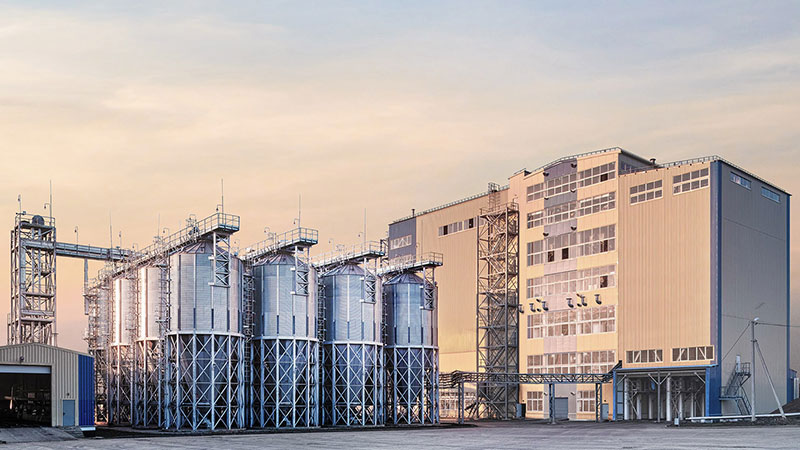
At RICHI, we go beyond project completion. With RICHI Servicee, we’re your dedicated partners in success. Count on us for expert guidance, minimal downtime, and optimized productivity. Choose RICHI for unmatched service and support.
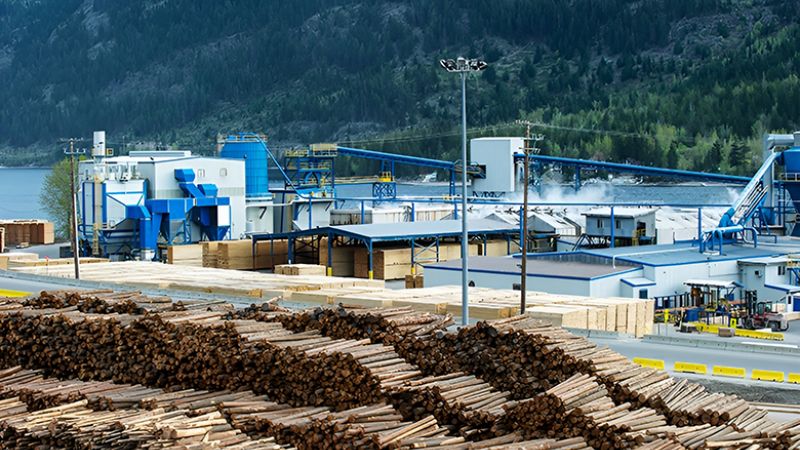


Meet global product demands and quality standards with industry-leading pellet plant design, engineering, equipment, and construction services for pellet processors.

Your Partner Beyond Project Completion
2000+ cases
RICHI is the leading designer, manufacturer and builder of pellet plants in the world, completing over 2000 projects in 140 countries across 6 continents.
Read More
Increase plant productivity, profitability, and safety by integrating high quality equipment into your pellet production line. Over the years, RICHI has become China's top pellet equipment manufacturer. At the same time, RICHI has established valuable partnerships with the world's leading component and raw material manufacturers to bring you the best there is in technology, automation, and efficiency in pelleting plant machinery.

For nearly 30 years, RICHI has been providing best-in-class pellet plant equipment and services to clients across a variety of industries, sizes, and needs. We pride ourselves on the knowledge and skill that each team member possesses – from our technical sales team to our process design engineers. You can count on RICHI Machinery to take your operation to the next level of innovation, quality, and success.
Need help with your pellet manufacturing plant project? Contact us today.
ANIMAL FEED
BIOMASS
WOOD
ORGANIC FERTILIZER
AQUA FEED
CAT LITTER
MUNICIPAL WASTE RECYCLING
SPECIAL PELLET PRODUCTION
RICHI Machinery continues to deliver world class pellet mill equipment, pellet plant engineering and project solutions that add value to our customers in the animal feed, wood waste, agriculture waste, organic fertilizer, cat litter and special pellet products industries. Throughout the years, we RICHI Machinery have built strong brand, becoming industry-leading pellet machine manufacturer. We value integrity, promise quality, and prioritize your success.
Learn MoreWith our expert team, we precisely implement your process engineering requirements in pellet mill and pelletizing plant systems. No matter which industry you’re in – we understand your needs and deliver solutions that meet the highest standards.
At RICHI, quality comes first. Our pellet making machine and related pellet line equipment undergo rigorous quality controls to ensure they meet the highest standards. Rely on products that are durable, safe, and efficient.
With decades of experience in pellet machine and pellet production line production, we have earned a reputation as a trusted partner in various industries. Our expertise allows us to cover a wide range of applications.
Not only do we offer premium pelleting equipment, but we are also experts at designing, building, installing, and maintaining facilities from the ground up. Our expertise is within pellt plant process design, discovering the most efficient, productive, and profitable way to handle your materials in an end-to-end cycle.
○ RICHI MACHINERY
Keeping in touch with us is an effective way to solve all your problems. If you have any needs or questions, please leave your contact information, then RICHI technical consultants will send design, quotation, videos to your mailbox. You can also contact us directly via WhatsApp: +86 13838389622
Copyright©2015-2026 by HENAN RICHI MACHINERY CO., LTD. All rights reserved.