
Biochar pellet production machine in Spain for olive-pomace-derived biochar. RICHI MZLH520 produces 1.5–2 t/h for pelletized agricultural soil amendments.
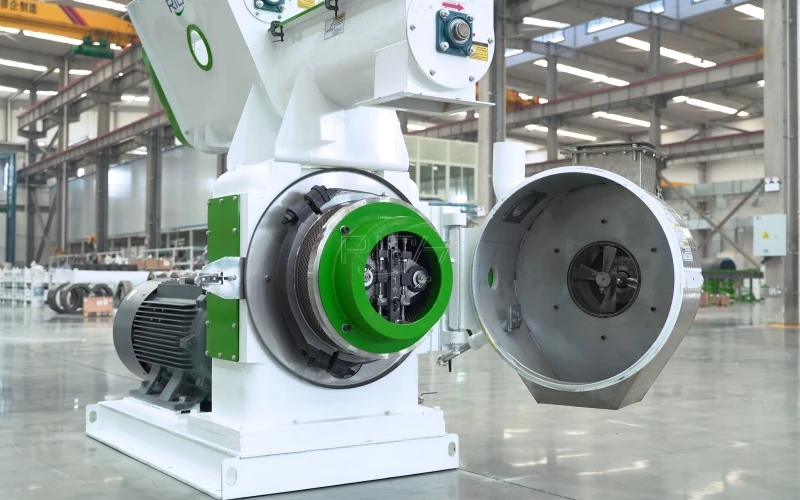
An olive residue can leave the mill as waste, enter a thermal conversion process, and eventually return to agricultural land in an entirely different physical form. That circular route shaped the biochar pellet production machine in Spain project. The customer wanted to take olive-derived biochar already produced within its residue-utilization operation and manufacture a pelletized soil amendment that was easier for distributors and growers to handle than loose carbon powder.
RICHI Machinery supplied one MZLH520 biochar pellet machine rated at 1.5–2 t/h. The project did not replace the customer's pyrolysis equipment, nor was it designed as a conventional organic fertilizer plant. Pelletizing occupied one specific position in the chain: after olive residue had become biochar and before the finished carbon product entered agricultural distribution.
Name:
Biochar Pellet Machine
Country:
Spain
Date:
2026
Capacity:
1.5–2 t/h
Model:
MZLH520
Main Motor Power:
132 kW
Raw Materials:
Olive-pomace-derived biochar
Pellet diameter:
6 mm
Spain provided an unusually clear raw-material setting for this application.
Olive cultivation and olive-oil production generate several different residues. They include olive-tree pruning biomass from orchards, leaves separated during mill cleaning and olive pomace from oil extraction. Research into Spanish olive-sector biomass has documented these streams and their potential for further valorization.
The customer did not treat all of them as one interchangeable raw material.
For the pellet product, the principal carbon material was biochar produced from prepared olive pomace. Olive-pruning-derived biochar could also be evaluated as another qualified carbon source, but it was not automatically mixed into every batch.
That distinction allowed the finished pellet specification to remain controllable.
The MZLH520 sat well downstream of the olive mill.
Fresh olive pomace can contain substantial moisture and is not something that should simply be fed into a ring die machine and called biochar pellets. It first requires an appropriate thermal-conversion route if biochar is the intended product.
Spanish research provides a real industrial reference for this sequence. A study of super-intensive olive groves in southern Spain used olive-pomace biochar produced by continuous slow pyrolysis at an industrial facility in Jaén, Andalusia.
Only after thermal conversion and cooling does the solid carbon product become relevant to this pelletizing project.
For RICHI, the starting material was therefore prepared biochar—not wet olive pomace.
Because application form matters.
Loose biochar remains entirely valid for many agricultural applications. If a grower has appropriate bulk handling and incorporation equipment, there may be no reason to pelletize it.
The Spanish customer was targeting another distribution route.
A pellet can be easier to meter into bags, transfer through handling equipment and combine operationally with mechanized agricultural application. It also reduces some of the handling inconvenience associated with very light loose powder.
The company therefore planned both forms rather than declaring one universally better.
This made pelletizing a product-format decision, not a prerequisite for biochar to function as biochar.
The olive-residue operation itself was larger than 2 t/h, but only part of the resulting biochar was scheduled for pellet production.
That was the number that mattered.
| Project Definition | Selected Configuration |
|---|---|
| Machine | Biochar pellet production machine |
| Model | MZLH520 |
| Quantity | 1 unit |
| Main Motor | 132 kW |
| Capacity | 1.5–2 t/h |
| Main Material | Olive-pomace-derived biochar |
| Product | Pelletized biochar soil amendment |
| Customer Type | Olive-residue utilization enterprise |
| Project Form | Pelletizing addition to existing operation |
RICHI therefore selected the MZLH520 rather than scaling the pellet machine from tonnes of olives processed or tonnes of fresh pomace generated.
Those figures belong to earlier stages of the material balance.
The pelletizer has to follow the quantity of prepared biochar actually assigned to it.
One reason not to copy settings from a wood-char project is that olive-derived biochar has its own composition.
For example, the Spanish industrial olive-pomace biochar characterized in the Jaén study contained a substantial ash fraction and measurable mineral components. Other studies also show that biochar characteristics change according to feedstock and thermal-conversion conditions.
RICHI therefore avoided assuming that a die and recipe proven with clean woody char could simply be transferred unchanged.
The actual customer's char would need its own particle-size, moisture and ash assessment.
Those results influence forming behavior, equipment wear and the finished product.
The customer did not need a carbon pellet that behaved like a permanent ceramic granule.
It needed one that could survive its commercial journey.
Prepared biochar was mixed under controlled conditions before entering the MZLH520. Where additional binding was necessary, binder selection had to remain compatible with the intended soil application.
The ring die then provided the mechanical compression needed to form cylindrical pellets.
But the useful test came afterward.
Could those pellets leave the machine, stabilize, pass through screening, enter packaging and survive transport without turning predominantly back into powder?
If yes, the mechanical requirement had been achieved.
Making them dramatically harder than the supply chain required would not automatically make the agricultural product better.
Spain is also a realistic market for biochar-based fertilizer development. Research assessing Spain and other Mediterranean countries has specifically examined the potential for producing biochar-based fertilizers from olive-mill wastes.
That does not mean every olive biochar pellet should use fertilizer equipment.
This customer was pelletizing predominantly olive-derived biochar, so RICHI selected the MZLH densification route.
Consider a different formulation: olive biochar blended heavily with composted livestock manure and other nutrient-bearing organic materials to produce a compound organic fertilizer.
Now the material system has changed.
RICHI would reassess that project around the FZLH fertilizer pellet machine series rather than automatically supplying the MZLH520 used here.
The percentage and physical behavior of each ingredient matter more than the marketing name printed on the bag.
The customer already possessed the upstream conversion capability and other useful plant infrastructure.
RICHI's integration work therefore concentrated on the missing section.
Prepared char storage had to supply the pelletizer without large feed interruptions. Mixing had to distribute moisture and binder evenly. The MZLH520 required appropriate electrical supply, foundation and maintenance clearance.
Downstream, the customer needed stabilization and screening suitable for the intended throughput.
Fines separated there could be evaluated for controlled return rather than automatically becoming waste.
Dust collection remained most important around the sections where the material was still fine and loose.
This approach kept the retrofit focused. Equipment was added because a process function was missing, not because every existing machine needed replacing.
Commissioning therefore ended differently from a simple capacity test.
The team followed product through the downstream stages.
Pellet appearance mattered. Breakage mattered more. Fines content after screening mattered. Bag handling mattered.
The customer summarized the project this way:
"We already understood how we wanted to use the biochar. The question was how to offer it in a form that was practical for more customers. Pelletizing gave us that additional format without changing the whole olive-residue process."
That was also why the project remained a single-machine-centered retrofit rather than becoming a new complete factory.
The MZLH520 was prepared for sea transport from Qingdao Port to Valencia, Spain after manufacturing and inspection.
Technical documentation allowed the customer to prepare the installation area while shipment was underway. RICHI supplied guidance covering positioning, electrical connection, material interfaces and maintenance access.
Commissioning support then focused on the actual olive-derived char.
Operators were trained to observe feeding, machine load, extrusion condition, downstream pellet breakage and normal ring die and roller wear. They were also instructed to reassess operating parameters when the incoming biochar changed instead of assuming that every black carbon material required the same settings.
Olive-derived biochar is not merely a theoretical Spanish feedstock. Research has examined olive pomace, olive stones, olive-tree pruning and other olive-industry residues as precursors for biochar and related carbon materials, while agricultural studies in Spain have directly applied olive-pomace biochar to olive-growing soils.
That gives this project a different logic from a generic charcoal-pellet factory.
The material begins within an agricultural value chain and can return to an agricultural application after conversion.
The MZLH520 performs only one part of that loop.
Its job is to change prepared olive-derived biochar from a loose carbon material into a controlled pellet form at 1.5–2 t/h. Whether another Spanish project should use the same machine depends on its actual char production, formulation and finished product.
If the product remains predominantly biochar, an MZLH model can be evaluated. If the formulation moves toward a true biochar-based organic fertilizer, RICHI Machinery can instead match the project with an FZLH solution.
That distinction keeps equipment selection tied to what the customer is really manufacturing—not simply to the word "biochar."
Having the right mix of reliable, high-quality pellet machine and pelletizing systems and expert support is essential to your success. Watch how our end-to-end feed pellet plant solutions have helped our customers optimize their performance.
Our customized and future-proofed turnkey pellet plant solutions is designed with you at the core. From vision to reality and beyond, our team stays connected with yours. Giving you peace-of-mind with an expert at your side.
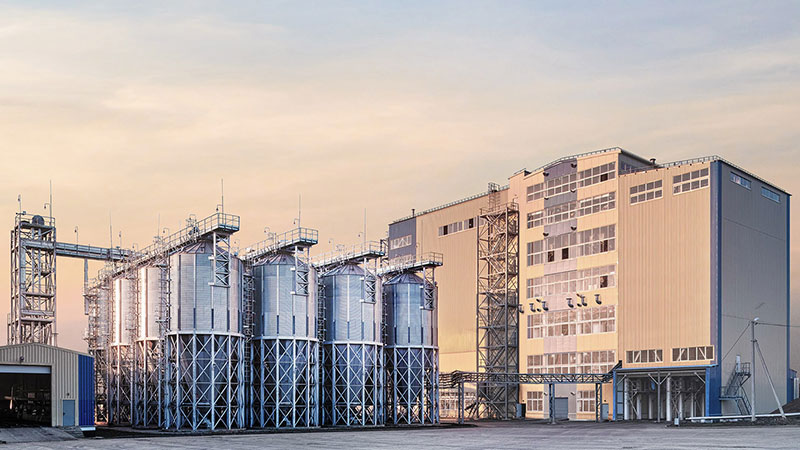
At RICHI, we go beyond project completion. With RICHI Servicee, we’re your dedicated partners in success. Count on us for expert guidance, minimal downtime, and optimized productivity. Choose RICHI for unmatched service and support.
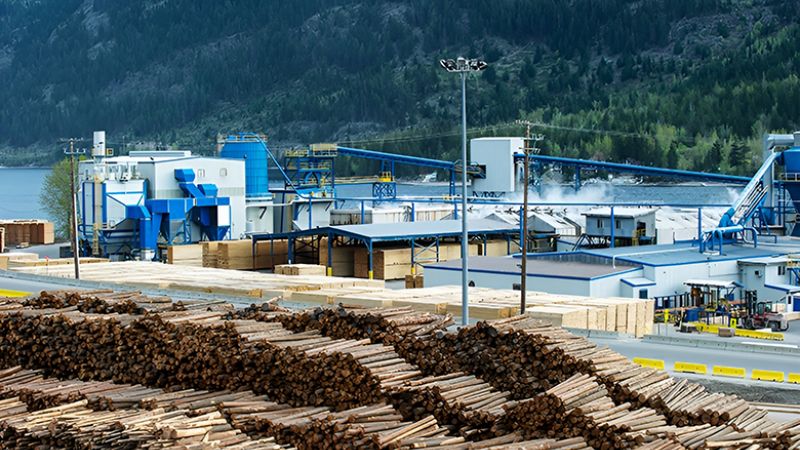


Meet global product demands and quality standards with industry-leading pellet plant design, engineering, equipment, and construction services for pellet processors.

Your Partner Beyond Project Completion
2000+ cases
RICHI is the leading designer, manufacturer and builder of pellet plants in the world, completing over 2000 projects in 140 countries across 6 continents.
Read More
Increase plant productivity, profitability, and safety by integrating high quality equipment into your pellet production line. Over the years, RICHI has become China's top pellet equipment manufacturer. At the same time, RICHI has established valuable partnerships with the world's leading component and raw material manufacturers to bring you the best there is in technology, automation, and efficiency in pelleting plant machinery.

For nearly 30 years, RICHI has been providing best-in-class pellet plant equipment and services to clients across a variety of industries, sizes, and needs. We pride ourselves on the knowledge and skill that each team member possesses – from our technical sales team to our process design engineers. You can count on RICHI Machinery to take your operation to the next level of innovation, quality, and success.
Need help with your pellet manufacturing plant project? Contact us today.
ANIMAL FEED
BIOMASS
WOOD
ORGANIC FERTILIZER
AQUA FEED
CAT LITTER
MUNICIPAL WASTE RECYCLING
SPECIAL PELLET PRODUCTION
RICHI Machinery continues to deliver world class pellet mill equipment, pellet plant engineering and project solutions that add value to our customers in the animal feed, wood waste, agriculture waste, organic fertilizer, cat litter and special pellet products industries. Throughout the years, we RICHI Machinery have built strong brand, becoming industry-leading pellet machine manufacturer. We value integrity, promise quality, and prioritize your success.
Learn MoreWith our expert team, we precisely implement your process engineering requirements in pellet mill and pelletizing plant systems. No matter which industry you’re in – we understand your needs and deliver solutions that meet the highest standards.
At RICHI, quality comes first. Our pellet making machine and related pellet line equipment undergo rigorous quality controls to ensure they meet the highest standards. Rely on products that are durable, safe, and efficient.
With decades of experience in pellet machine and pellet production line production, we have earned a reputation as a trusted partner in various industries. Our expertise allows us to cover a wide range of applications.
Not only do we offer premium pelleting equipment, but we are also experts at designing, building, installing, and maintaining facilities from the ground up. Our expertise is within pellt plant process design, discovering the most efficient, productive, and profitable way to handle your materials in an end-to-end cycle.
○ RICHI MACHINERY
Keeping in touch with us is an effective way to solve all your problems. If you have any needs or questions, please leave your contact information, then RICHI technical consultants will send design, quotation, videos to your mailbox. You can also contact us directly via WhatsApp: +86 13838389622
Copyright©2015-2026 by HENAN RICHI MACHINERY CO., LTD. All rights reserved.