
Biochar pellet making machine in Thailand for rice-straw-derived biochar. The project uses an MZLH678 at 2.5–3 t/h for agricultural biochar pellet production.
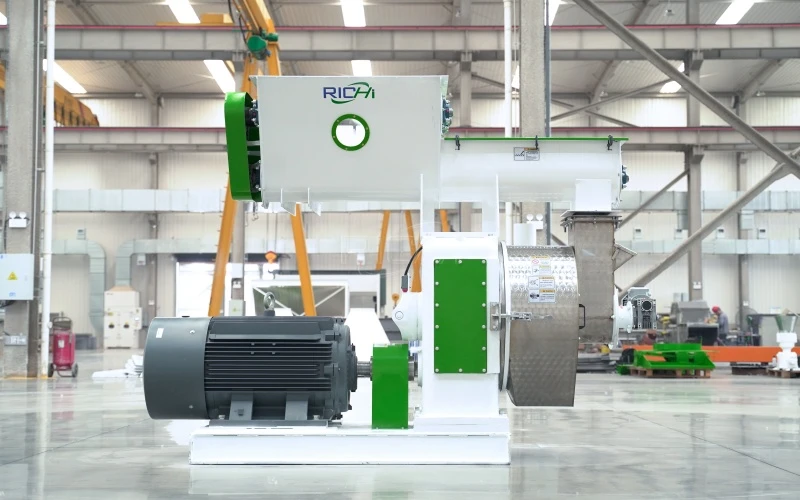
The biochar pellet making machine in Thailand was purchased by an agricultural-residue utilization company that processes rice straw collected after the harvest season. Its existing pyrolysis equipment could convert prepared straw into biochar, but the company wanted part of that output in a denser form for agricultural distribution instead of selling everything as loose char. One MZLH678 with a rated capacity of 2.5–3 t/h was added as the main forming machine for this new product route.
The project was shaped by seasonality. Rice straw does not enter the facility at exactly the same rate throughout the year, while pellet production needs a more predictable feed supply. The customer therefore planned storage and carbonization separately from pelletizing: straw could be collected and converted when available, while prepared biochar could be buffered before entering the pellet production section.
Name:
Biochar Pellet Making Machine
Country:
Thailand
Date:
2025
Capacity:
2.5–3 t/h
Model:
MZLH678
Main Motor Power:
200 kW
Raw Materials:
rice straw
Pellet diameter:
6 mm
The customer initially described its project using the amount of rice straw available each year. That figure was useful for planning raw-material supply, but it could not be used directly to select the pellet machine.
Pyrolysis removes moisture and volatile components from biomass, so the mass of biochar leaving the carbonization process is substantially lower than the mass of raw straw entering it. In addition, not every fraction necessarily has to be pelletized.
RICHI therefore calculated the pelletizing requirement from the prepared biochar stream.
The result was a 2.5–3 t/h production target, which matched one MZLH678 rather than several small machines.
This configuration also gave the customer a very different operating model from the smaller Indian rice-husk project. The Thai company already had enough carbonized material to justify continuous commercial pellet production rather than using the machine primarily for market testing.
The customer never intended to stop selling loose biochar.
Some agricultural users can receive and incorporate loose material without needing densification. For those buyers, pelletizing would simply introduce another processing cost.
The new product was intended for customers who valued easier dosing, cleaner handling, bagged distribution or subsequent blending with other agricultural inputs.
Keeping both forms gave the producer more flexibility.
Loose biochar could continue through the existing route, while material allocated to pellet production was screened, prepared and transferred to the new forming section.
This also prevented the MZLH678 from dictating the operation of the entire biochar business.
Thailand has substantial rice production, making rice straw an important agricultural residue. Research in Thailand has evaluated rice-straw biochar for paddy-soil applications and carbon management, so the raw-material and end-use combination has a real technical basis.
However, the machine does not process raw straw in this project.
Raw rice straw is fibrous and contains lignocellulosic material. After pyrolysis, the material becomes brittle, carbon-rich and structurally different. Its natural ability to bind under pressure is therefore not equivalent to that of untreated straw.
The customer had to prepare the char accordingly.
Coarse carbonized pieces were reduced where necessary, and the material was screened before mixing. Moisture and an application-compatible binder could then be distributed through the prepared char according to trial results.
RICHI did not assign a universal binder percentage because rice-straw biochar characteristics change with the original straw and pyrolysis conditions.
One discussion during equipment selection concerned how hard the finished pellet actually needed to be.
For a fuel pellet, high durability during repeated mechanical handling can be a dominant requirement. This Thai project had a different end use.
The biochar was intended primarily for agricultural distribution and soil-related applications. The pellets therefore needed to remain sufficiently intact through cooling, screening, bagging, transport and normal application, but extreme hardness offered no automatic advantage.
This affected the forming strategy.
Rather than adding excessive binder simply to maximize pellet strength, trial production focused on finding enough cohesion for the intended supply chain while preserving the character of the biochar product.
Pellet size, binder, moisture and ring-die compression therefore had to be considered together.
The project had another characteristic that did not appear in the previous cases: harvest timing.
Rice straw collection is linked to cropping and harvesting cycles. Pellet orders, however, do not necessarily follow the same schedule.
The customer therefore did not want the MZLH678 dependent on straw arriving directly from farms every day.
Instead, raw-straw collection, pyrolysis and pellet production were treated as connected but independently manageable stages. Suitable feedstock could be accumulated and carbonized according to the customer's seasonal operating plan, while prepared char storage provided a buffer for the pelletizing section.
This allowed the pellet machine to operate more consistently even when fresh straw collection slowed.
It also made storage design important. Biochar intended for later pelletizing had to be protected from uncontrolled contamination and moisture changes that could make subsequent forming less predictable.
Agricultural application did not automatically lead RICHI to select fertilizer equipment.
The customer was producing densified rice-straw biochar rather than a compound fertilizer containing large proportions of manure, compost or other nutrient-bearing materials.
For that product, the MZLH ring-die route was selected.
The decision would change if the company later developed a blended product containing, for example, biochar plus composted livestock manure as major formulation components. Such a project would require a new assessment and could be better matched with the FZLH fertilizer pellet machine series.
RICHI therefore separates product use from product composition when choosing equipment.
A pellet can be applied to farmland without automatically being a conventional organic fertilizer pellet.
The commissioning team did not use hourly output as the only acceptance criterion.
Operators observed whether the prepared char entered the machine steadily, whether main-motor load remained stable, whether extrusion was continuous and how much breakage appeared after the pellets had passed through downstream handling.
Changes in the stored biochar were particularly important.
A batch that had absorbed additional moisture could not necessarily use the same water addition as a drier batch. Likewise, changes in particle distribution could affect feeding and compression.
The operators were therefore trained to adjust the process according to actual material behavior instead of recording one setting and treating it as permanent.
Routine inspection of the ring die, rollers, feeder and lubrication points was incorporated into the operating plan.
At 2.5–3 t/h, the MZLH678 required more attention to material continuity than a small batch-production pelletizer.
The customer needed enough prepared char storage ahead of the machine to prevent frequent interruptions. Mixing and feeding also had to keep pace with the pelletizer instead of becoming new bottlenecks.
RICHI Machinery reviewed the installation position, foundation, power requirement, feeding connection, discharge arrangement and maintenance clearance before shipment.
The customer retained its existing pyrolysis equipment, but the new pelletizing module was arranged so that operators could service the ring die and roller area without dismantling surrounding equipment.
That practical access becomes increasingly important as machine size increases.
The customer did not describe the project simply as "turning waste into value." Its more immediate concern was making a seasonal agricultural-residue business easier to operate throughout the year.
After trial production, the customer commented:
"We collect straw according to the agricultural season, but our finished-product orders do not arrive only during harvest. Separating biochar production from pellet production gives us much better control over when the pellet machine runs."
This was the main operational value of the project.
The pelletizer became a downstream production module supplied from prepared char inventory rather than a machine forced to follow daily straw collection.
After factory inspection, the MZLH678 and supplied components were prepared for ocean transport from Qingdao Port, China, to Laem Chabang Port, Thailand.
Because the 200 kW machine was going into an existing facility, electrical preparation and installation planning were completed before arrival. RICHI supplied the relevant technical information for foundation preparation, machine positioning and process connection.
Installation guidance, commissioning assistance, operator training and troubleshooting support were also included in the project service.
The biochar pellet making machine in Thailand was selected around three conditions: rice-straw-derived biochar, an existing pyrolysis operation and a prepared char stream sufficient to support 2.5–3 t/h pellet production.
Changing any of those conditions could change the equipment.
A small farm cooperative testing pelletized biochar would not need an MZLH678. A large industrial producer could require parallel or larger equipment. A company blending biochar with substantial compost or manure could move toward an FZLH fertilizer configuration instead.
Even another rice-straw project should not automatically copy the same settings because pyrolysis temperature can materially affect rice-straw biochar properties. Research on rice-straw-derived biochar has demonstrated that pyrolysis conditions influence its chemical composition and structure.
For a new project, RICHI therefore needs to know how much prepared biochar is actually available per hour, how it was produced, its particle and moisture condition, whether binder is acceptable, the required pellet specification and how the finished pellets will be used.
Those factors—not the word "biochar" alone—determine the appropriate pellet machine.
Having the right mix of reliable, high-quality pellet machine and pelletizing systems and expert support is essential to your success. Watch how our end-to-end feed pellet plant solutions have helped our customers optimize their performance.
Our customized and future-proofed turnkey pellet plant solutions is designed with you at the core. From vision to reality and beyond, our team stays connected with yours. Giving you peace-of-mind with an expert at your side.
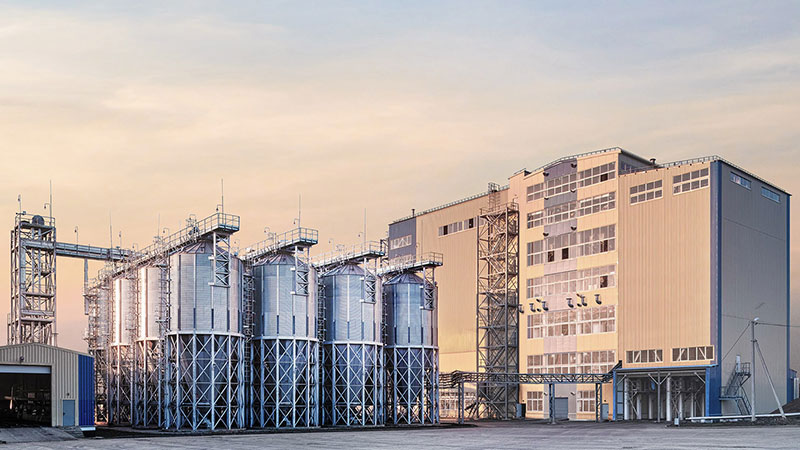
At RICHI, we go beyond project completion. With RICHI Servicee, we’re your dedicated partners in success. Count on us for expert guidance, minimal downtime, and optimized productivity. Choose RICHI for unmatched service and support.
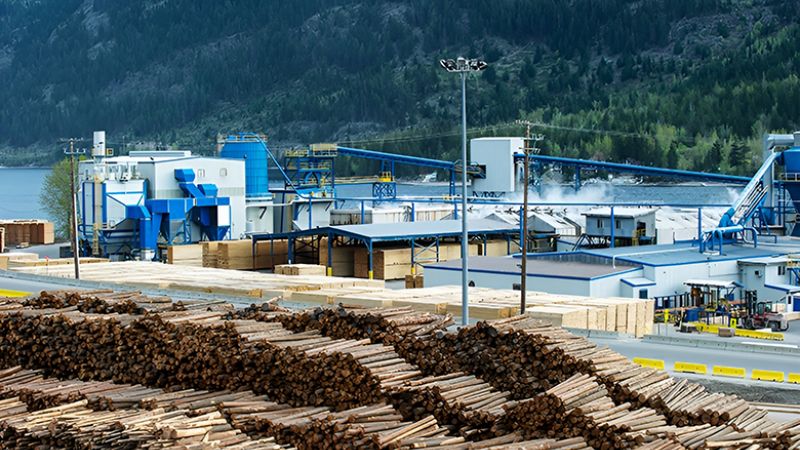


Meet global product demands and quality standards with industry-leading pellet plant design, engineering, equipment, and construction services for pellet processors.

Your Partner Beyond Project Completion
2000+ cases
RICHI is the leading designer, manufacturer and builder of pellet plants in the world, completing over 2000 projects in 140 countries across 6 continents.
Read More
Increase plant productivity, profitability, and safety by integrating high quality equipment into your pellet production line. Over the years, RICHI has become China's top pellet equipment manufacturer. At the same time, RICHI has established valuable partnerships with the world's leading component and raw material manufacturers to bring you the best there is in technology, automation, and efficiency in pelleting plant machinery.

For nearly 30 years, RICHI has been providing best-in-class pellet plant equipment and services to clients across a variety of industries, sizes, and needs. We pride ourselves on the knowledge and skill that each team member possesses – from our technical sales team to our process design engineers. You can count on RICHI Machinery to take your operation to the next level of innovation, quality, and success.
Need help with your pellet manufacturing plant project? Contact us today.
ANIMAL FEED
BIOMASS
WOOD
ORGANIC FERTILIZER
AQUA FEED
CAT LITTER
MUNICIPAL WASTE RECYCLING
SPECIAL PELLET PRODUCTION
RICHI Machinery continues to deliver world class pellet mill equipment, pellet plant engineering and project solutions that add value to our customers in the animal feed, wood waste, agriculture waste, organic fertilizer, cat litter and special pellet products industries. Throughout the years, we RICHI Machinery have built strong brand, becoming industry-leading pellet machine manufacturer. We value integrity, promise quality, and prioritize your success.
Learn MoreWith our expert team, we precisely implement your process engineering requirements in pellet mill and pelletizing plant systems. No matter which industry you’re in – we understand your needs and deliver solutions that meet the highest standards.
At RICHI, quality comes first. Our pellet making machine and related pellet line equipment undergo rigorous quality controls to ensure they meet the highest standards. Rely on products that are durable, safe, and efficient.
With decades of experience in pellet machine and pellet production line production, we have earned a reputation as a trusted partner in various industries. Our expertise allows us to cover a wide range of applications.
Not only do we offer premium pelleting equipment, but we are also experts at designing, building, installing, and maintaining facilities from the ground up. Our expertise is within pellt plant process design, discovering the most efficient, productive, and profitable way to handle your materials in an end-to-end cycle.
○ RICHI MACHINERY
Keeping in touch with us is an effective way to solve all your problems. If you have any needs or questions, please leave your contact information, then RICHI technical consultants will send design, quotation, videos to your mailbox. You can also contact us directly via WhatsApp: +86 13838389622
Copyright©2015-2026 by HENAN RICHI MACHINERY CO., LTD. All rights reserved.