
Biochar pellet making equipment in Saudi Arabia for date-palm pruning biochar. RICHI MZLH350 produces 0.3–0.5 t/h for agricultural handling and dosing.
The request did not come from the pyrolysis operator. It came from the people handling the finished product.
A Saudi agricultural-input company was already developing biochar from date palm pruning residues, but feedback from distributors and agricultural service contractors pointed to a practical limitation. Fine carbon material could be difficult to meter consistently through ordinary handling equipment, especially when customers wanted to combine field application with other mechanized operations.
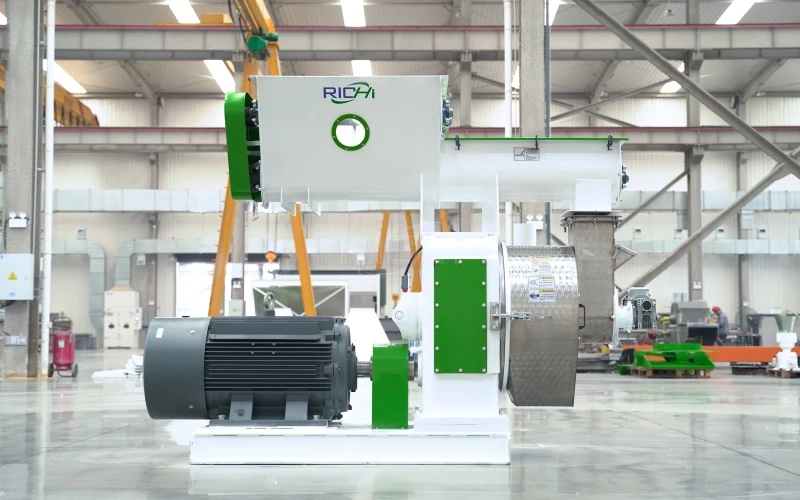
That feedback changed the product plan. Instead of increasing carbonization capacity, the company added biochar pellet making equipment in Saudi Arabia to manufacture a controlled granular form alongside its existing loose product. RICHI Machinery selected one MZLH350 ring die pellet machine, providing 0.3–0.5 t/h from a 37 kW main motor.
Name:
Biochar Pellet Making Equipment
Country:
Saudi Arabia
Date:
2026
Capacity:
0.3–0.5 t/h
Model:
MZLH350
Main Motor Power:
37 kW
Raw Materials:
Prepared date-palm biochar
Pellet diameter:
6 mm
Most equipment projects begin at the factory gate.
This one effectively began at the farm.
The customer first defined how the finished biochar should be stored, transported, dosed and applied. Only then did it work backward toward pellet diameter, required mechanical integrity and the preparation condition of the char.
That order mattered.
There was no benefit in producing an extremely hard pellet simply because the machine could generate more compression. The pellet needed enough integrity for normal handling and field delivery while remaining appropriate for its intended soil application.
The finished-product requirement therefore controlled the forming target.
Saudi Arabia has an extensive date palm sector, and pruning generates recurring lignocellulosic residues from orchard management.
Those residues should not be confused with date pits generated during fruit processing.
For this project, the carbon source was prepared pruning material such as palm fronds and related woody portions removed during orchard maintenance.
Suitable residues entered thermal conversion before the RICHI equipment became involved.
After pyrolysis, cooling and carbon preparation, part of the resulting date-palm biochar was allocated to pellet production.
The machine therefore received prepared carbon material rather than freshly shredded palm fronds.
The agricultural-input company could have selected a larger pelletizer.
It chose not to.
Pelletized biochar was a new product format within its business, and the customer wanted commercial-scale production without immediately committing several tonnes of char per hour to a market that was still being developed.
The MZLH350 created that intermediate step.
| Project ItemSaudi Arabia Configuration | |
|---|---|
| Equipment | Biochar pellet making equipment |
| Model | MZLH350 |
| Quantity | 1 unit |
| Main Motor | 37 kW |
| Capacity | 0.3–0.5 t/h |
| Original Biomass | Date palm pruning residues |
| Machine Feed | Prepared date-palm biochar |
| Finished Form | Biochar pellets |
| Main Objective | Easier agricultural handling and dosing |
The capacity also left the customer free to continue supplying loose biochar.
Pellets were an additional SKU, not a mandatory destination for every batch leaving the pyrolysis section.
At first glance, a dry Saudi environment might appear to make moisture management easy.
Pelletizing does not work that way.
Ambient climate and material moisture at the ring die are two different questions.
Biochar stored in a dry environment may still require controlled moisture adjustment before forming. Conversely, adding water without measuring the existing material condition can move the mixture outside a useful processing range.
The operator therefore needed to check the prepared char rather than infer its condition from the weather.
This was particularly important after storage.
A batch that had remained in inventory for some time could behave differently from freshly prepared material even though both originated from the same date palm residue.
Carbonized date palm material does not retain the same natural binding behavior as untreated biomass.
If the prepared char could not achieve sufficient pellet integrity through moisture and compression alone, an appropriate binder could be evaluated.
But the strongest binder was not automatically the best one.
The finished product was intended for agricultural use. Binder compatibility with that application therefore mattered alongside mechanical performance and cost.
RICHI did not prescribe a universal addition percentage.
Instead, the customer needed to establish the minimum practical formulation that allowed pellets to survive production, screening, packaging and distribution at the required quality level.
This kept product formulation connected to actual use rather than merely to the appearance of pellets leaving the die.
The customer had no interest in winning a laboratory hardness contest.
Its distributors wanted a product they could handle.
Finished pellets therefore had to be evaluated after the processes that would actually challenge them: transfer, stabilization, screening, bagging and subsequent movement.
If excessive fines appeared after those steps, the production team worked backward.
Was the char too coarse?
Had moisture changed?
Was binder distribution uneven?
Was feeding unstable?
Had die or roller condition changed?
The troubleshooting sequence prevented every quality issue from being treated as a mechanical failure.
Saudi Arabia introduced another project-specific issue: equipment does not operate in an abstract indoor climate.
High ambient temperatures can affect working conditions around industrial equipment, electrical rooms, lubrication practices and the way operators interact with the production area.
The MZLH350 itself therefore could not be considered independently of ventilation, electrical protection and the customer's actual workshop environment.
RICHI reviewed maintenance clearance and airflow around the installation rather than placing the machine tightly into an enclosed corner simply because its footprint fitted.
Raw-material storage also required attention.
Keeping prepared biochar protected from uncontrolled contamination and weather exposure was still necessary even in an arid climate.
Dry does not mean maintenance-free.
The reasoning came from the material at the machine inlet.
It was predominantly carbonized date palm residue.
That made the MZLH densification route appropriate.
If the Saudi customer later decides to manufacture a compound soil product containing a substantial share of composted manure or another organic fertilizer base, RICHI would review the formulation again. Such a product could move into the FZLH fertilizer pellet machine family.
This distinction matters because both products might be sold to farms.
Their market may overlap.
Their material behavior does not necessarily do so.
The small commercial capacity gave the customer another advantage.
Product development could take place without consuming all available biochar.
Different agricultural customers could evaluate the pellet form while existing loose-product sales continued. Feedback on handling, packaging and application could then influence future production decisions.
If pellet demand increased, the company would have operating data from real date-palm biochar rather than relying on estimates made before launch.
Expansion could then be based on actual prepared-char availability and actual sales requirements.
That made the MZLH350 a first commercial module rather than a permanently fixed ceiling for the project.
After installation, RICHI's work shifted from equipment positioning to material behavior.
The commissioning team established initial feeding and forming conditions using the prepared date-palm biochar supplied for the project.
Operators were shown how to observe motor load, material feeding, pellet formation and downstream breakage. Routine work included lubrication, ring die and roller inspection and recognition of abnormal wear.
More importantly, the team learned when not to change the machine.
If an incoming batch behaved differently, raw-material condition was checked before mechanical settings were repeatedly adjusted.
That distinction helps protect both pellet quality and equipment life.
The machine was manufactured and inspected in China before shipment from Qingdao Port to Jeddah Islamic Port.
The customer prepared the installation area while the equipment was in transit. Electrical supply, machine position, material inlet, discharge connection and maintenance space could therefore be coordinated before commissioning began.
RICHI provided the technical information required for those preparations and followed the project with installation guidance, start-up assistance, operator instruction and spare/wear-part planning.
The service scope remained focused on integrating one pellet machine into the customer's existing biochar operation rather than turning the purchase into an unnecessary complete production line.
The project returned to the same question that started it: how would agricultural users actually handle the product?
Date-palm pruning supplied a locally relevant carbon source. Pyrolysis transformed that residue into biochar. The MZLH350 then gave the company another way to present the carbon material.
But pelletizing was justified only because the new physical form answered a downstream handling requirement.
That is why RICHI Machinery would not automatically recommend the same configuration to every Saudi biochar producer.
A customer selling bulk loose biochar locally may not need pelletization at all. A large carbon-product manufacturer may require a much higher-capacity MZLH model. A producer blending biochar into an organic fertilizer may require FZLH equipment instead.
For this agricultural-input company, 0.3–0.5 t/h provided the right starting point: enough capacity to establish a commercial pellet product, but small enough to let real field demand determine what the next expansion should look like.
Having the right mix of reliable, high-quality pellet machine and pelletizing systems and expert support is essential to your success. Watch how our end-to-end feed pellet plant solutions have helped our customers optimize their performance.
Our customized and future-proofed turnkey pellet plant solutions is designed with you at the core. From vision to reality and beyond, our team stays connected with yours. Giving you peace-of-mind with an expert at your side.
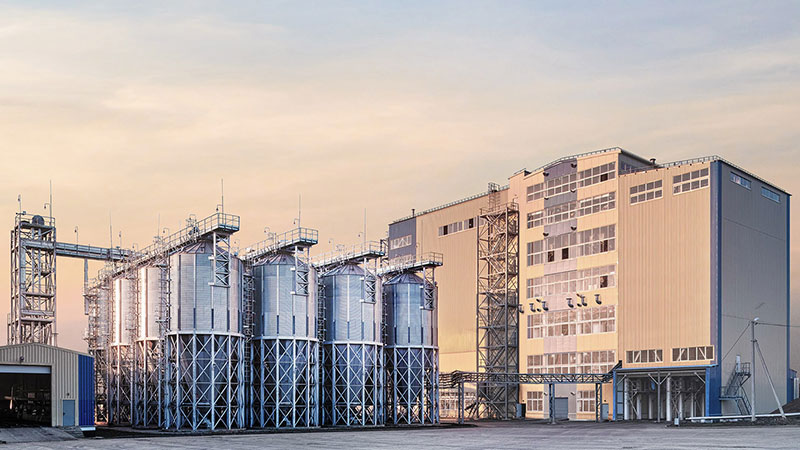
At RICHI, we go beyond project completion. With RICHI Servicee, we’re your dedicated partners in success. Count on us for expert guidance, minimal downtime, and optimized productivity. Choose RICHI for unmatched service and support.
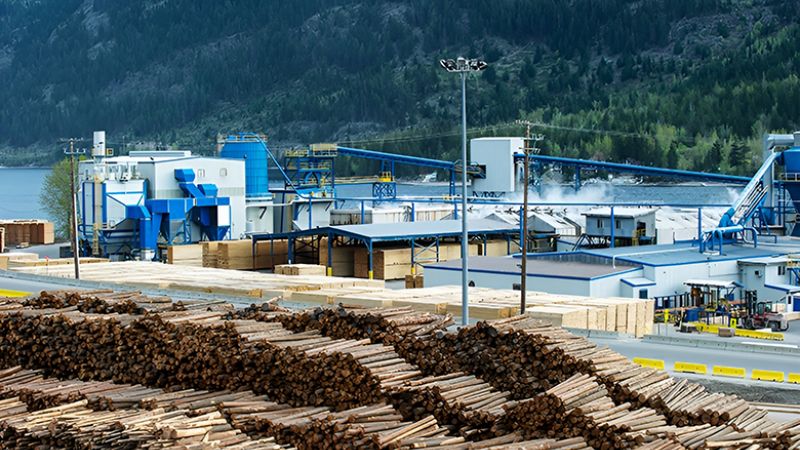


Meet global product demands and quality standards with industry-leading pellet plant design, engineering, equipment, and construction services for pellet processors.

Your Partner Beyond Project Completion
2000+ cases
RICHI is the leading designer, manufacturer and builder of pellet plants in the world, completing over 2000 projects in 140 countries across 6 continents.
Read More
Increase plant productivity, profitability, and safety by integrating high quality equipment into your pellet production line. Over the years, RICHI has become China's top pellet equipment manufacturer. At the same time, RICHI has established valuable partnerships with the world's leading component and raw material manufacturers to bring you the best there is in technology, automation, and efficiency in pelleting plant machinery.

For nearly 30 years, RICHI has been providing best-in-class pellet plant equipment and services to clients across a variety of industries, sizes, and needs. We pride ourselves on the knowledge and skill that each team member possesses – from our technical sales team to our process design engineers. You can count on RICHI Machinery to take your operation to the next level of innovation, quality, and success.
Need help with your pellet manufacturing plant project? Contact us today.
ANIMAL FEED
BIOMASS
WOOD
ORGANIC FERTILIZER
AQUA FEED
CAT LITTER
MUNICIPAL WASTE RECYCLING
SPECIAL PELLET PRODUCTION
RICHI Machinery continues to deliver world class pellet mill equipment, pellet plant engineering and project solutions that add value to our customers in the animal feed, wood waste, agriculture waste, organic fertilizer, cat litter and special pellet products industries. Throughout the years, we RICHI Machinery have built strong brand, becoming industry-leading pellet machine manufacturer. We value integrity, promise quality, and prioritize your success.
Learn MoreWith our expert team, we precisely implement your process engineering requirements in pellet mill and pelletizing plant systems. No matter which industry you’re in – we understand your needs and deliver solutions that meet the highest standards.
At RICHI, quality comes first. Our pellet making machine and related pellet line equipment undergo rigorous quality controls to ensure they meet the highest standards. Rely on products that are durable, safe, and efficient.
With decades of experience in pellet machine and pellet production line production, we have earned a reputation as a trusted partner in various industries. Our expertise allows us to cover a wide range of applications.
Not only do we offer premium pelleting equipment, but we are also experts at designing, building, installing, and maintaining facilities from the ground up. Our expertise is within pellt plant process design, discovering the most efficient, productive, and profitable way to handle your materials in an end-to-end cycle.
○ RICHI MACHINERY
Keeping in touch with us is an effective way to solve all your problems. If you have any needs or questions, please leave your contact information, then RICHI technical consultants will send design, quotation, videos to your mailbox. You can also contact us directly via WhatsApp: +86 13838389622
Copyright©2015-2026 by HENAN RICHI MACHINERY CO., LTD. All rights reserved.