
A 0.2–0.3 T/H MZLH320 biochar granulator in India densifies rice husk biochar for easier bagging, metering, blending and agricultural handling.
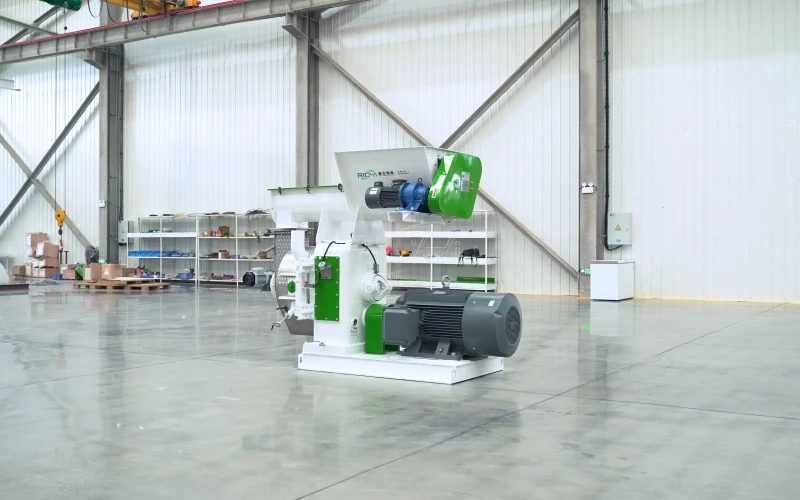
The biochar granulator in India was selected for an agricultural-residue processor working with rice husk from local rice mills. The company had already established a pyrolysis route for converting part of the husk into biochar, but most of the finished char remained in a light, fine form. Its next step was to produce a denser rice husk biochar pellet that could be bagged, transported and blended with other agricultural inputs more conveniently.
This project did not require a new carbonization plant. The customer purchased one MZLH320 ring die machine with a rated capacity of 0.2–0.3 t/h as a dedicated product-development and small commercial production unit. RICHI Machinery selected the model according to the amount of prepared rice husk biochar actually available for pelletizing rather than the much larger quantity of raw rice husk handled by the business.
Name:
Biochar Granulator
Country:
India
Date:
2025
Capacity:
0.2–0.3 t/h
Model:
MZLH320
Main Motor Power:
22 kW
Raw Materials:
Rice Husk
Pellet diameter:
6 mm
The customer operated in an Indian rice-processing region where rice husk was available through nearby milling operations.
Instead of treating the husk only as a low-value residue or burning all of it directly, the company had developed a pyrolysis route to produce biochar. Part of this material was supplied in loose form, while another portion was selected for a new pelletized product.
The reason for pelletizing was practical.
Loose rice husk biochar has low bulk density and can create dust during repeated handling. For a company planning packaged agricultural products, a controlled pellet form was easier to meter and combine with other products than very light loose char.
The customer therefore added pelletizing after pyrolysis instead of expanding its carbonization capacity.
Rice husk biochar is substantially different from the woody biochar used in many other projects.
Rice husk naturally contains a significant mineral fraction associated particularly with silica. After thermal conversion, this mineral component remains important to the properties of the resulting char.
That meant RICHI could not assume that settings developed for eucalyptus or another clean woody char would transfer directly to this project.
The customer first controlled the particle condition of the carbonized husk. Oversized and irregular fragments were reduced, while obvious contaminants were removed before mixing.
Because carbonization has already changed the original lignocellulosic structure, the char does not possess the same natural binding behavior as untreated rice husk.
Moisture adjustment and a suitable binder therefore had to be evaluated before ring die forming.
This project was intentionally small.
The company was not planning to convert every kilogram of rice husk biochar into pellets. Loose biochar remained useful for some customers, while the pelletized form represented an additional product route.
An MZLH320 therefore provided a more realistic starting capacity.
The customer could operate this section according to the amount of prepared char available without installing a large pellet mill that would frequently wait for material.
The MZLH320 also left the company room to verify customer acceptance of the new product before considering a larger pelletizing module.
One project-specific issue was the mineral character of rice husk biochar.
Rice husk is well known for its silica-rich ash fraction. The actual amount and form depend on the original material and thermal process, so RICHI did not assign one fixed silica percentage to the customer's char without laboratory analysis.
However, its mineral content still needed to be considered during equipment operation.
Compared with some relatively clean woody chars, mineral-rich rice husk biochar can place different demands on dies and rollers. Wear therefore becomes part of the operating-cost discussion rather than something noticed only after production begins.
RICHI advised the customer to monitor die condition, roller condition and pellet quality during routine maintenance and to keep appropriate wear parts in its maintenance plan.
This was a more important consideration for this project than simply chasing maximum hourly output.
The customer already had the equipment required to create rice husk biochar.
After pyrolysis, the char was cooled before further handling. Material intended for pelletizing was then separated and prepared to achieve a more consistent particle condition.
Binder and controlled moisture were introduced during mixing rather than applied unevenly at the pellet mill inlet.
The prepared material then entered the MZLH320 at a stable feed rate. Rollers compressed the mixture through the ring die, converting the loose carbonaceous particles into cylindrical pellets.
After forming, the pellets needed stabilization and screening.
Broken particles and loose fines could be separated and, when still suitable, returned to the preparation stage rather than immediately discarded.
This recycling arrangement was especially useful for a customer whose objective was to improve utilization of an agricultural residue.
The customer did not position these pellets as conventional biomass fuel pellets.
Their intended route remained agricultural.
Pelletization gave the biochar a form that was easier to bag, meter and distribute. It also allowed the customer to consider subsequent blending with other separately prepared agricultural products.
That did not mean every rice husk biochar pellet automatically qualified as fertilizer.
RICHI kept the distinction clear.
A predominantly biochar product used as a soil amendment remains different from an organic fertilizer formulated with manure, compost or nutrient-bearing ingredients. Product claims and local regulatory requirements have to follow the actual formulation and market.
For this reason, the Indian project remained on the MZLH densification route.
The customer was processing rice husk biochar as the dominant material.
It was not blending the char with composted poultry manure, cattle manure, digestate solids or another organic fertilizer base.
Using an FZLH fertilizer pellet machine simply because the finished pellets might eventually be applied to soil would therefore have ignored the actual product composition.
If the customer later develops a carbon-enriched organic fertilizer containing substantial nutrient-bearing organic material, RICHI can reassess the project around the FZLH series.
This flexibility is important because the search term biochar pellet machine can describe very different products.
The machine should follow the formulation, not the keyword.
The highest dust potential existed before densification.
Prepared rice husk biochar is light and fine, so transfer, mixing and feeding points require appropriate containment and housekeeping.
The customer already had experience handling loose char, but the new pelletizing module introduced additional transfer points.
RICHI therefore considered the inlet arrangement, enclosed material movement and suitable dust collection around preparation and feeding.
Once properly formed and screened, the pelletized product is easier to handle than the original loose powder, but pelletization does not remove the need for proper dust-risk management in the upstream area.
The customer evaluated the project as a way to test a new product form without interfering with the existing loose-biochar business.
The smaller MZLH320 was particularly useful because production could follow actual orders and prepared-material availability rather than requiring a large continuous char stream.
The customer commented:
"The rice husk was already available and we were already making biochar. What we needed was a practical way to test a pellet product without changing the whole operation. Starting with a smaller machine gave us that flexibility."
The feedback also confirmed why capacity selection had to be based on pelletizable char rather than total rice-mill residue.
After manufacturing and inspection, the MZLH320 was prepared for ocean shipment from Qingdao Port, China, to Chennai Port, India.
The customer prepared the installation position according to the machine dimensions, electrical requirements, feeding arrangement and maintenance clearance supplied before delivery.
RICHI Machinery provided installation guidance, commissioning support and operator instruction for the new pelletizing module.
Training included normal machine operation, feeder adjustment, die and roller inspection, lubrication, recognition of abnormal load changes and troubleshooting when the condition of the rice husk biochar changed.
The biochar granulator in India was designed around rice husk char, but India's agricultural-residue base allows many other biochar routes to be evaluated.
Depending on regional availability, suitable residues can include crop stalks, maize cobs, woody residues and other agricultural biomass. ICAR has itself reported biochar production trials using rice husk, wheat husk, maize stalk and maize cob.
Those materials should not automatically use the same pelletizing parameters.
Their ash content, carbon structure, particle behavior and binder requirements can differ significantly after pyrolysis.
For a customer considering a similar project, RICHI therefore needs the original biomass type, char condition, particle size, moisture, available hourly quantity and intended pellet use before selecting the final machine.
For this Indian processor, those factors supported one MZLH320 at 0.2–0.3 t/h: a small commercial biochar pelletizing module built around locally available rice husk char rather than an oversized machine selected from the capacity of the customer's entire rice-residue business.
Having the right mix of reliable, high-quality pellet machine and pelletizing systems and expert support is essential to your success. Watch how our end-to-end feed pellet plant solutions have helped our customers optimize their performance.
Our customized and future-proofed turnkey pellet plant solutions is designed with you at the core. From vision to reality and beyond, our team stays connected with yours. Giving you peace-of-mind with an expert at your side.
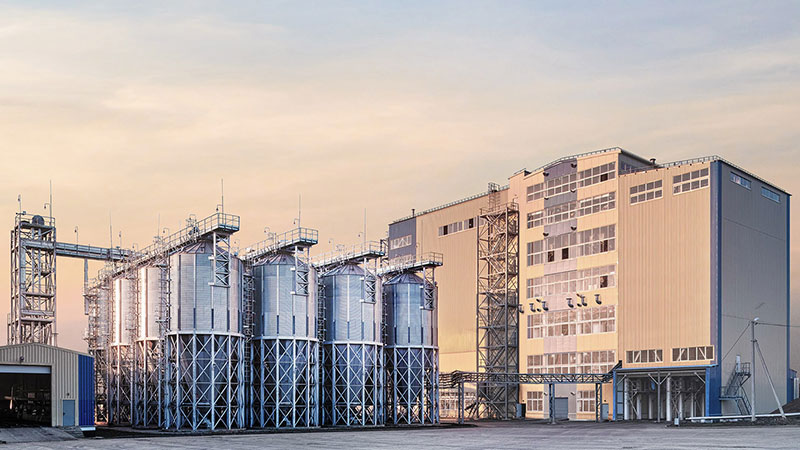
At RICHI, we go beyond project completion. With RICHI Servicee, we’re your dedicated partners in success. Count on us for expert guidance, minimal downtime, and optimized productivity. Choose RICHI for unmatched service and support.
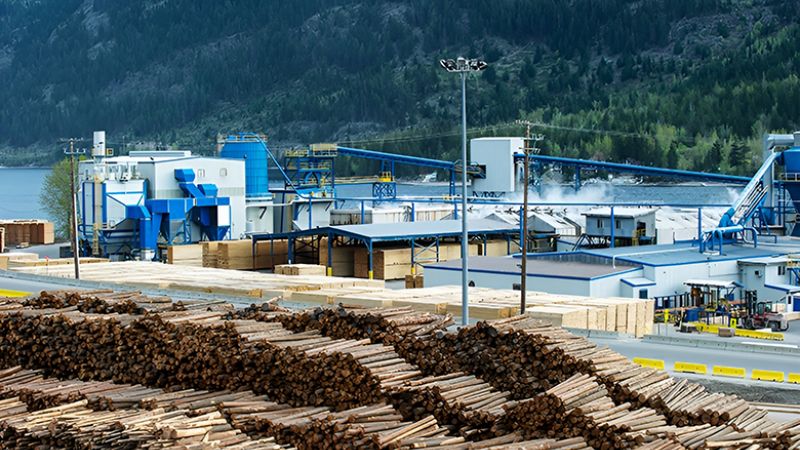


Meet global product demands and quality standards with industry-leading pellet plant design, engineering, equipment, and construction services for pellet processors.

Your Partner Beyond Project Completion
2000+ cases
RICHI is the leading designer, manufacturer and builder of pellet plants in the world, completing over 2000 projects in 140 countries across 6 continents.
Read More
Increase plant productivity, profitability, and safety by integrating high quality equipment into your pellet production line. Over the years, RICHI has become China's top pellet equipment manufacturer. At the same time, RICHI has established valuable partnerships with the world's leading component and raw material manufacturers to bring you the best there is in technology, automation, and efficiency in pelleting plant machinery.

For nearly 30 years, RICHI has been providing best-in-class pellet plant equipment and services to clients across a variety of industries, sizes, and needs. We pride ourselves on the knowledge and skill that each team member possesses – from our technical sales team to our process design engineers. You can count on RICHI Machinery to take your operation to the next level of innovation, quality, and success.
Need help with your pellet manufacturing plant project? Contact us today.
ANIMAL FEED
BIOMASS
WOOD
ORGANIC FERTILIZER
AQUA FEED
CAT LITTER
MUNICIPAL WASTE RECYCLING
SPECIAL PELLET PRODUCTION
RICHI Machinery continues to deliver world class pellet mill equipment, pellet plant engineering and project solutions that add value to our customers in the animal feed, wood waste, agriculture waste, organic fertilizer, cat litter and special pellet products industries. Throughout the years, we RICHI Machinery have built strong brand, becoming industry-leading pellet machine manufacturer. We value integrity, promise quality, and prioritize your success.
Learn MoreWith our expert team, we precisely implement your process engineering requirements in pellet mill and pelletizing plant systems. No matter which industry you’re in – we understand your needs and deliver solutions that meet the highest standards.
At RICHI, quality comes first. Our pellet making machine and related pellet line equipment undergo rigorous quality controls to ensure they meet the highest standards. Rely on products that are durable, safe, and efficient.
With decades of experience in pellet machine and pellet production line production, we have earned a reputation as a trusted partner in various industries. Our expertise allows us to cover a wide range of applications.
Not only do we offer premium pelleting equipment, but we are also experts at designing, building, installing, and maintaining facilities from the ground up. Our expertise is within pellt plant process design, discovering the most efficient, productive, and profitable way to handle your materials in an end-to-end cycle.
○ RICHI MACHINERY
Keeping in touch with us is an effective way to solve all your problems. If you have any needs or questions, please leave your contact information, then RICHI technical consultants will send design, quotation, videos to your mailbox. You can also contact us directly via WhatsApp: +86 13838389622
Copyright©2015-2026 by HENAN RICHI MACHINERY CO., LTD. All rights reserved.