
RICHI supplied a 3–4 T/H SPHS120×2 Basa Fish Feed Extruder Machine in Philippines for producing 4 mm floating pangasius grower feed in Central Luzon.
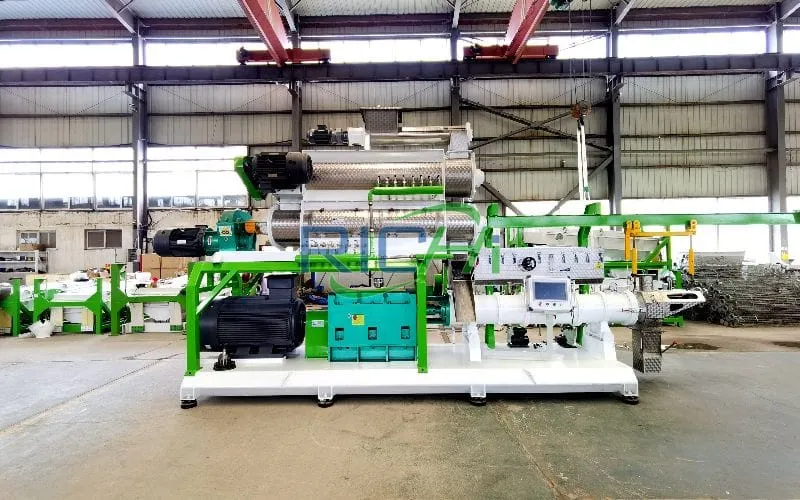
The decision to add a Basa Fish Feed Extruder Machine in Philippines came from a specific gap in one Central Luzon aquafeed mill's product range. The company already manufactured feeds for conventional freshwater species and had grinding, fine-mixing, drying, cooling and liquid-coating equipment on site. What it did not have was enough extrusion capacity to run a dedicated floating feed for local pangasius growers without repeatedly interrupting its other production schedules.
RICHI supplied an SPHS120×2 twin-screw extruder for that job. The machine uses a 110 kW main motor, 120 mm screws and a dual pre-conditioning arrangement, with a reference production range of approximately 3–4 T/H. For this project, the customer standardizes on approximately 4 mm floating pangasius grower feed. The mixed formula is fine-ground to roughly the 0.5–0.8 mm range before conditioning and extrusion, then passes through the mill's existing dryer, cooler and coating section before finished-feed storage.
Name:
Basa Fish Feed Extruder
Country:
Philippines
Date:
2026
Capacity:
3–4 T/H
Model:
SPHS120×2
Main Motor Power:
110 kW
Fine-Ground Mash:
0.5–0.8 mm
Pellet diameter:
4 mm
The customer did not buy the extruder to make tilapia feed on Monday, shrimp feed on Tuesday, pet food on Wednesday and several other products whenever an order appeared. The commercial target was much narrower: a floating grower feed for pangasius, also known in the Philippine market as cream dory and commonly associated with the search term basa.
That narrower product plan matters. It gives the mill one formulation family, one principal pellet diameter and one buoyancy target to stabilize during commissioning. It also reduces the number of changes in die configuration, screw setup, drying conditions and coating recipes during the early production period.
The project target is approximately 7,500 tonnes of this feed annually. That is large enough to justify an industrial twin-screw extruder, but still within the range of a single SPHS120×2 fish feed extruder running mainly on one shift.
| Item | Project Basis |
|---|---|
| Extruder Model | SPHS120×2 twin-screw fish feed extruder |
| Main Motor | 110 kW |
| Screw Diameter | 120 mm |
| Feeder Motor | 1.5 kW |
| Conditioner | DC500-244, 11 kW |
| Differential Conditioner | DC500×400-300, 11 kW |
| Extrusion Capacity | Approximately 3–4 T/H |
| Fine-Ground Mash | Approximately 0.5–0.8 mm project target |
| Main Finished Size | Approximately 4 mm |
| Feed Type | Floating pangasius grower feed |
| Annual Target | Approximately 7,500 T/Y |
The 3–4 T/H figure is an extrusion range, not a promise that every formula will run at 4 T/H. Protein sources, starch type, fat level, fiber, incoming moisture, grinding fineness, screw configuration and required product density can all move the practical output within or below that range.
The existing mill previously prepared conventional feed with a coarser grind. That was one of the first interfaces reviewed before the new extruder was added. Extrusion feed requires much tighter particle-size control than an ordinary livestock mash.
For the 4 mm pangasius product, the project works with a fine-ground mixture around approximately 0.5–0.8 mm, with oversized particles controlled before the mash reaches the conditioner. Fine grinding supports more uniform hydration and cooking inside the extrusion system and reduces the risk of large particles disturbing die flow or finished-feed structure.
The customer therefore did not treat the SPHS120×2 as a machine that could correct coarse grinding upstream. The pulverizing section had to deliver material suitable for aquafeed first.
The mill has access to rice-derived ingredients, maize products and locally traded or imported protein materials, but those ingredients are not locked into percentages such as 30% soybean meal, 25% rice bran and 10% fishmeal.
The nutritionist sets the formula according to fish size, nutrient specification, ingredient analysis and current raw-material availability. Starch-bearing ingredients also have a technological role because extrusion behavior and expansion depend partly on the starch system, but increasing starch only to make a pellet float would be the wrong formulation approach.
Extrusion settings must follow a nutritionally valid formula, not force the nutritionist to design the diet around the machine.
The customer wanted floating pangasius feed because farmers can see how feed is being consumed at the water surface and adjust feeding accordingly. That requirement led to extrusion rather than ordinary ring-die pelleting.
But the extruder does not carry a fixed setting labelled “100% floating.” Product density develops from the interaction of formula, fine grinding, pre-conditioning, water and steam addition, screw configuration, mechanical shear, barrel conditions, die geometry and pressure release at the die.
The twin-screw design gives the operator useful control over mixing and thermo-mechanical processing, particularly when formulas change. Even so, commissioning is based on actual bulk density and water testing of the finished feed rather than assuming that every 4 mm pellet leaving a twin-screw machine will float for the same period.
This was one of the most important integration checks in the project. Extrusion is not the last stage of floating fish feed production. The feed leaves the extruder hot and with substantially more moisture than a finished bagged aquafeed can safely retain.
After cutting, the wet extrudate therefore enters the customer's existing drying section. Product moisture is reduced to approximately 9–11% according to the final feed specification, then the pellets are cooled before screening and liquid coating.
The operating sequence is fine grinding → batching and mixing → pre-conditioning → SPHS120×2 extrusion → drying → cooling → screening → oil coating → finished-feed handling.
A customer that has only a grinder and mixer cannot simply purchase this extruder and begin packing commercial floating feed. Dryer capacity, cooler capacity and downstream product handling have to be solved at the same time.
The plant already owned downstream thermal equipment, but existing equipment is useful only if its mass flow matches the new extrusion section. A 3–4 T/H extruder can create a larger wet-product load than a dryer originally selected for a smaller line.
RICHI therefore checked the dryer's evaporation capacity rather than comparing only its nominal tonnes per hour. Extrudate moisture after processing, targeted final moisture and actual product rate determine how much water the dryer must remove.
The same review was carried downstream to the cooler, screener and coater. Otherwise, installing a higher-capacity extruder would simply move the plant bottleneck one machine further along the line.
Pangasius is not presented here as the dominant freshwater aquaculture species in the Philippines. Milkfish and tilapia occupy much larger positions in national aquaculture production, while pangasius remains a smaller specialized segment.
That is exactly why the Central Luzon customer treats this as a focused product rather than a mass-market replacement for its entire aquafeed portfolio. Commercial pangasius culture does exist in the country, including farms in Luzon, and national aquaculture rules specifically cover pangasius culture and feed management.
The mill's location near Pampanga also places it inside one of the country's strongest aquaculture regions and within trucking reach of customers elsewhere in Luzon.
The annual target was checked against effective extrusion hours rather than selected from a marketing capacity table.
This puts the product within a realistic one-shift operating envelope while preserving time for warm-up, formula preparation, cleaning and routine maintenance. It also leaves the mill some scheduling room instead of assuming continuous production at the maximum nameplate rate.
The first commercial batches are not judged only by whether pellets come out of the die. The customer needs several linked measurements before releasing a formula to regular production.
These checks also provide a better basis for adjusting the extruder than relying on one fixed barrel temperature, one starch percentage or one claimed floating rate for every batch.
The SPHS120×2 is shipped from Qingdao for entry through the Manila container port system before inland delivery toward Pampanga. The machine is protected for ocean transport with particular attention to the gearbox, screw assemblies, conditioner and electrical components.
Before dispatch, the interface drawings are checked against the customer's existing feed conveyor, conditioner elevation, dryer inlet, electrical supply and maintenance access. Because the project reuses both upstream and downstream equipment, those connection points matter as much as the footprint of the extruder itself.
For another producer considering a Basa Fish Feed Extruder Machine in Philippines, the fastest way to determine whether the SPHS120×2 is appropriate is not to start with a catalog. Start with six numbers: required annual feed tonnage, expected T/H, prepared mash particle size, finished pellet diameter, moisture entering the downstream dryer and final moisture after drying.
RICHI Machinery also needs the intended floating or sinking behavior, major formula characteristics and the capacities of the existing grinder, mixer, dryer, cooler and coating section. With those figures, the extruder can be evaluated as part of a real mass-flow system instead of being selected as an isolated 110 kW machine.
Having the right mix of reliable, high-quality pellet machine and pelletizing systems and expert support is essential to your success. Watch how our end-to-end feed pellet plant solutions have helped our customers optimize their performance.
Our customized and future-proofed turnkey pellet plant solutions is designed with you at the core. From vision to reality and beyond, our team stays connected with yours. Giving you peace-of-mind with an expert at your side.
At RICHI, we go beyond project completion. With RICHI Servicee, we’re your dedicated partners in success. Count on us for expert guidance, minimal downtime, and optimized productivity. Choose RICHI for unmatched service and support.


Meet global product demands and quality standards with industry-leading pellet plant design, engineering, equipment, and construction services for pellet processors.


Your Partner Beyond Project Completion
2000+ cases
RICHI is the leading designer, manufacturer and builder of pellet plants in the world, completing over 2000 projects in 140 countries across 6 continents.
Read More
Increase plant productivity, profitability, and safety by integrating high quality equipment into your pellet production line. Over the years, RICHI has become China's top pellet equipment manufacturer. At the same time, RICHI has established valuable partnerships with the world's leading component and raw material manufacturers to bring you the best there is in technology, automation, and efficiency in pelleting plant machinery.

For nearly 30 years, RICHI has been providing best-in-class pellet plant equipment and services to clients across a variety of industries, sizes, and needs. We pride ourselves on the knowledge and skill that each team member possesses – from our technical sales team to our process design engineers. You can count on RICHI Machinery to take your operation to the next level of innovation, quality, and success.
Need help with your pellet manufacturing plant project? Contact us today.
ANIMAL FEED
BIOMASS
WOOD
ORGANIC FERTILIZER
AQUA FEED
CAT LITTER
MUNICIPAL WASTE RECYCLING
SPECIAL PELLET PRODUCTION
RICHI Machinery continues to deliver world class pellet mill equipment, pellet plant engineering and project solutions that add value to our customers in the animal feed, wood waste, agriculture waste, organic fertilizer, cat litter and special pellet products industries. Throughout the years, we RICHI Machinery have built strong brand, becoming industry-leading pellet machine manufacturer. We value integrity, promise quality, and prioritize your success.
Learn MoreWith our expert team, we precisely implement your process engineering requirements in pellet mill and pelletizing plant systems. No matter which industry you’re in – we understand your needs and deliver solutions that meet the highest standards.
At RICHI, quality comes first. Our pellet making machine and related pellet line equipment undergo rigorous quality controls to ensure they meet the highest standards. Rely on products that are durable, safe, and efficient.
With decades of experience in pellet machine and pellet production line production, we have earned a reputation as a trusted partner in various industries. Our expertise allows us to cover a wide range of applications.
Not only do we offer premium pelleting equipment, but we are also experts at designing, building, installing, and maintaining facilities from the ground up. Our expertise is within pellt plant process design, discovering the most efficient, productive, and profitable way to handle your materials in an end-to-end cycle.
○ RICHI MACHINERY
Keeping in touch with us is an effective way to solve all your problems. If you have any needs or questions, please leave your contact information, then RICHI technical consultants will send design, quotation, videos to your mailbox. You can also contact us directly via WhatsApp: +86 13838389622
Copyright©2015-2026 by HENAN RICHI MACHINERY CO., LTD. All rights reserved.