
For this northern Jordan forage operation, the pressure point appeared after the alfalfa had already been harvested and dried. Baled hay was bulky, difficult to ration consistently across several livestock groups, and took considerable storage space during the months when forage production was concentrated. The farm therefore began looking at pelleting not as a replacement for alfalfa production, but as a way to convert part of its existing hay crop into a denser and easier-to-handle feed product.
For this northern Jordan forage operation, the pressure point appeared after the alfalfa had already been harvested and dried. Baled hay was bulky, difficult to ration consistently across several livestock groups, and took considerable storage space during the months when forage production was concentrated. The farm therefore began looking at pelleting not as a replacement for alfalfa production, but as a way to convert part of its existing hay crop into a denser and easier-to-handle feed product.
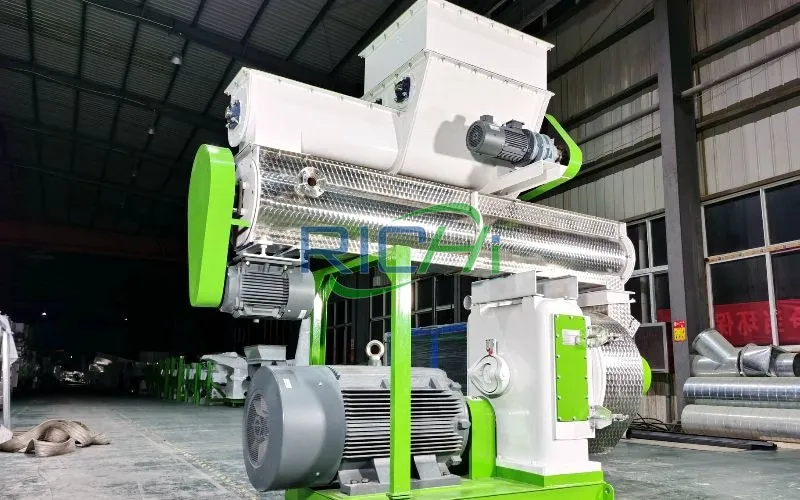
The result was the installation of one CZLH678 alfalfa pellet mill in Jordan. The farm retained its existing bale handling and forage grinding equipment and added the 185 kW pellet mill as the central pelleting unit, producing mainly 6–8 mm alfalfa pellets for cattle, sheep and goats. With a reference capacity of approximately 4–5 T/H under suitable forage conditions, the machine gave the customer enough seasonal processing capacity without requiring a complete new commercial feed factory.
Name:
Alfalfa Pelletizer
Country:
Jordan
Date:
2025
Capacity:
4–5 T/H
Model:
CZLH678
Main Motor Power:
185 kW
Raw Materials:
100% alfalfa
Pellet diameter:
6–8 mm
The customer operates an irrigated forage and livestock business in northern Jordan. Part of its acreage is dedicated to alfalfa, while the livestock side includes dairy cattle and small ruminants.
The farm had already been producing hay successfully. The problem was what happened after baling.
During periods of strong forage production, large volumes of alfalfa had to be stored until livestock demand caught up. Bales required substantial covered space, and repeated handling generated leaf losses, particularly when dry alfalfa was moved several times between storage and feeding areas.
The customer also wanted a more standardized feed format for purchased and internally produced forage. Pellets could be weighed, transported and incorporated into feeding programs more easily than long-stem baled hay.
This made an alfalfa pellet mill in Jordan commercially interesting, but only if the farm could use most of the infrastructure it already owned.
Jordan is not a country where a forage project should be designed around unlimited water or unlimited local feed production.
Water availability is a major agricultural constraint, and livestock producers also depend on imported feed ingredients for part of their requirements. For an alfalfa-pellet project, this means the machine should be matched to the customer’s real irrigated forage volume rather than to a theoretical maximum output.
The farm therefore did not purchase the CZLH678 grass pellet machine with the intention of operating it twenty-four hours a day throughout the year.
Its operating pattern is seasonal. During periods when suitable dried alfalfa accumulates, the pellet mill runs for concentrated production shifts. At other times, the farm can reduce operating hours or stop pelleting completely.
This makes a 4–5 T/H machine more practical than it may appear from annual acreage alone. The customer wants enough hourly capacity to process stored hay efficiently during selected production windows, not a factory that must remain fully loaded every day.
The farm purchased one CZLH678 as a standalone pellet mill because several upstream functions were already available.
Bales could already be opened and handled mechanically. The customer also had forage size-reduction equipment that could prepare dried alfalfa before pelleting.
This point is important: whole alfalfa bales cannot be pushed directly into the CZLH678.
The pellet mill requires prepared forage with a controlled particle size, reasonably uniform moisture and stable feeding characteristics. Long stems create feeding problems and make pellet formation less predictable.
For this project, dried alfalfa is first broken from the bale, chopped and ground to a more suitable size. The exact final grinding specification is adjusted according to the die and forage condition, but the objective is a relatively uniform fibrous meal rather than intact 5–10 mm stem pieces.
By retaining those existing preparation stages, the customer avoided paying again for equipment that was already usable.
The primary raw material is dried alfalfa hay produced by the farm.
Pelleting begins only after the forage has reached a suitable moisture range. Hay that is still too wet is not sent directly to the alfalfa hay pellet machine simply because the machine can generate pressure and heat.
The customer normally works with alfalfa at approximately 12–15% moisture before final adjustment. Actual pelleting moisture is determined during production because leaf-to-stem ratio, cutting stage and storage condition affect how the forage behaves under compression.
The project also allows limited use of other dry forage materials when the feeding program requires them.
Wheat straw can be incorporated into selected forage pellets, but it is not included merely to make the machine run. Straw changes nutrient density and pellet behavior, so its use is based on the livestock ration rather than on a fixed 10% formula.
The same principle applies to cereal residues. The original plan included maize husks as a standard additive, but the farm does not need to add them to every batch. The CZLH678 is selected primarily for alfalfa pellet production.
| Project Parameter | Configuration |
|---|---|
| Equipment | Alfalfa pellet mill |
| Model | CZLH678 |
| Quantity | 1 unit |
| Main Motor Power | 185 kW |
| Breaker Feeder Power | 3 kW |
| Forced Feeder Power | 1.5 kW |
| Ring Die Inner Diameter | 673 mm |
| Available Pellet Diameter | 4–12 mm |
| Project Pellet Diameter | Mainly 6–8 mm |
| Reference Capacity | Approximately 4–5 T/H under suitable material conditions |
| Main Raw Material | Dried and ground alfalfa hay |
The 4–5 T/H figure is a reference for suitable forage material rather than a guaranteed output regardless of moisture or fiber condition.
Stem-heavy alfalfa, excessively dry material, changing particle size and different die specifications can all affect actual capacity. The machine therefore has to be operated around the material rather than forcing every batch to meet one fixed tonnes-per-hour figure.
The customer chose 6 mm and 8 mm as its principal forage-pellet specifications.
Six-millimeter pellets are used when a smaller product is preferred for sheep, goats or particular cattle rations. Eight-millimeter pellets are produced for larger-ruminant applications and where the customer wants a somewhat larger forage pellet.
RICHI does not describe one of these diameters as nutritionally superior by itself.
Pellet diameter affects handling and physical form, but animal performance depends primarily on the complete ration, forage quality and feeding management.
The ring die can be changed when another pellet specification is required, although frequent die changes simply to create minor product differences would reduce operating efficiency.
Alfalfa is fibrous and behaves differently from grain-rich compound feed.
Increasing compression can make a stronger pellet, but excessive compression also increases energy demand and may reduce capacity. The customer therefore does not aim for the hardest pellet the machine can physically produce.
The target is enough durability to survive conveying, storage and normal handling without creating excessive fines.
Ring-die compression, forage moisture, particle size and feed rate are adjusted together during commissioning.
This is one reason the farm chose a heavy-duty ring-die alfalfa pellet making machine instead of a small flat-die machine intended for occasional low-volume use.
The original project concept described the CZLH678 as operating directly in remote fields from a diesel generator.
For a machine with a 185 kW main motor plus feeders and auxiliary equipment, that description needs to be more practical.
The pellet mill is installed at a fixed on-farm processing site where forage can be brought after harvest and drying. The customer has access to a suitably sized electrical supply, with generator capacity available where required as part of the site power arrangement.
A commercial generator for this machine must be sized for motor starting, continuous electrical load and the other equipment operating at the same time. It is therefore not comparable to powering a small farm implement from an ordinary portable generator.
This stationary arrangement also improves foundation stability, dust control, electrical safety and maintenance access.
The customer does not cut green alfalfa and feed it directly into the CZLH678.
Fresh alfalfa contains far too much moisture for normal dry-forage pelleting.
The forage is first dried into hay or otherwise reduced to an appropriate moisture condition. Only then is it ground and prepared for the pellet mill.
This correction is important because pelleting does not replace the drying stage.
If another Jordanian customer wants to pellet freshly harvested forage rather than hay, the project would require a drying system in addition to crushing, pelleting and cooling equipment.
Freshly formed alfalfa pellets leave the ring die warm.
Even when the customer purchases the CZLH678 as the main standalone machine, downstream cooling remains necessary before dense storage or packaging.
The cooling stage allows pellet temperature and moisture to stabilize and helps prevent condensation after the product enters a bag or storage bin.
This means “standalone pellet mill” should not be misunderstood as “one machine can perform every process.”
It means the customer purchased one pellet mill rather than another complete turnkey forage-pellet plant because several supporting stages were already available or could be integrated separately.
The original project used 100% alfalfa for dairy cows and sheep, then a fixed 90/10 alfalfa-straw blend for beef cattle.
Those ratios are not necessary to demonstrate the pellet mill’s capability.
Alfalfa pellets can function as a forage ingredient or supplement within a larger ration, but they are not automatically a complete diet for dairy cattle, beef cattle, sheep or goats.
The farm therefore separates machine formulation from nutritional formulation.
The CZLH678 can pellet pure prepared alfalfa when that is the required product. It can also process suitable dry forage blends. The livestock nutrition program determines where those pellets fit into the ration.
Most production is consumed internally.
The pellets provide a compact forage format that can be stored and handled alongside other feed ingredients. They are especially useful when the customer wants precise quantities moved from storage into feeding areas without repeatedly handling bales.
The farm can also hold surplus pellets for sale to neighboring livestock operations when its own forage reserve is sufficient.
For a Jordanian forage grower, this creates another possible sales format. Instead of selling only baled alfalfa, the producer can offer a denser product that may be easier for some customers to transport, store and meter.
Whether that extra processing creates enough additional margin depends on electricity, labor, wear parts, hay value and the market price for pellets.
Dry alfalfa produces a large amount of light leaf material and dust during grinding and handling.
The project therefore cannot be designed around the pellet mill alone.
Enclosed conveying, aspiration and dust collection help reduce material loss and keep the working area cleaner. Fine leaf particles are nutritionally valuable material, so losing them to uncontrolled dust is also a feed-value loss.
Before recommending the final layout, RICHI reviews how ground forage reaches the pelletizer and how fines are handled around the feeding and cooling sections.
The customer does not wait for a ring die or roller problem to stop production in the middle of the forage-processing season.
Wear parts are inspected before peak operation begins, and critical spares are kept available at the site.
Actual wear life depends on forage cleanliness, mineral contamination, particle size, operating load and die specification. Sand and soil picked up during harvesting can shorten wear life considerably.
This makes raw-material cleanliness important for both feed quality and machine cost.
The maintenance team also monitors feeder condition, main motor load and changes in pellet output. If a familiar forage batch suddenly requires more power or generates more fines, die and roller condition are among the items checked.
The CZLH678 was shipped by sea from Qingdao Port in China to Aqaba, Jordan.
Aqaba is Jordan’s principal maritime gateway and handles a wide range of industrial, agricultural and general cargo, making it the logical arrival point for heavy feed-processing machinery.
Before shipment, RICHI supplied the foundation requirements, electrical information, machine dimensions and installation drawings so the customer could prepare the processing site.
This preparation was particularly important for the CZLH678 because the 185 kW pellet mill requires a proper foundation and enough surrounding space for ring-die and roller maintenance.
The first lesson was that hay quality mattered more than expected.
Uniformly dried, well-ground alfalfa fed much more steadily than bales containing wetter sections or an unusually high proportion of long stems.
The operators also found that trying to maximize feed rate before moisture and particle size were stable created unnecessary fluctuations in motor load.
Production became more predictable when the team treated forage preparation, pellet-mill feeding and ring-die compression as one process.
The customer therefore established separate operating references for its main alfalfa batches instead of trying to use one permanent machine setting throughout the season.
A 4–5 T/H machine is not an appropriate investment for every small livestock farm.
The customer needs enough dried forage to justify commercial pelletizing capacity.
At 4 T/H, an eight-hour production day can consume roughly 32 tonnes of prepared forage. Even if the machine operates only seasonally, the annual hay volume needs to support that processing rate.
This is why RICHI asks about harvested alfalfa tonnage rather than only the number of hectares.
Yield per hectare can vary widely with irrigation, cutting frequency, climate and farm management. Two farms with the same acreage can therefore require very different pellet mill capacities.
This alfalfa pellet mill in Jordan project demonstrates how a forage producer can add high-capacity pelletizing without unnecessarily rebuilding equipment that is already useful.
The customer uses one CZLH678 to convert prepared alfalfa hay into mainly 6–8 mm pellets at a reference capacity of approximately 4–5 T/H. The machine is installed at a fixed on-farm processing site, with hay preparation, power supply and downstream cooling arranged around its actual production requirements.
For another Jordanian project, RICHI would first need to know annual dried-alfalfa availability, moisture, bale type, existing chopping and grinding equipment, required pellet diameter, operating hours and whether the pellets will be consumed internally or sold commercially.
Power conditions are also critical. A customer considering the CZLH678 should provide the available transformer or generator capacity and the electrical loads of equipment that will operate simultaneously.
With these figures, RICHI Machinery can determine whether the CZLH678 used in this alfalfa pellet mill in Jordan project is appropriately sized or whether a smaller machine would provide better utilization.
The objective is not simply to make alfalfa smaller and denser. It is to match the pellet mill to the amount of forage the farm can genuinely produce, prepare and consume or sell, creating a practical processing system rather than oversized equipment waiting for raw material.
Having the right mix of reliable, high-quality pellet machine and pelletizing systems and expert support is essential to your success. Watch how our end-to-end feed pellet plant solutions have helped our customers optimize their performance.
Our customized and future-proofed turnkey pellet plant solutions is designed with you at the core. From vision to reality and beyond, our team stays connected with yours. Giving you peace-of-mind with an expert at your side.
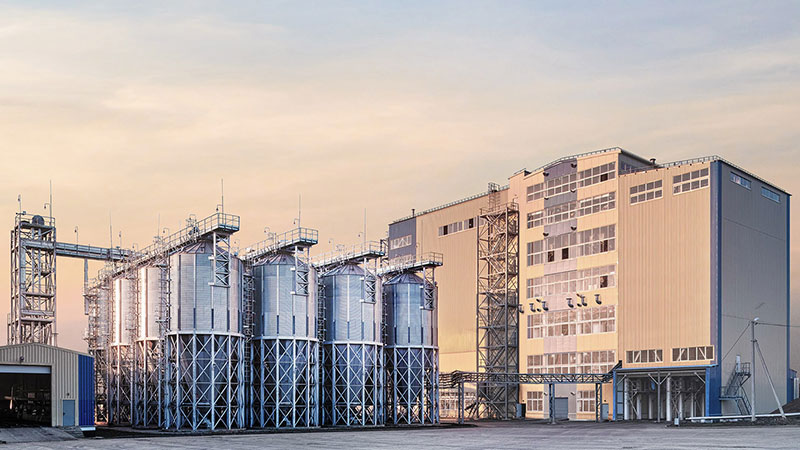
At RICHI, we go beyond project completion. With RICHI Servicee, we’re your dedicated partners in success. Count on us for expert guidance, minimal downtime, and optimized productivity. Choose RICHI for unmatched service and support.
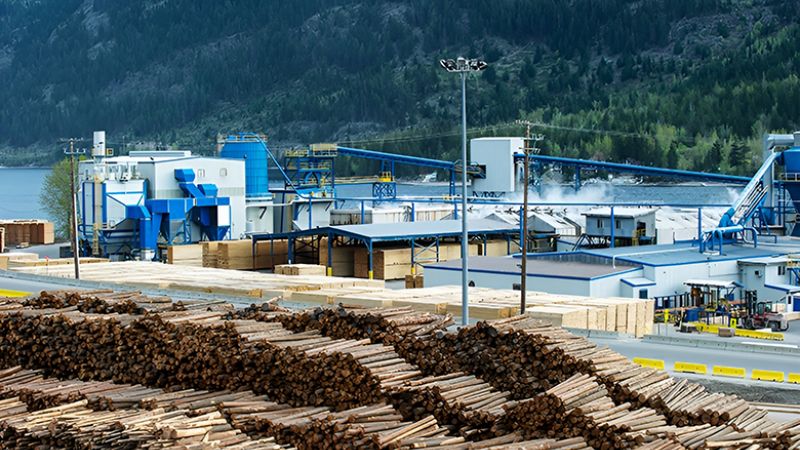


Meet global product demands and quality standards with industry-leading pellet plant design, engineering, equipment, and construction services for pellet processors.


Your Partner Beyond Project Completion
2000+ cases
RICHI is the leading designer, manufacturer and builder of pellet plants in the world, completing over 2000 projects in 140 countries across 6 continents.
Read More
Increase plant productivity, profitability, and safety by integrating high quality equipment into your pellet production line. Over the years, RICHI has become China's top pellet equipment manufacturer. At the same time, RICHI has established valuable partnerships with the world's leading component and raw material manufacturers to bring you the best there is in technology, automation, and efficiency in pelleting plant machinery.

For nearly 30 years, RICHI has been providing best-in-class pellet plant equipment and services to clients across a variety of industries, sizes, and needs. We pride ourselves on the knowledge and skill that each team member possesses – from our technical sales team to our process design engineers. You can count on RICHI Machinery to take your operation to the next level of innovation, quality, and success.
Need help with your pellet manufacturing plant project? Contact us today.
ANIMAL FEED
BIOMASS
WOOD
ORGANIC FERTILIZER
AQUA FEED
CAT LITTER
MUNICIPAL WASTE RECYCLING
SPECIAL PELLET PRODUCTION
RICHI Machinery continues to deliver world class pellet mill equipment, pellet plant engineering and project solutions that add value to our customers in the animal feed, wood waste, agriculture waste, organic fertilizer, cat litter and special pellet products industries. Throughout the years, we RICHI Machinery have built strong brand, becoming industry-leading pellet machine manufacturer. We value integrity, promise quality, and prioritize your success.
Learn MoreWith our expert team, we precisely implement your process engineering requirements in pellet mill and pelletizing plant systems. No matter which industry you’re in – we understand your needs and deliver solutions that meet the highest standards.
At RICHI, quality comes first. Our pellet making machine and related pellet line equipment undergo rigorous quality controls to ensure they meet the highest standards. Rely on products that are durable, safe, and efficient.
With decades of experience in pellet machine and pellet production line production, we have earned a reputation as a trusted partner in various industries. Our expertise allows us to cover a wide range of applications.
Not only do we offer premium pelleting equipment, but we are also experts at designing, building, installing, and maintaining facilities from the ground up. Our expertise is within pellt plant process design, discovering the most efficient, productive, and profitable way to handle your materials in an end-to-end cycle.
○ RICHI MACHINERY
Keeping in touch with us is an effective way to solve all your problems. If you have any needs or questions, please leave your contact information, then RICHI technical consultants will send design, quotation, videos to your mailbox. You can also contact us directly via WhatsApp: +86 13838389622
Copyright©2015-2026 by HENAN RICHI MACHINERY CO., LTD. All rights reserved.