
RICHI supplied an SLHJ1A 500 Kg Feed Mixer in Nigeria with 11 kW power and 500 kg batch capacity for an existing 1–2 T/H broiler mash feed plant in Oyo State.
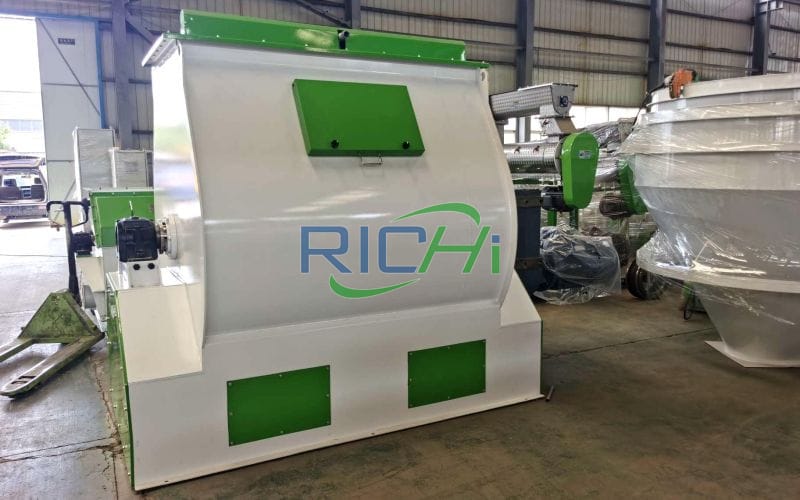
A poultry feed producer in Oyo State selected one RICHI SLHJ1A 500 Kg Feed Mixer in Nigeria to replace a slower manual mixing process inside an existing small feed plant. The customer already operated a grain grinder, ingredient weighing section and bagging equipment, so the investment focused on one production stage: blending ground ingredients and micro-components into consistent broiler mash feed before packaging.
The SLHJ1A is a single-shaft paddle mixer with an 11 kW motor, 1 m³ effective volume and a rated batch size of approximately 500 kg. The surrounding plant operates at approximately 1–2 T/H, depending on ingredient preparation, manual dosing and bagging speed. Main grains are ground to approximately 1–3 mm before mixing, while premixes and mineral ingredients enter in finer form. One batch therefore combines materials with different bulk densities and particle sizes without treating the mixer itself as a continuous tonnes-per-hour machine.
Name:
Feed Mixer
Country:
Nigeria
Date:
2026
Capacity:
500 kg/batch
Model:
SLHJ1A
Main Motor Power:
11 kW
Effective Volume:
1 m³
Construction:
Carbon steel
The customer's annual broiler-feed requirement is approximately 3,000 tonnes. A much larger one- or two-tonne-per-batch mixer would have increased installation height, supporting conveyor capacity and batch inventory without solving an immediate production requirement. The 500 kg SLHJ1A fits the existing grinder, manual ingredient preparation and small-scale bagging arrangement more closely.
At 500 kg per batch, every two completed batches equal one tonne of mixed feed. In a practical 1–2 T/H production line, the customer handles approximately two to four batches per hour once ingredient weighing, loading, active mixing, discharge and downstream handling are considered. Across an eight-hour production day, this corresponds to roughly 8–16 tonnes of plant throughput, or about 2,400–4,800 tonnes of theoretical annual capacity at 300 operating days.
The plant's approximately 3,000 T/Y target therefore falls within a realistic operating range without requiring the mixer to run continuously at its maximum possible batch frequency.
| Project Parameter | Specification |
|---|---|
| Equipment | Single-shaft paddle mixer |
| Model | SLHJ1A |
| Motor Power | 11 kW |
| Rated Batch Size | Approximately 500 kg/batch |
| Effective Volume | Approximately 1 m³ |
| Construction | Carbon steel |
| Motor Connection | Direct connection |
| Active Mixing Stage | Typically approximately 1–3 minutes, depending on formula and loading condition |
| Integrated Line Capacity | Approximately 1–2 T/H |
| Main Ground Ingredient Size | Approximately 1–3 mm |
| Project Annual Feed Target | Approximately 3,000 T/Y |
| Main Application | Broiler mash feed |
The 500 kg figure refers to material weight per batch rather than a universal volume-based fill level. Bulk density changes between maize meal, wheat by-products, soybean meal and groundnut cake, so the mixer should be loaded according to both batch weight and usable working volume. Overfilling can reduce material movement even when the motor still turns normally.
The customer produces one main product through this mixing section: broiler mash feed. The formula changes according to raw-material prices and nutrient specifications rather than following one permanent percentage combination.
Maize is used as an important energy ingredient, while soybean meal and properly tested groundnut cake can supply part of the protein requirement. Wheat bran or wheat offal may be incorporated where the formulation permits, together with vegetable oil, limestone, phosphate, salt, amino acids and vitamin-mineral premix.
This raw-material profile fits the Oyo feed sector, where maize, soybean products and other locally traded feed ingredients are readily relevant to poultry production. The mixer does not determine the nutritional formula; its job is to distribute the ingredients selected by the nutritionist as uniformly as the process allows.
Whole maize and other ingredients requiring size reduction first pass through the existing hammer mill. For this broiler mash project, major ground components are generally prepared to an approximately 1–3 mm particle range before entering the batching section.
Macro ingredients are weighed first. Smaller ingredients and premixes are dosed separately to improve measurement accuracy. Where a micro-ingredient represents only a very small fraction of the 500 kg batch, the customer can prepare a carrier preblend before adding it to the main mixer. This reduces the risk of placing a very small quantity directly into a large mass of coarse material and expecting instantaneous distribution.
If oil is included, it should be sprayed or distributed through a suitable liquid-addition arrangement rather than poured into one location. Heavy localized liquid addition can form wet agglomerates and increase residue on the mixer wall or paddles.
The SLHJ1A is designed for rapid paddle mixing, so the active mixing stage is much shorter than the 10–12 minutes associated with some slow vertical mixers. For this project, active mixing is normally evaluated in an approximately 1–3 minute window after the required ingredients are loaded.
However, the complete production cycle is longer. Ingredient weighing, conveyor transfer, manual micro-dosing, liquid addition, mixer discharge and bagging all take additional time. This is why a 500 kg mixer can fit naturally into a 1–2 T/H feed line even though the paddles themselves complete the actual mixing action in only a few minutes.
Final mixing time should be confirmed through production trials rather than extended automatically. Mixing for longer does not necessarily continue improving uniformity and, with some ingredients, unnecessary handling can contribute to segregation.
Visual appearance alone cannot prove that a feed batch is uniformly mixed. Maize meal and protein meals may look evenly distributed while salt, minerals or premix still vary between samples.
The customer therefore uses periodic sampling from discharged batches and can evaluate an appropriate tracer or nutrient marker when validating the mixer. Sample position, number of samples and laboratory method need to remain consistent if results are to be compared over time.
RICHI does not use one unsupported uniformity percentage as proof for every formula. Actual mixing performance depends on batch filling level, ingredient particle size, density differences, liquid addition, loading sequence and equipment condition.
The mixer machine cannot correct poor raw materials. Maize and oilseed cakes arriving at the Oyo facility need inspection for moisture, mold, foreign material and storage condition before they are accepted into feed production.
This is especially important for maize and groundnut-derived ingredients because warm, humid storage conditions can create significant mycotoxin risk. A perfectly mixed batch containing contaminated material is still an unsuitable feed batch.
The customer's operating procedure therefore separates raw-material quality control from mixing control: acceptable ingredients first, accurate weighing second, controlled mixing third and finished-feed sampling after discharge.
The SLHJ1A is installed between the existing batching section and the customer's mash-feed bagging equipment. Ground ingredients move into weighing and dosing, enter the 500 kg mixer, and discharge into a receiving hopper before packaging.
This arrangement allows the customer to retain usable equipment rather than purchasing a complete feed mill. It also makes future expansion easier to evaluate. If production later exceeds approximately 1–2 T/H, RICHI would first review grinding capacity, ingredient weighing, mixer batch frequency, conveying and bagging before recommending a larger mixer.
Simply replacing the SLHJ1A with a one-tonne mixer would not double plant production if the grinder or bagging system remained the actual bottleneck.
The 500 Kg Feed Mixer in Nigeria is prepared for export from Qingdao, China, with Lagos Port Complex at Apapa used as a practical container gateway before inland delivery toward Oyo State.
Before shipment, RICHI checks the feed inlet height, mixer support structure, 11 kW electrical connection, upstream weighing arrangement, discharge hopper and downstream bagging interface. Because the customer is installing one mixer in an operating workshop, matching these interfaces is more important than replacing equipment that remains suitable for the 1–2 T/H plant.
This 500 Kg Feed Mixer in Nigeria project uses one RICHI SLHJ1A with an 11 kW motor, 1 m³ effective volume and approximately 500 kg batch capacity. Maize and other major ingredients are generally ground to approximately 1–3 mm before weighing and mixing, while micro-components are dosed separately. The mixer supports an existing approximately 1–2 T/H broiler mash feed system with an annual production target of around 3,000 tonnes.
For another feed producer selecting a 500 kg mixer, RICHI Machinery needs the formula ingredients, bulk densities, percentage of micro-additives, liquid-addition requirement, required batches per hour, existing grinder capacity, weighing method and downstream discharge arrangement. These details determine whether the SLHJ1A is correctly matched to the complete plant rather than selecting a mixer from batch weight alone.
Having the right mix of reliable, high-quality pellet machine and pelletizing systems and expert support is essential to your success. Watch how our end-to-end feed pellet plant solutions have helped our customers optimize their performance.
Our customized and future-proofed turnkey pellet plant solutions is designed with you at the core. From vision to reality and beyond, our team stays connected with yours. Giving you peace-of-mind with an expert at your side.
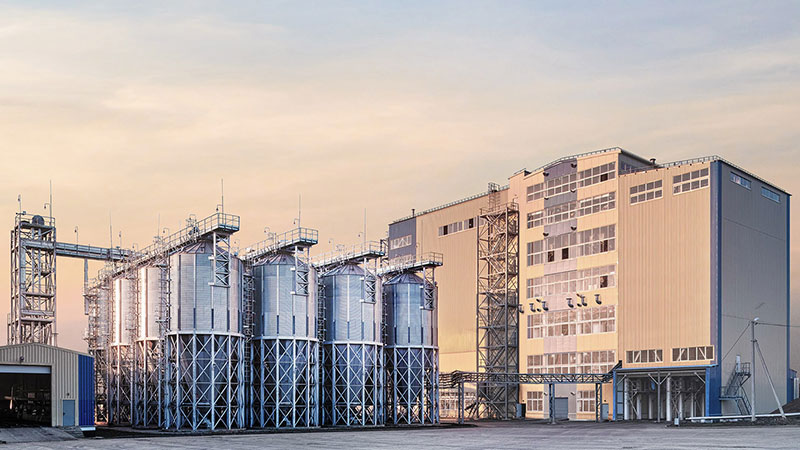
At RICHI, we go beyond project completion. With RICHI Servicee, we’re your dedicated partners in success. Count on us for expert guidance, minimal downtime, and optimized productivity. Choose RICHI for unmatched service and support.
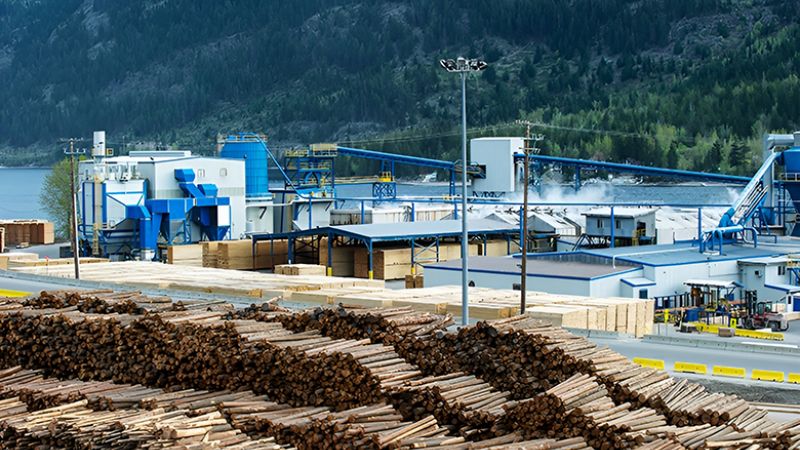


Meet global product demands and quality standards with industry-leading pellet plant design, engineering, equipment, and construction services for pellet processors.

Your Partner Beyond Project Completion
2000+ cases
RICHI is the leading designer, manufacturer and builder of pellet plants in the world, completing over 2000 projects in 140 countries across 6 continents.
Read More
Increase plant productivity, profitability, and safety by integrating high quality equipment into your pellet production line. Over the years, RICHI has become China's top pellet equipment manufacturer. At the same time, RICHI has established valuable partnerships with the world's leading component and raw material manufacturers to bring you the best there is in technology, automation, and efficiency in pelleting plant machinery.

For nearly 30 years, RICHI has been providing best-in-class pellet plant equipment and services to clients across a variety of industries, sizes, and needs. We pride ourselves on the knowledge and skill that each team member possesses – from our technical sales team to our process design engineers. You can count on RICHI Machinery to take your operation to the next level of innovation, quality, and success.
Need help with your pellet manufacturing plant project? Contact us today.
ANIMAL FEED
BIOMASS
WOOD
ORGANIC FERTILIZER
AQUA FEED
CAT LITTER
MUNICIPAL WASTE RECYCLING
SPECIAL PELLET PRODUCTION
RICHI Machinery continues to deliver world class pellet mill equipment, pellet plant engineering and project solutions that add value to our customers in the animal feed, wood waste, agriculture waste, organic fertilizer, cat litter and special pellet products industries. Throughout the years, we RICHI Machinery have built strong brand, becoming industry-leading pellet machine manufacturer. We value integrity, promise quality, and prioritize your success.
Learn MoreWith our expert team, we precisely implement your process engineering requirements in pellet mill and pelletizing plant systems. No matter which industry you’re in – we understand your needs and deliver solutions that meet the highest standards.
At RICHI, quality comes first. Our pellet making machine and related pellet line equipment undergo rigorous quality controls to ensure they meet the highest standards. Rely on products that are durable, safe, and efficient.
With decades of experience in pellet machine and pellet production line production, we have earned a reputation as a trusted partner in various industries. Our expertise allows us to cover a wide range of applications.
Not only do we offer premium pelleting equipment, but we are also experts at designing, building, installing, and maintaining facilities from the ground up. Our expertise is within pellt plant process design, discovering the most efficient, productive, and profitable way to handle your materials in an end-to-end cycle.
○ RICHI MACHINERY
Keeping in touch with us is an effective way to solve all your problems. If you have any needs or questions, please leave your contact information, then RICHI technical consultants will send design, quotation, videos to your mailbox. You can also contact us directly via WhatsApp: +86 13838389622
Copyright©2015-2026 by HENAN RICHI MACHINERY CO., LTD. All rights reserved.